¡Acompáñanos a viajar por el mundo de los libros!
Añadir este libro a la estantería
Grey
Escribe un nuevo comentario Default profile 50px
Grey
Suscríbete para leer el libro completo o lee las primeras páginas gratis.
All characters reduced
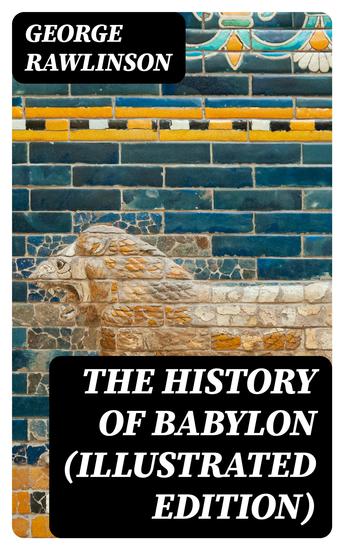
The History of Babylon (Illustrated Edition) - Enriched edition - cover

The History of Babylon (Illustrated Edition) - Enriched edition

George Rawlinson

Editorial: DigiCat

  • 0
  • 0
  • 0

Sinopsis

In 'The History of Babylon (Illustrated Edition),' George Rawlinson presents a comprehensive exploration of one of the world's most enigmatic ancient civilizations. This meticulously researched work not only chronicles Babylon's political and cultural evolution but also delves into its contributions to science, literature, and religion. Rawlinson's literary style is characterized by clarity and precision, blending detailed scholarship with engaging narrative, all enhanced by rich illustrations that breathe life into the historical account. Situated within the broader context of 19th-century historical scholarship, the book reflects growing Western interest in Eastern civilizations during the age of exploration and archaeological discovery. George Rawlinson, a prominent Victorian historian and classical scholar, was deeply influenced by his linguistic expertise and his experiences as a British consul in Persia. His proficiency in ancient languages and his passion for Assyriology fueled his desire to make Babylon's history accessible to a wider audience. Rawlinson's works aimed to illuminate the complexities of ancient societies, drawing on a wealth of primary sources and archaeological findings that were becoming increasingly available in his time. This illustrated edition is highly recommended for both scholars and general readers alike, serving as an invaluable resource for understanding Babylon's historical significance. Rawlinson's engaging prose, coupled with striking illustrations, makes this work an essential addition to the libraries of those interested in ancient civilizations and their enduring legacies.

In this enriched edition, we have carefully created added value for your reading experience:
- A succinct Introduction situates the work's timeless appeal and themes.
- The Synopsis outlines the central plot, highlighting key developments without spoiling critical twists.
- A detailed Historical Context immerses you in the era's events and influences that shaped the writing.
- A thorough Analysis dissects symbols, motifs, and character arcs to unearth underlying meanings.
- Reflection questions prompt you to engage personally with the work's messages, connecting them to modern life.
- Hand‐picked Memorable Quotes shine a spotlight on moments of literary brilliance.
- Interactive footnotes clarify unusual references, historical allusions, and archaic phrases for an effortless, more informed read.
Disponible desde: 13/11/2022.
Longitud de impresión: 144 páginas.

Otros libros que te pueden interesar

  • The Tensaw River - Alabama's Hidden Heritage Corridor - cover

    The Tensaw River - Alabama's...

    Mike Bunn

    • 0
    • 0
    • 0
    The Tensaw River introduces one of the American South's richest and most fertile natural features. Author Mike Bunn is director of Historic Blakeley State Park, which is nestled in a prominent bend of the majestic Tensaw River. 


    Forming the eastern boundary of the expansive Mobile-Tensaw Delta, the Tensaw has had little industrial development. Left largely undisturbed, the river flows free and bountiful into the grand estuary of Mobile Bay in ways that would be recognizable to Native Americans centuries ago and to pioneers who arrived before Alabama became a state. 


    Bunn's unforgettable stories in The Tensaw River trace the construction and occupation of the Bottle Creek site, an important mound complex built by Southeastern Native Americans a millennia ago. Nearby Blakeley is an antebellum ghost town whose lost memories tease the imagination. During the Civil War, the boom of artillery fire in the battle that sealed the fate of the city of Mobile echoed along the bends in the Tensaw. 


    Located near popular travel destinations, the Tensaw's "Forgotten Cultural Heritage Corridor" is a gateway to the enchanting beauty of—and humankind's relationship to—the landscape of the American South.
    Ver libro
  • Ancient Greece’s Most Famous Oracles: The History of the Oracles at Delphi and Dodona - cover

    Ancient Greece’s Most Famous...

    Editors Charles River

    • 0
    • 0
    • 0
    In ancient Greece, “no other practice was so universal than the consultation of oracles.” These holy sites were found in 260 locations around the Greek-speaking world, and they were considered the “most satisfactory means of ascertaining the future.” These sanctuaries were “set apart from the profane, ordinary world” and were in the beginning restricted to natural locations where the divine was thought to be “especially present.” They were set aside for special spiritual functions, and a state of purity was generally required of its participants. A historical tendency toward providing haven for criminals was based on the fear of shedding blood in a holy place, and the “fear that the evil magic would emanate from his curse.” 
    The Oracle of Delphi was one of the greatest religious institutions in Greece and one which played a significant role not only in the formation and collective decisions of Hellenic localities and city-states but also in the personal lives of Greeks known and unknown. The site was dedicated to the god Apollo, and the Greeks believed the god spoke his oracles through his prophetess known as the Pythia. The judgments and decisions rendered by the oracle were so important to the Greeks that they often put them above all other interests, even security threats posed by the likes of the Persians, and Delphi was popular even amongst outsiders. Many authors of antiquity mention the oracle for one reason or another, and there even survive epigraphic collections that preserve the god’s words on stone. 
    The Oracle of Dodona was the oldest of all, and it was one of the few dedicated to Zeus and his consort goddess Dione. The oracular utterances heard at the oracles are generally referred to as “smokiness” in Greek, but at Dodona, the answers came in natural sounds and other peripheral phenomena.
    Ver libro
  • A Rare Recording of President John F Kennedy’s "We Choose To Go To The Moon" Speech - cover

    A Rare Recording of President...

    President John F. Kennedy

    • 0
    • 0
    • 0
    "We choose to go to the Moon", officially titled the Address at Rice University on the Nation's Space Effort, is a September 12, 1962, speech by United States President John F. Kennedy to bolster public support for his proposal to land a man on the Moon before 1970. Kennedy gave the speech, largely written by presidential advisor and speechwriter Ted Sorensen, to a large crowd at Rice University Stadium in Houston, Texas. 
     
    President John Fitzgerald Kennedy (May 29, 1917 - November 22, 1963), often referred to by his initials JFK, was an American politician who served as the 35th president of the United States from 1961 until his assassination in 1963. He was the youngest person to assume the presidency by election and the youngest president at the end of his tenure. Kennedy served at the climax of the Cold War, and the majority of his foreign policy concerned relations with the Soviet Union and Cuba. A Democrat, Kennedy represented Massachusetts in both houses of the U.S. Congress prior to his presidency.
    Ver libro
  • The Friendship Bench - How Fourteen Grandmothers Inspired a Mental Health Revolution - cover

    The Friendship Bench - How...

    Dixon Chibanda

    • 0
    • 0
    • 0
    A simple, human solution for loneliness and depressionWhen Dr. Dixon Chibanda lost a patient to suicide, he began a soul-searching journey that eventually led to a mental healthcare revolution. As one of only six psychiatrists in all of Zimbabwe, a country traumatized by decades of conflict, Chibanda quickly realized that millions there were suffering from mental illness with no hope of receiving care. He saw that the only way to narrow this care gap was to leverage existing resources in the community, and one such resource was the compassion and understanding of grandmothers. With fourteen of these wise elders as partners, Chibanda pioneered the Friendship Bench program, a community-driven initiative addressing loneliness, depression, substance abuse, and suicide by fostering intergenerational connectedness. Since then, more than 500,000 people worldwide have sat on a park bench to share their personal stories with an empathetic grandmother.
     
    A primer on how human connection forms the bedrock of our resilience, The Friendship Bench gives readers the tools to facilitate transformative healing by reaching out to those who are struggling and isolated from the world around them. It’s a case study of how interventions supported by robust scientific evidence can be made accessible for all. Ultimately, it’s a celebration of the collective wisdom and knowledge of those rooted in their communities and their profound ability to foster belonging, purpose, and healing.
    Ver libro
  • Revolution's Guiding Light: The Marquis de Lafayette Legend - Illuminate history with powerful audio lessons unraveling The Marquis de Lafayette your Revolution's Guiding Light - cover

    Revolution's Guiding Light: The...

    Bartholomew Vance

    • 0
    • 0
    • 0
    The Legend of Lafayette: A Beacon of Revolution 
    Are you seeking to learn more about a pivotal historical figure who exemplified bravery and passion in shaping a nation? Desiring a resource that simplifies profound historical insights for easy understanding? 
    You've found your answer! 
    This audiobook is your ultimate guide to deepening your knowledge, applying critical reflections, and engaging in thought-provoking narratives. With this, you're prepared for an enlightening journey. 
    Discover a compelling tale inspired by the ideals that fueled change. 
    Key highlights of this enlightening resource include: 
    - In-depth exploration of Lafayette's influence and legacy 
    - Comprehensive details of the revolutionary struggles 
    - Effective strategies for understanding and appreciating historical contributions 
    Our audiobook sets itself apart with expansive coverage, essential for truly grasping the historical impact. Concepts are not just briefly touched upon; they are meticulously examined. 
    Please note that this audiobook is an independent creation focused solely on enriching your understanding. 
    Crafted with a straightforward structure and clear language, "The Legend of Lafayette" ensures seamless transitions between topics. Say farewell to complex jargon and embrace clear, precise, and engaging content. 
    So, why hesitate? Click the BUY NOW button, secure your copy, and embark on your journey of discovery with "The Legend of Lafayette: A Beacon of Revolution!"
    Ver libro
  • The American Operations in WW2: Central Burma - cover

    The American Operations in WW2:...

    History U.S. Army Center of...

    • 0
    • 0
    • 0
    World War II was the largest and most violent armed conflict in the history of mankind. Highly relevant today, World War II has much to teach us, not only about the profession of arms, but also about military preparedness, global strategy, and combined operations in the coalition war against fascism. This book follows military operations of the US Army in North Ease Asia from 29 January to 15 July 1945. 
    At the beginning of 1945, less than eight months remained before the final surrender of Japan. Those eight months, however, were to see some of the bitterest fighting of the war. Although the final outcome was no longer in doubt, when and how the conflict would end remained unclear. The American naval blockade of Japan, combined with a growing air offensive, was placing a serious strain on Japan's economy. Yet any invasion of the Japanese home islands would most likely be drawn out and extremely costly in lives. There was also the danger that even with the capture of the home islands the war might not end, but continue interminably on the Asian mainland, where large numbers of Japanese troops occupied Korea, Manchuria, and the richest and most populous areas of China.
    While American forces in the Pacific had been making dramatic progress since early 1942, the Allied effort in the China-Burma-India theater had bogged down in a morass of conflicting national objectives. The hope Americans held in the early stages of the war, that Chinese manpower and bases would play a vital role in the defeat of Japan, was unrealized. Americans sought to achieve great aims on the Asian mainland at small cost, looking to the British in India and the Chinese, with their vast reservoirs of manpower, to carry the main burden of the ground conflict. Neither proved capable of exerting the effort the Americans had hoped...
    Ver libro