Join us on a literary world trip!
Add this book to bookshelf
Grey
Write a new comment Default profile 50px
Grey
Subscribe to read the full book or read the first pages for free!
All characters reduced
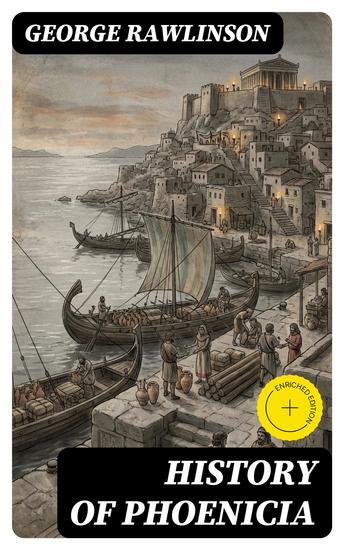
History of Phoenicia - Enriched edition - cover

History of Phoenicia - Enriched edition

George Rawlinson

Publisher: DigiCat

  • 0
  • 0
  • 0

Summary

In "History of Phoenicia," George Rawlinson delivers a meticulously researched and engaging narrative that explores the rich and complex civilization of the Phoenicians. Drawing from an array of ancient sources, including inscriptions, classical texts, and archaeological findings, Rawlinson presents a comprehensive analysis of Phoenician society, commerce, and culture. His writing marries scholarly rigor with an accessible literary style, enabling readers to appreciate the nuances of historical development while situating the Phoenicians within the broader context of the ancient world, particularly their interactions with neighboring powers such as the Egyptians, Greeks, and Romans. George Rawlinson, a noted historian and scholar of the ancient Near East, was significantly influenced by his background in classical studies and his tenure as a scholar of Assyriology. His profound interest in ancient civilizations, nurtured by experiences in the field, profoundly shaped his analytical approach in "History of Phoenicia." Rawlinson's work reflects an era of increasing interest in the historical narratives of marginalized cultures, as he sought to reclaim the Phoenicians' legacy, often overshadowed by their more dominant contemporaries. I highly recommend "History of Phoenicia" to any reader interested in ancient history, trade, or cultural studies. With its synthesis of relentless inquiry and thoughtful narrative, Rawlinson's work serves both as an academic resource and a fascinating exploration for those seeking to understand the profound legacy of one of history's most intriguing civilizations.

In this enriched edition, we have carefully created added value for your reading experience:
- A succinct Introduction situates the work's timeless appeal and themes.
- The Synopsis outlines the central plot, highlighting key developments without spoiling critical twists.
- A detailed Historical Context immerses you in the era's events and influences that shaped the writing.
- A thorough Analysis dissects symbols, motifs, and character arcs to unearth underlying meanings.
- Reflection questions prompt you to engage personally with the work's messages, connecting them to modern life.
- Hand‐picked Memorable Quotes shine a spotlight on moments of literary brilliance.
- Interactive footnotes clarify unusual references, historical allusions, and archaic phrases for an effortless, more informed read.
Available since: 08/15/2022.
Print length: 390 pages.

Other books that might interest you

  • 500 Writing Prompts for Fiction Journaling Blogging and Creative Writing - cover

    500 Writing Prompts for Fiction...

    S. A. M. Richards

    • 0
    • 1
    • 0
    Beat writer's block with 500 writing prompts and finish that novel, journal, poem, assignment, or blog post. Get your creative juices flowing and stretch your writing muscles with this fun collection of prompts. 
    This exciting resource of creative writing exercises is designed to help fiction writers and creative writing students crush their writer's block. 
    This book is designed to unlock a treasure trove of awesome ideas to start your own story, novel, poetic journal, blog post, or writing assignment. 
    Have fun with these prompts!
    Show book
  • Nurturing Newborns: Your Essential Guide to Safe Breastfeeding - cover

    Nurturing Newborns: Your...

    Anonymous

    • 0
    • 0
    • 0
    Breastfeeding is a crucial aspect of early motherhood that plays a significant role in the health and development of both the mother and the baby. Yet, many mothers face challenges or choose not to breastfeed due to various reasons, such as lack of support, time constraints, or misconceptions about formula feeding. Understanding the consequences of not breastfeeding and the benefits it offers can help new mothers make more informed decisions for their well-being and their child's future.The Risks of Not Breastfeeding: Health Risks to the Baby: Babies who are not breastfed miss out on vital nutrients and antibodies that can protect them from infections, illnesses, and diseases. Breastfeeding strengthens the baby's immune system, reducing the likelihood of:Respiratory infections and ear infectionsGastrointestinal issues, such as diarrhoeaChronic conditions later in life, like asthma, obesity, and type 2 diabetesThe Importance of BreastfeedingNutritional Superiority: Breast milk is the perfect food for infants. It contains the ideal balance of fats, proteins, carbohydrates, vitamins, and minerals to meet the baby's developmental needs. Unlike formula, breast milk adapts to the baby's changing nutritional requirements as they grow. Boosts Immunity: Breastfeeding helps protect babies from various illnesses, thanks to the antibodies in the milk, especially colostrum (the first milk). These antibodies protect against respiratory and digestive infections, helping babies build a more robust immune system
    Show book
  • On Liberty: Book Summary & Analysis - cover

    On Liberty: Book Summary & Analysis

    Briefly Summaries

    • 0
    • 0
    • 0
    This is a concise summary and analysis of On Liberty, by John Stuart Mill.
     
    It is not the original book and is not affiliated with or endorsed by John Stuart Mill.
    Ideal those seeking a quick and insightful overview.
     
    On Liberty is a groundbreaking philosophical work that explores the nature and limits of individual freedom in society. This classic text examines the tension between personal autonomy and societal authority, advocating for the protection of individual rights against the tyranny of the majority. With profound arguments on free speech, individuality, and self-expression, it provides a compelling defense of civil liberties that remain relevant in contemporary debates about democracy and personal freedom.
    Show book
  • Master HSK 1 Grammar: Volume 1 – A Complete Guide to Mandarin Chinese Grammar for Beginners - Perfect for Everyone Starting Their Language Journey - cover

    Master HSK 1 Grammar: Volume 1 –...

    Letitia Wu

    • 0
    • 0
    • 0
    Unlock the power of Mandarin Chinese with Master HSK 1 Grammar: Volume 1! Designed for HSK 1 learners and Chinese language beginners, this audiobook simplifies essential grammar concepts to help you speak confidently and build a solid foundation. 
    In this volume, you’ll learn: 
    1. Essential Words for ‘I,’ ‘You,’ and ‘He or She’ 
    2. Essential Words for ‘We,’ ‘You All,’ and ‘They’ 
    3. Essential Words for Saying “Is” and “Is Not” 
    4. The Particle 的 (de) – Indicating Possession 
    5. The Question Particle 吗 (ma) – Turning Statements into Questions 
    6. The Question Word 什么 (shén me) – Asking “What” in Chinese 
    7. The Particle 了 (le) – Expressing Change and Completion 
    8. More Uses of the Particle 了 (le) 
    9. The Question Word 谁 (shéi) – “Who” and 谁的 (shéi de) – “Whose” 
    10. Using ‘This,’ ‘That,’ ‘This One,’ and ‘That One’ in Chinese 
    With step-by-step explanations, practical examples, and guided practice, this audiobook is perfect for anyone starting their journey into the Chinese language. Whether you’re preparing for the HSK 1 exam or exploring Mandarin for personal growth, this is your go-to resource for mastering beginner-level grammar. 
    Start speaking Mandarin with confidence today!
    Show book
  • The Sociology of Everyday Life - How Ordinary Experiences Shape Our Social World - cover

    The Sociology of Everyday Life -...

    Fred Grandsen

    • 0
    • 0
    • 0
    Everyday life is often taken for granted, filled with routines and interactions that seem ordinary. However, sociology reveals that even the most mundane moments are shaped by broader social forces. From morning commutes to casual conversations, every action we take is influenced by cultural norms, social structures, and historical contexts. Understanding everyday life through sociology allows us to see how society operates at both individual and collective levels, uncovering patterns that might otherwise go unnoticed. 
    Sociologists study everyday life to explore how individuals interact, how social norms are maintained, and how power dynamics influence our behaviors. The interactions we engage in, whether greeting a coworker or ordering coffee at a café, follow unspoken social rules. These rules, shaped by culture and history, guide our behaviors without us always being aware of them. For example, the way we dress, speak, and behave in public is dictated by societal expectations, which can vary across different cultures and historical periods. By analyzing these seemingly simple actions, sociology provides insight into how larger social structures function. 
    The concept of the “sociological imagination,” introduced by C. Wright Mills, is central to understanding everyday life. It encourages individuals to connect their personal experiences to larger societal issues. For instance, someone struggling with job insecurity may view their situation as a personal failure. However, from a sociological perspective, their experience can be linked to broader economic trends, shifts in labor markets, and corporate policies. This shift in perspective helps individuals understand that personal troubles are often rooted in social structures rather than isolated events.
    Show book
  • Plutarco Elías Calles and the Mexican Revolution - cover

    Plutarco Elías Calles and the...

    Jürgen Buchenau

    • 0
    • 0
    • 0
    This biography of the Mexican revolutionary examines his rise from soldier to president to his continued influence as Jefe Maximo. Hailing from the border state of Sonora, Plutarco Elías Calles found his calling in the early years of the revolution, quickly rising to national prominence. As president from 1924 to 1928, Calles undertook an ambitious reform program, modernized the financial system, and defended national sovereignty against an interventionist U.S. government. Yet these reforms failed to eradicate underdevelopment, corruption, and social injustice. Moreover, his unyielding campaigns against political enemies and the Catholic Church earned him a reputation as a repressive strongman. After his term as president, Calles continued to exert broad influence as his country's foremost political figure while three weaker presidents succeeded each other in an atmosphere of constant political crisis. He played a significant role in founding a ruling party that reined in power-hungry military leaders and helped workers attain better living conditions. This dynastic party and its successors, including the present-day Partido Revolucionario Institucional (Party of the Institutional Revolution), remained in power until 2000. Through this comprehensive assessment of a quintessential Mexican politician, Buchenau opens an illuminating window into both the Mexican Revolution and contemporary Mexico.
    Show book