¡Acompáñanos a viajar por el mundo de los libros!
Añadir este libro a la estantería
Grey
Escribe un nuevo comentario Default profile 50px
Grey
Suscríbete para leer el libro completo o lee las primeras páginas gratis.
All characters reduced
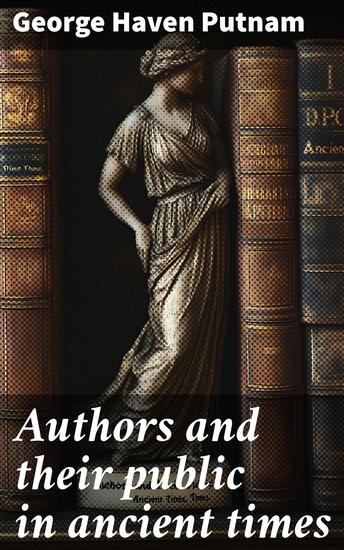
Authors and their public in ancient times - From the earliest times to the fall of the Roman Empire - cover

Authors and their public in ancient times - From the earliest times to the fall of the Roman Empire

George Haven Putnam

Editorial: Good Press

  • 0
  • 0
  • 0

Sinopsis

In "Authors and Their Public in Ancient Times," George Haven Putnam delves into the intricate dynamics between writers and their audiences throughout antiquity. This scholarly work blends historical analysis with literary critique, illuminating the nuanced relationships that characterized the production and reception of literary works in ancient societies. Putnam employs a clear and engaging prose style, incorporating a wealth of primary sources to contextualize the authors' lives and the societal frameworks that shaped their narratives. His exploration ranges from the oratory of ancient Greece to the epistolary traditions of Rome, providing a comprehensive overview of how authors navigated their public personas and the implications of patronage, censorship, and acclaim in their careers. George Haven Putnam, a noted American publisher and literary historian of the late 19th and early 20th centuries, was driven by a profound fascination with the historical context of literary works. His background in publishing equipped him with unique insights into the publishing industry and the author's professional journey, making his perspectives all the more valuable. Putnam's academic voyage was steeped in the classics, which undoubtedly informed his understanding of the ancient literary landscape and the broad appeal of its authors. This book is essential reading for anyone interested in literary history, classical studies, or the evolution of authorial identity. Putnam's meticulous research and compelling narrative reveal the timeless complexities of the author-public relationship, making it a pivotal resource for scholars, students, and literary enthusiasts alike.
Disponible desde: 02/03/2025.
Longitud de impresión: 210 páginas.

Otros libros que te pueden interesar

  • This Creative Life - A Handbook for Writers - cover

    This Creative Life - A Handbook...

    Sara Zarr

    • 0
    • 0
    • 0
    There are a lot of books about writing out there. If you’re like most writers, you’ve just about read them all. But learning how to write (and organize and outline and plot and edit and save the cat and market a breakout book) is one thing. Making and living a sustainable creative life in the face of...everything...is an entirely different matter. To know how to do that, we need to take a look at what goes on between the lines of our lives as writers so that we can live them with maybe a little more thought and intention--no matter the many interior and exterior obstacles that can threaten to derail our purpose. 
    In this companion book to her long-running podcast, Sara Zarr brings her sixteen-year publishing career and experience as a speaker, teacher, and mentor to a conversational and encouraging collection of hard-won insights about what it means not to just write (and perchance to publish), but to be a writer.
    Ver libro
  • The Pineal Eye - Third Eye of Divine Mind - cover

    The Pineal Eye - Third Eye of...

    M. Doreal, ALIO Publishing Group

    • 0
    • 0
    • 0
    From the original English translator of The Emerald Tablets of Thoth! Lost esoteric writings on the metaphysical wisdom and occult history behind the pineal gland - or as it is more frequently known: "the Third Eye". Author Doreal reminds us that Christ called it the "Single Eye", and at one time - eons before Old Testament events, when Earth was still shrouded in mists - it was more prominent in man's physiology. However: that's not to say it has vanished, or even ceased to function completely...
    Ver libro
  • Rumbles - A Curious History of the Gut: The Secret Story of the Body’s Most Fascinating Organ - cover

    Rumbles - A Curious History of...

    Elsa Richardson

    • 0
    • 0
    • 0
    The fascinating—and often secret—history of the body's most fascinating system: the gut. 


    The stomach is notoriously outspoken. It growls, gurgles, and grumbles while other organs remain silent, inconspicuous, and content. For centuries humans have puzzled over this rowdy organ, deliberating on the extent of its influence over cognition, mental wellbeing, and emotions, and wondering how the gut became so central to our sense of self. 


    Traveling from ancient Greece to Victorian England, eighteenth-century France to modern America, historian Elsa Richardson leads us on a tour of the gut, exploring all the ways that we have imagined, theorized, and probed the mysteries of the gastroenterological system. We'll meet a diverse cast of characters including Edwardian body builders, hunger-striking suffragettes, demons, medieval alchemists, and one poor teenage girl plagued by a remarkably vocal gut, all united by this singular organ. 


    Engaging, eye-opening, and thought-provoking, Rumbles leaves no stone unturned, scrutinizing religious tracts and etiquette guides, satirical cartoons and political pamphlets, in its quest to answer the millennia-old question: Are we really ruled by our stomachs?
    Ver libro
  • History of Hungary - Details about the Hungarian Economy Origins and Background - cover

    History of Hungary - Details...

    Kelly Mass

    • 0
    • 0
    • 0
    The history of ancient Hungary begins well before the arrival of the Hungarians themselves, tracing back to the Iron Age and the early cultural developments in the Carpathian Basin. Around 800 BC, the Iron Age began to shape this region, with the emergence of "Thraco-Cimmerian" artifact types that suggested a significant overlap between the pre-Scythian cultures (Novocherkassk culture) and the pre-Celtic Hallstatt culture. This cultural intermingling marked the beginning of a complex interplay between indigenous peoples and incoming groups. 
    The Hallstatt Culture and Early Inhabitants 
    By around 750 BC, the Hallstatt culture, named after the archaeological site in Austria, had spread across much of Europe, including the western region of Transdanubia. This culture is renowned for its advancements in metalworking, especially iron, and the production of distinctive pottery and burial practices. As the Hallstatt people settled in this area, they influenced the local populations, leading to a rich blend of traditions and customs. During this period, early Greek ethnographic sources mention tribes such as the Agathyrsi and Sigynnae, believed to inhabit the Carpathian Basin and surrounding territories, which reflects the growing interactions between various ethnic groups.
    Ver libro
  • Migration - cover

    Migration

    Steph Matuku

    • 0
    • 0
    • 0
    Farah of Untwa joins a school for training fighters, strategic thinkers and military personnel. It means she escapes her domineering mother and the tedious duties that come with being from a Ngāti in the upper echelons of society. But at the school, Farah, an intuitive, is teamed up with fighter Lase, a boy from a lower Ngāti. Farah's condescension and disturbing hallucinations and Lase's resentment test their partnership. But just when they finally seem to be working well together, the school is attacked by other-worldly forces. Farah and Lase must use their skills to fight the alien invaders and save their people from obliteration.
    Ver libro
  • The Ascent of Affect - Genealogy and Critique - cover

    The Ascent of Affect - Genealogy...

    Ruth Leys

    • 0
    • 0
    • 0
    In recent years, emotions have become a major, vibrant topic of research not merely in the biological and psychological sciences but throughout a wide swath of the humanities and social sciences as well. Yet, surprisingly, there is still no consensus on their basic nature or workings.   Ruth Leys’s brilliant, much anticipated history, therefore, is a story of controversy and disagreement. The Ascent of Affect focuses on the post–World War II period, when interest in emotions as an object of study began to revive. Leys analyzes the ongoing debate over how to understand emotions, paying particular attention to the continual conflict between camps that argue for the intentionality or meaning of emotions but have trouble explaining their presence in non-human animals and those that argue for the universality of emotions but struggle when the question turns to meaning. Addressing the work of key figures from across the spectrum, considering the potentially misleading appeal of neuroscience for those working in the humanities, and bringing her story fully up to date by taking in the latest debates, Leys presents here the most thorough analysis available of how we have tried to think about how we feel.  
    Ver libro