Join us on a literary world trip!
Add this book to bookshelf
Grey
Write a new comment Default profile 50px
Grey
Subscribe to read the full book or read the first pages for free!
All characters reduced
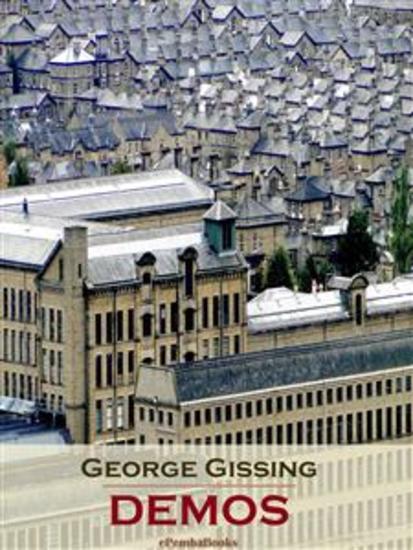
Demos (Annotated) - cover

Demos (Annotated)

George Gissing

Publisher: ePembaBooks

  • 0
  • 0
  • 0

Summary

This edition includes the following editor's introduction: "The Odd Women," a pioneering novel of women's emancipation


Originally published in 1886, “Demos” (AKA Demos: A Story of English Socialism) is the third novel by English author George Gissing.

“Demos” tells the story of a young, lower-class, Radical working-man, Richard Mutimer, who unexpectedly inherits a large fortune. He becomes the leader of a socialist movement and decides to use his inheritance to set up a cooperative factory. However, his new wealth and power serve to highlight the defects of character that he brings from his working-class origin and he begins to treat his workers harshly, as well as abandoning the girl of his own station to whom he had been engaged.
Later in life, Mutimer marries an upper-middle-class woman (who does not love him) and stands for Parliament. However, his downfall begins when his wife, Adela, finds a later version of the will that had enriched Mutimer. As this could deprive him of his inheritance, he wants to destroy it but Adela will not permit this...
Available since: 05/25/2022.

Other books that might interest you

  • The Gentleman from San Francisco Nobel Prize 1933 - cover

    The Gentleman from San Francisco...

    Ivan Bunin

    • 0
    • 0
    • 0
    Ivan Bunin received the 1933 Nobel Prize in Literature "for the strict artistry with which he has carried on the classical Russian traditions in prose writing." Aristocrat to the core, Bunin somehow remained connected to the land and people and keenly felt their pulse of life. His acute observations resulted in the accurate and unforgettable characters who populated his writing. His love for punctuation and punctilious choice of words is legendary. Reading Bunin's stories is one of the best ways to understand the mysterious Russian soul and begin to understand one of Russia's greatest periods of literature.
    Show book
  • Fisherman and His Wife The - Story Time Episode 29 (Unabridged) - cover

    Fisherman and His Wife The -...

    Brothers Grimm

    • 0
    • 0
    • 0
    The tale of the fisherman and his wife is a fairytale about a wife that asked the impossible from her husband. He caught a magical fish, and she asked him to let her live. He was kindhearted and pleased her demand, and she granted him three wishes. The fisherman had no desires, and he let her swim on.
    Show book
  • A Witch's Den - A look into the darker rituals of late 19th Century rural India - cover

    A Witch's Den - A look into the...

    Helena Blavatsky

    • 0
    • 0
    • 0
    Helena Petrovna Blavatsky, often known as Madame Blavatsky, was born on 12th August 1831 into an aristocratic family in present day Dnipro in Ukraine, then part of the Russian Empire.  She was the younger sister of the writer Vera Zhelikhovsky. 
     
    Much of Blavatsky’s life story relies on her own memories which changed much during her lifetime and therefore parts of it are unreliable.  What appears to be certain is that much of her life was lived first on family travels and postings and then on her journeys in an effort to further her own self-education and quest for knowledge. 
     
    As a teenager she developed an interest in Western esotericism and from there she claimed many travels including a trip to India where she encountered a group of spiritual adepts, the ‘Masters of the Ancient Wisdom’, who sent her to Shigatse, Tibet, where they trained her to develop a deeper understanding of the synthesis of religion, philosophy, and science.  
     
    By the early 1870s, Blavatsky was involved in the Spiritualist movement, which was then popular both in Britain and abroad, even though she argued against its main tenet that those ‘contacted’ were the spirits of the dead.  
     
    She moved to the United States in 1873 and became close to the journalist Henry Steel Olcott who helped her gain public attention as a spirit medium and then also became an adherent to her principles.   
     
    In 1875 in New York City she co-founded the Theosophical Society and two years later published ‘Isis Unveiled’, a book outlining her Theosophical world-view from its ancient roots to the modern day.  Her work was even more popular in Asia than elsewhere and is said to have influenced both Ghandi and Nehru amongst many others.  
     
    In 1880, she and Olcott moved to India, where the Society was allied to a Hindu reform movement.  That same year she converted to Buddhism.  However, she was often plagued with accusations of fraudulent paranormal phenomena.  
     
    With her health failing she returned to London and published ‘The Secret Doctrine’, her commentary on claimed ancient Tibetan manuscripts, and other books.  
     
    Helena Blavatsky died in London of influenza during the global pandemic on 8th May 1891.  She was 59.
    Show book
  • Top 10 Short Stories The - The 1840's - The top ten short stories written in the 1840's - cover

    Top 10 Short Stories The - The...

    Nathaniel Hawthorne, Nikolai...

    • 0
    • 0
    • 0
    Talent bursts from this decade with astonishing ease.  From America across Europe to Russia each and every story is an indelible mark of story-telling flecked with genius that enthralls us all.  Whatever their chosen genre their stories break new ground, cover new topics and carry a legacy that cannot be disputed. 
     
    1 - The Top Ten - The 1840's 
     
    2 - The Tell Tale Heart by Edgar Allan Poe 
     
    3 - The Cloak by Nikolai Gogol 
     
    4 - Sextons Hero by Elizabeth Gaskell 
     
    5 - The Mummys Foot by Théophile Gautier 
     
    6 - Rappaccinnis Daughter by Nathaniel Hawthorne 
     
    7 - The Spectre of Tappington by Richard Harris Barham 
     
    8 - The Jew by Ivan Turgenev 
     
    9 - An Honest Thief by Fyodor Dostoyevsky 
     
    10 - Taman by Mikhail Lermantov 
     
    11 - The Return of Martin Guerre by Alexander Dumas
    Show book
  • Helping Others (Unabridged) - cover

    Helping Others (Unabridged)

    Booker T. Washington

    • 0
    • 0
    • 0
    Booker Taliaferro Washington (April 5, 1856 - November 14, 1915) was an American educator, author, orator, and adviser to several presidents of the United States. Between 1890 and 1915, Washington was the dominant leader in the African American community and of the contemporary black elite. Washington was from the last generation of black American leaders born into slavery and became the leading voice of the former slaves and their descendants. They were newly oppressed in the South by disenfranchisement and the Jim Crow discriminatory laws enacted in the post-Reconstruction Southern states in the late 19th and early 20th centuries.
    HELPING OTHERS: There are a few essential things in an institution of this kind that I think it is well for you to keep ever before you. This institution does not exist for your education alone; it does not exist for your comfort and happiness altogether, although those things are important, and we keep them in mind; it exists that we may give you intelligence, skill of hand, and strength of mind and heart; and we help you in these ways that you, in turn, may help others.
    Show book
  • Aesop's Fables-A New Revised Edition - cover

    Aesop's Fables-A New Revised...

    Aesop

    • 0
    • 0
    • 0
    "The 18th century was a wealth of knowledge, exploration and rapidly growing technology and expanding record-keeping made possible by advances in the printing press. In its determination to preserve the century of revolution, Gale initiated a revolution of its digitization of epic proportions to preserve these invaluable works in the largest archive of its kind. Now for the first time these high-quality digital copies of original 18th century manuscripts are available in print, making them highly accessible to libraries, undergraduate students, and independent scholars.  Western literary study flows out of eighteenth-century works by Alexander Pope, Daniel Defoe, Henry Fielding, Frances Burney, Denis Diderot, Johann Gottfried Herder, Johann Wolfgang von Goethe, and others. Experience the birth of the modern novel, or compare the development of language using dictionaries and grammar discourses."
    Show book