¡Acompáñanos a viajar por el mundo de los libros!
Añadir este libro a la estantería
Grey
Escribe un nuevo comentario Default profile 50px
Grey
Suscríbete para leer el libro completo o lee las primeras páginas gratis.
All characters reduced
Life Among the Indians - Illustrated Edition - Indians of North and South America: Everyday Life & Customes of Indian Tribes Indian Art & Architecture Warfare Medicine and Religion - cover

Life Among the Indians - Illustrated Edition - Indians of North and South America: Everyday Life & Customes of Indian Tribes Indian Art & Architecture Warfare Medicine and Religion

George Catlin

Editorial: e-artnow

  • 0
  • 0
  • 0

Sinopsis

Life Among the Indias was written as a result of a demand for a book of facts on the character and condition of the American Indians. George Catlin (1796-1872) was an American painter, author, and traveler, who specialized in portraits of Native Americans in the Old West. Travelling to the American West five times during the 1830s, Catlin was the first white man to depict Plains Indians in their native territory. Contents:  The Indians of America My Adventure With the First Indian I Ever Saw How the Indians Build Their Wigwams Indian Warfare — Scalps and Scalping Medicine Men — "Drawing Fire From the Sun" How the Indians Paint Themselves — The Prairies   Catching Wild Horses — A Buffalo Hunt An Adventure With Bears  The Mandan Indians — The Chief's Tale The Sioux Indians — A Challenge! Pipe-stone Quarry — "The Thunder's Nest" — "Stone Man Medicine" A Ride to the Camanchees — A False Alarm A Solitary Bide on "Charley" Across the Prairies A Journey Down the Orinoco — The "Handsome Dance" En Route for the Amazon — The "Medicine Gun" Rio Trombutas — Adventures With a Tiger and a Rattlesnake Still en Route for the Amazon — An Adventure With Peccaries On the Amazon The Indians of the Amazon — Poisoned Arrows Red Indians in London  Red Indians in Paris
Disponible desde: 15/12/2023.
Longitud de impresión: 215 páginas.
Otros libros que te pueden interesar

  • Native Americans - Uncovering the History of the Cherokee Sioux and Comanche Tribes - cover

    Native Americans - Uncovering...

    Kelly Mass

    • 0
    • 0
    • 0
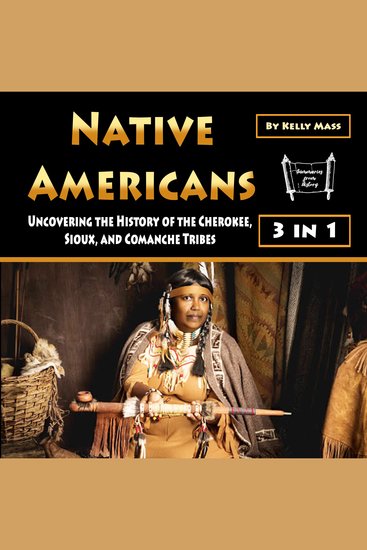
    This is a combo of several books, which are: 
    1 - The Cherokee are among the native tribes of the United States' Southeastern Woodlands. They resided in communities along river valleys in what's now southwestern North Carolina, southeastern Tennessee, the limits of western South Carolina, northern Georgia, and northeastern Alabama just before the 18th century. Cherokee belongs to the Iroquoian language family. One oral legend tells of the people moving south in age-old times from the Great Lakes area, where other Iroquoian-speaking tribes were based, according to James Mooney, an early American ethnographer. 
    2 - The Comanche are a Native American people from the contemporary United States' Great Plains. Most of contemporary northwestern Texas, and also surrounding parts in eastern New Mexico, southeastern Colorado, southwestern Kansas, western Oklahoma, and northern Chihuahua, were previously part of their historical domain. 
    The Comanche people are acknowledged by the federal government as the Comanche Country, which is headquartered in Lawton, Oklahoma. 
    The Comanche language belongs to the Uto-Aztecan family of Numic languages. It started as a Shoshoni dialect, but has since developed into its own language. 
    3 - The Sioux, also called the Oceti Sakowin are a North American people of Native American tribe and First Countries tribes. The contemporary Sioux are split into 2 significant groups based upon language: Dakota and Lakota; they're called together as the Ohéthi akówi ("7 Council Fires"). The term "Sioux" is an exonym stemmed from a French transliteration of the Ojibwe term "Nadouessioux," and can apply to any ethnic group or language dialect within the Great Sioux Country.
    Ver libro
  • Prince The (Fingerprint Classics) - cover

    Prince The (Fingerprint Classics)

    Niccolò Machiavelli

    • 0
    • 0
    • 0
    The Prince by Niccolò Machiavelli is a timeless political treatise that explores the dynamics of power, leadership, and statecraft. Written in the early 16th century, this concise yet provocative work offers pragmatic advice to rulers on how to gain, maintain, and consolidate authority, often advocating for realism over idealism. Machiavelli examines historical examples and human behavior to present strategies that prioritize effectiveness over morality, making the book both influential and controversial. Its insights into political maneuvering and the nature of authority have cemented it as a foundational text in political philosophy and realpolitik.
    Ver libro
  • Best Things First - cover

    Best Things First

    Bjorn Lomborg

    • 0
    • 0
    • 0
    Selected as one of the Best Books of 2023 by The Economist. 
    In this urgent, thought-provoking book, Bjorn Lomborg presents the 12 most efficient solutions for the world's poorest and our global SDG promises. • If you want to make the world better, Best Things First is the book to read. 
    World leaders have promised everything to everyone. But they are failing. The UN’s Sustainable Development Goals are supposed to be delivered by 2030. The goals literally promise everything, like eradicating poverty, hunger and disease; stopping war and climate change, ending corruption, fixing education along with countless other promises. This year, the world is at halftime for its promises, but nowhere near halfway. Together with more than a hundred of the world’s top economists, Bjorn Lomborg has worked for years to identify the world’s best solutions. Based on 12 new, peer-reviewed papers, forthcoming in Cambridge University Press’ Journal of Benefit-Cost Analysis, this book highlights the world’s best policies.
    Ver libro
  • Anglo-Saxons and the Jutes The: The History and Legacy of the European Groups that Settled Britain in the Middle Ages - cover

    Anglo-Saxons and the Jutes The:...

    Editors Charles River

    • 0
    • 0
    • 0
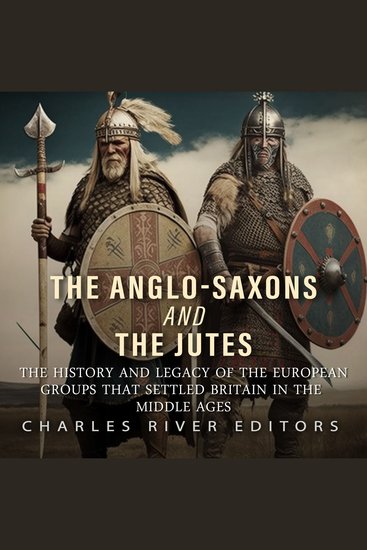
    As the Western Roman Empire collapsed in the late 5th century, Hadrian’s Wall was abandoned and Roman control of the area broke down.  
    Little is known of this period of British history, but soon the Anglo-Saxons – who had been harassing the Saxon Shore as pirates – showed up and began to settle the land, creating a patchwork of little kingdoms and starting a new era of British history. Several early medieval historians, writing well after the events, said the Anglo-Saxons were invited to Britain to defend the region from the northern tribes and ended up taking over. However they came to control most of England, the Anglo-Saxons became the dominant power in the region for nearly 500 years, and the strength of their cultural influence could be felt even after William the Conqueror won the Battle of Hastings and became the first Norman ruler on the island. The efforts to consolidate his rule in England were complicated from the start, both due to external enemies and those jockeying for his position while he was still alive, but the Normans would manage just barely to cling to power over England, and William remains the last foreign conqueror of the island.  
    The Jutes were so closely related to the Angles and Saxons that the nature of their existence has been, and continues to be, the subject of scholarly debates. Although historians and archaeologists have identified a Germanic tribe known as the Jutes that migrated to England at the same time as the Angles and Saxons, the attempt to distinguish them from the other tribes has been questioned. Either way, once the Jutes landed in England, they immediately distinguished themselves from the Angles and Saxons by carving out kingdoms in the regions of Kent and the Isle of Wight. From these two locations, the Jutes not only carried on many of their pre-migration cultural traditions but also adopted some of the new, unifying European traditions, particularly Christianity.
    Ver libro
  • Chopin's Concert in Rouen in 1838 - cover

    Chopin's Concert in Rouen in 1838

    Nicolas Labatut, Renee Clancy

    • 0
    • 0
    • 0
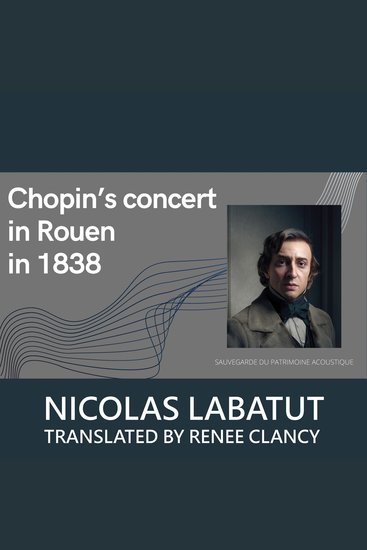
    This original hour-long audio documentary will take you in the footsteps of the 19th century’s most beloved and most played piano composer in the world : Frederic Chopin !  His compositions are reconfigured or remixed in many popular songs and are often heard in cinema as well as in the theater.The music of Frederic Chopin is part of our soundscape. Its humanity, its refinement and its modernity have enabled it to successfully cross over centuries. This great composer lived only 39 short years, during which he gave only a few rare concerts (which he hardly appreciated).So here we are going to discuss a relatively undocumented musical event (rich in anecdotes) : Frederic Chopin's concert at the Hotel de Ville in Rouen on the evening of March 12, 1838. Whether you are a music lover, passionate about history or simply of a curious temperament, I invite you to immerse yourself in this fascinating story, alone or with your family. The music terms have been simplified to the maximum to make the story accessible to as many people as possible.Have a good sound journey to the 19th century, don’t hesitate to share this original episode produced by the Safeguarding of the Acoustic Heritage (Sauvegarde du Patrimoine Acoustique) !
    Ver libro
  • Libertarian Policies - cover

    Libertarian Policies

    Arlo Holders

    • 0
    • 0
    • 0
    Libertarianism is a political philosophy centered on the belief that individuals should have the maximum possible freedom to pursue their own lives, with minimal interference from the government. Rooted in the principles of classical liberalism, libertarianism advocates for a limited government whose primary role is to protect individual rights and maintain peace. It emphasizes personal responsibility, free markets, and the belief that voluntary exchange is the foundation of a prosperous society. At its core, libertarianism seeks to protect the rights of individuals to live as they see fit, free from the coercive power of the state. 
    The history of libertarian thought can be traced back to influential philosophers such as John Locke, who argued for the natural rights of individuals to life, liberty, and property. His ideas formed the intellectual groundwork for the concept of limited government, which would later be expanded by thinkers like Adam Smith, who promoted the idea of free markets. The Enlightenment era, with its focus on reason, individualism, and skepticism of authority, provided a fertile ground for the development of libertarian ideas. In the 20th century, libertarianism gained further prominence through the works of economists such as Friedrich Hayek and Milton Friedman, who critiqued the expansion of government power and emphasized the importance of individual liberty in economic affairs. 
    Libertarianism's role in modern politics is to challenge the prevailing trend toward ever-expanding government intervention in people's lives. Libertarians argue that many of society’s problems are caused by government overreach, and that solutions should instead focus on allowing individuals to make their own decisions, free from state-imposed constraints.
    Ver libro