Junte-se a nós em uma viagem ao mundo dos livros!
Adicionar este livro à prateleira
Grey
Deixe um novo comentário Default profile 50px
Grey
Assine para ler o livro completo ou leia as primeiras páginas de graça!
All characters reduced
Penal Methods of the Middle Ages: Criminals Witches Lunatics - cover
LER

Penal Methods of the Middle Ages: Criminals Witches Lunatics

George Burnham Ives

Editora: DigiCat

  • 0
  • 0
  • 0

Sinopse

In "Penal Methods of the Middle Ages: Criminals, Witches, Lunatics," George Burnham Ives meticulously examines the draconian punitive measures employed during this turbulent period of history. Through a compelling narrative interwoven with academic rigor, Ives elucidates the societal context of criminality, witchcraft, and lunacy, demonstrating how each group was subjected to unique forms of punishment steeped in superstition and fear. His keen literary style evokes an uncomfortable yet necessary contemplation of moral philosophy, shedding light on the often barbaric legal systems that prevailed from the 5th to the 15th century. George Burnham Ives, an influential figure in criminology and legal reform, was profoundly motivated by the injustices he perceived within contemporary penal systems. His extensive research and advocacy for humane treatment reflect his deep-seated commitment to social justice, which undoubtedly informed the creation of this insightful work. Ives's background in law and history positions him uniquely to bridge the gap between past and present, offering readers a clear lens through which to view humanity's evolving relationship with crime and punishment. This book is essential for anyone interested in the history of criminal justice, social norms, and the cultural ramifications of law throughout the Middle Ages. Ives's thorough examination is not just an academic endeavor but a call to reflect on the complexities of justice and morality that resonate even today.
Disponível desde: 28/05/2022.
Comprimento de impressão: 103 páginas.

Outros livros que poderiam interessá-lo

  • How to Control Your Emotions - 10 Tips to Help You Conquer Your Emotions - cover

    How to Control Your Emotions -...

    Alex Wolf

    • 0
    • 0
    • 0
    You’re having a bad day, all your emotions are overwhelming you, and you have no idea what to do! All you feel like doing is laying in bed, crying, and eating some grossly saturated food. Going through emotional phases can be really difficult, as it feels like you’ve lost complete control over yourself. What if you were told you could take back control over yourself now? 
    Emotions can feel so strong and influential because they are! They can influence the decisions you make, how you live your life, and how you interact with others. It’s time to leave the negativity, stress, and depression behind, so you pursue life with positivity and freedom. 
    You have the power within you to conquer your emotions once and for all, through these 10 powerful tips. Read this book to learn how you can take back control over your emotions.
    Ver livro
  • Advanced Growth Strategies for Authors - cover

    Advanced Growth Strategies for...

    Russell Nohelty

    • 0
    • 0
    • 0
    I have a vision. 
    It's one that's haunted me for years…maybe haunted is not the right word, but in the absence of the right words, I have no choice but to use the ones that I have access to, and haunted feels right to me. 
    I've seen it in fits and starts, like somebody is turning on a fritzing light and illuminating a great darkness in my brain for a second here and a minute there. 
    When the light flickers on, though, I see the future. This book is what I see when I go there.  
    Unlock the secrets to creative success with Advanced Growth Tactics for Authors! Dive into a collection of powerful, no-nonsense essays from bestselling author Russell Nohelty, packed with practical strategies for building your writing career. 
    From mastering Kickstarter campaigns to navigating the ups and downs of indie publishing, this book offers invaluable insights to help you break through the noise, grow your audience, and thrive in the competitive world of authorship. 
    Whether you're just starting or looking to level up, this guide gives you the tools to take your writing career to the next
    Ver livro
  • The Overlife - A Tale of Schizophrenia - cover

    The Overlife - A Tale of...

    Diana Dirkby

    • 0
    • 0
    • 0
    The author of this book, Diana Dirkby, is an Australian-born research mathematician who lives with paranoid schizophrenia, a severe brain disorder, as did her mother. The title, “The Overlife,” suggests that a diagnosis of schizophrenia can be the beginning of a new, worthwhile life and not simply the death of the hopes and dreams that preceded the diagnosis. This book gives a fictional account of a mother and daughter living with paranoid schizophrenia. We follow the widely disparate effects of this brain disorder on Sarah, the narrator, and her mother, Jodie. We also meet Dalaigh, Jodie’s husband and Sarah’s father, with his violent resentment at being trapped in a marriage he doesn’t want. By age eight, Sarah is Jodie’s caregiver and must negotiate her mother’s rapidly worsening mental health and her father’s white-hot fury. The weight of these adult conflicts on the shoulders of one so young seems impossible to bear.
    Ver livro
  • Argentina History - A Historical Journey - From Colonial Rule to Modern Times - cover

    Argentina History - A Historical...

    Days of History

    • 0
    • 0
    • 0
    Ladies and Gentlemen, 
    Welcome to the world of Argentina, a land of passion, turmoil, and rich history. If you're like me, you love a good story, and let me tell you, Argentina has got some tales to tell. From the Spanish conquistadors to the tango dancers of Buenos Aires, this country has seen it all, and I've got an audiobook that will take you on a journey through its fascinating past. 
    But be warned, this audiobook is not for the faint of heart. If you're looking for a dry recitation of facts and dates, you're in the wrong place. No, my friends, this audiobook is a living, breathing thing, a story that will grab you by the throat and not let go until the last page has been turned (or in this case, the last chapter has been listened to). 
    I've always been fascinated by Argentina, with its vibrant culture, delicious food, and passionate people. But it wasn't until I dove into its history that I truly fell in love with this country. The struggles for independence, the golden age of immigration, the rise and fall of dictators – it's all here, waiting for you to discover. 
    And it's not just the history that makes this audiobook so special. You'll also hear from the people who make up this amazing country – the musicians, the writers, the everyday folks who call Argentina home. They'll share their stories and give you a glimpse into the heart and soul of this place. 
    So what are you waiting for? If you're ready for an adventure, if you're ready to be transported to a land of passion and intrigue, if you're ready to fall in love with Argentina like I did, then don't hesitate. Get your hands (or your ears) on this audiobook and let the journey begin. 
    Scroll up and buy this audibook today!
    Ver livro
  • Nazi Germany’s Conquest of Western Europe: The Negotiations and Campaigns that Let Hitler Conquer the Continent Before and During World War II - cover

    Nazi Germany’s Conquest of...

    Editors Charles River

    • 0
    • 0
    • 0
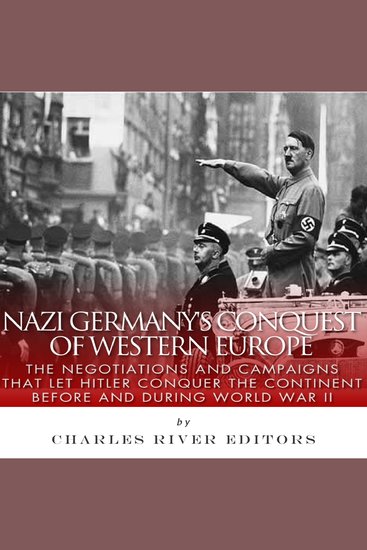
    Europe’s attempts to appease Hitler, most notably at Munich in 1938, failed, as Nazi Germany swallowed up Austria and Czechoslovakia by 1939. Italy was on the march as well, invading Albania in April of 1939. The straw that broke the camel's back, however, was Germany's invasion of Poland on September 1 of that year. Two days later, France and Great Britain declared war on Germany, and World War II had begun in earnest. 
    Of course, as most people now know, the invasion of Poland was merely the preface to the Nazi blitzkrieg of most of Western Europe, which would include Denmark, Belgium, and France by the summer of 1940. The resistance put up by these countries is often portrayed as weak, and the narrative is that the British stood alone in 1940 against the Nazi onslaught, defending the British Isles during the Battle of Britain and preventing a potential German invasion. 
    In particular, the campaign in Poland is remembered as one in which an antiquated Polish army was quickly pummeled by the world’s most modern army. Polish lancers charging in a valiant yet idiotic attack against German tanks is the only image from the 1939 Nazi-Soviet invasion of Poland remaining in the popular imagination today. Originating as a piece of Nazi propaganda, paradoxically adopted by the Poles as a patriotic myth, the fictional charge obscures the actual events of September 1939. Outnumbered, outgunned, and under-equipped, the Polish army nevertheless inflicted heavy losses on the invading Wehrmacht. In fact, only the unexpected advance of Soviet forces from the east put a quick end to the struggle and saw the Polish republic partitioned again after just 20 years of independence. Nonetheless, the campaign that started World War II was a bloody sign of things to come as the conflict engulfed the globe.
    Ver livro
  • Popular Works Volume 1 - The Vocation of the Scholar The Nature of the Scholar and The Vocation of Man - cover

    Popular Works Volume 1 - The...

    Johann Gottleib Fitche

    • 0
    • 0
    • 0
    History placed Johann Gottlieb Fichte (1762-1814) between two giants of German philosophy – Immanuel Kant (1724-1804) and Georg Hegel (1770-1831) – so it was not surprising that his light may have dimmed as the 19th century developed. It didn’t help that he also was regarded as one of the proponents of German nationalism, a legacy that spilled over into the darker times of the 20th century.  
    However, his singular character and his role in developing, (following Kant), transcendental idealism has resulted in a re-evaluation in recent years. His views on ethics, a practical approach towards the matter of free will, and the value he placed on culture, the intellect and the self, informed his output. 
    The three works in this collection, Volume 1, offer a steady insight into Fichte’s thought and personality. Many of his key works emerged in the form of lectures rather than books, and as such are eminently accessible: Fichte was certainly a popular speaker. When at the University of Jena (1794-1799) he drew large audiences for the five lectures which comprise The Vocation of the Scholar (1794). The main principles of the Enlightenment are examined here, in terms of culture, education, morality. As he writes in his Preface: ‘That the Ideal cannot be manifested in the Actual world, we know as well as they do, perhaps better. All we maintain is, that the Actual must be judged by the Ideal, and modified in accordance with it by those who feel themselves capable of such a task.’ 
    In 1799, he was dismissed from his post at Jena following accusations of atheism, and the last two works in this collection appeared while he was at the University of Berlin. The Nature of the Scholar and its Manifestations dates from 1806 and comprises 10 lectures which develop ideas initially presented in The Vocation of the Scholar. The final work here, The Vocation of Man, appeared in book form rather than as a series of lectures and is regarded as one of his most important. In it, Fichte sets out to examine ‘the true purpose of man’.  
    It is divided into three sections, Doubt, Knowledge, Faith. He addresses issues of free will and cause and effect, natural existence and perceived reality; and, finally, the ‘guiding’ matter of faith and God.
    Ver livro