¡Acompáñanos a viajar por el mundo de los libros!
Añadir este libro a la estantería
Grey
Escribe un nuevo comentario Default profile 50px
Grey
Suscríbete para leer el libro completo o lee las primeras páginas gratis.
All characters reduced
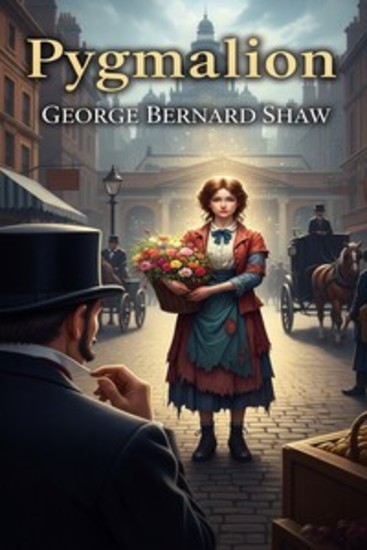
Pygmalion - cover

Pygmalion

George Bernard Shaw

Editorial: Bu Classics Books

  • 0
  • 0
  • 0

Sinopsis

A phonetics professor accepts a wager to transform a Cockney flower girl into a duchess, unleashing a storm of class conflict and personal identity. As the experiment succeeds, the human cost becomes apparent, raising timeless questions about independence and the artificial barriers of social standing.
Disponible desde: 05/03/2026.
Longitud de impresión: 128 páginas.

Otros libros que te pueden interesar

  • Poetry of the British Isles - cover

    Poetry of the British Isles

    Various Authors

    • 0
    • 0
    • 0
    A delightful selection of poetry from around the British Isles including 'Dover Beach' by Matthew Arnold,  'Leisure' by W. H. Auden and 'To Autumn' by John Keats. Including classic recordings by acclaimed actors Sir Ralph Richardson and Richard Burton.
    Ver libro
  • The Field in Winter - cover

    The Field in Winter

    David Clarke

    • 0
    • 0
    • 0
    The Field in Winter, the third collection of poetry by David Clarke, winner of the Michael Marks Award, elegantly reflects on memory, time, and the very particular landscape of loss, in a calendar of poems, a 'charm of words' that track and loop through seasons of nature and living.
    The relationship between the environment, the human body and the self takes centre stage here in poetry that is concerned with being in the world - senses alive to the detail of things, the trunk of a linden tree , the shock of cold water, the frenzy of bees and blossom. But these remarkable poems also write towards the intangible in the late summer's dusk – an empty cage, a bird flown; history's slow grind and echo. Clarke's elegies reach out to touch what passes us fleetingly in a moment of time – 'before the tongue can catch them' – held for that second, precious, in his poised and finely weighted poetry.
    Ver libro
  • Stefan Zweig Collection The - Volume 3 - cover

    Stefan Zweig Collection The -...

    Stefan Zweig

    • 0
    • 0
    • 0
    Stefan Zweig wrote these four legends primarily in the 1930s as Europe descended toward fascism. Turning from contemporary psychological novellas to legendary material, he sought timeless themes that transcended specific historical horror. 
    "The Dissimilar Doubles" — Twin sisters diverge: one pursuing sensual pleasure, the other austere devotion. A moral parable that complicates easy judgments about flesh and spirit. 
    "The Buried Candelabrum" — A maimed Jew journeys to fifth-century Constantinople seeking the Temple menorah. Written as antisemitism intensified, it explores displacement and whether exile can ever be overcome. 
    "Rachel Against God" — The biblical matriarch rises from her grave to confront God over her descendants' suffering. An audacious premise drawn from the Jewish tradition of arguing with the divine. 
    "The Eyes of the Eternal Brother" — An Indian legend of a warrior-judge who renounces violence after killing his brother, only to discover he cannot escape his violent karma. 
    Zweig's cosmopolitan range is extraordinary — moving from Jewish tradition to Christian legend to Indian mythology with elegant prose and psychological insight. Yet the universalizing impulse that enables this range also creates tension: extracting "universal themes" can flatten what makes specific traditions distinctive. 
    These legends represent Zweig's experimental engagement with ancient forms during Europe's darkest decade — a writer seeking to preserve humanistic values through mythic storytelling while the civilization that enabled such cosmopolitanism was being destroyed. They work best as literary meditations, demonstrating how a master stylist navigated between timeless myth and contemporary catastrophe. Essential reading for understanding both Zweig's range and his response to the 1930s.
    Ver libro
  • The Top 10 Poets – The Mystic East - Five poems each from poets ever from the Mystic East - cover

    The Top 10 Poets – The Mystic...

    Jalaluddin Rumi, Hafiz, Kabir,...

    • 0
    • 0
    • 0
    The language of Poetry is an art that most of us attempt at some point in our lives.  Although its commonplace exposure has been somewhat marginalised in today’s often fast-paced lives we all recognise good verse that can empathise with our thoughts or open us up to experience new things in new ways, to better understand and to enjoy the many strands of our lives. 
    But finding a starting point can be overwhelming, even off-putting, so in this series we offer up our Top 10 classic poets, who brim with talent and verse, on a range of subjects and themes that we can all enjoy. 
    From the point of view of the Western World, deep and eternal knowledge of mankind’s beginnings, its spirit, its reason to simply be was always waiting to be discovered and sampled in the far-off lands of the Mystic East.  These 10 Poets and their verse demonstrate just why that is.
    Ver libro
  • Uncle Vanya - cover

    Uncle Vanya

    Anton Chekhov

    • 0
    • 0
    • 0
    Uncle Vanya by Anton Chekhov is a masterful work of modern drama that captures the quiet desperation, unfulfilled longing, and fragile hope that shape ordinary human lives. First performed in 1899, this enduring play reveals Chekhov's extraordinary gift for portraying emotional complexity through subtle dialogue, layered relationships, and moments of stillness that speak louder than action.
    
    Set on a rural estate in provincial Russia, the story unfolds among a small group of individuals whose lives have become entangled in disappointment and regret. Ivan Voynitsky—known as Uncle Vanya—has spent years managing the family property to support the career of his brother-in-law, a self-absorbed professor. When the professor retires and returns to the estate with his young and captivating wife, Yelena, long-suppressed frustrations rise to the surface. Old grievances resurface, romantic tensions intensify, and the illusion of purpose begins to unravel.
    
    Alongside Vanya is Sonya, the professor's devoted daughter, whose quiet resilience stands in contrast to the emotional turbulence surrounding her. Her unrequited love for the idealistic Doctor Astrov adds another layer of longing to the story. Astrov himself, disillusioned yet passionate about environmental conservation, reflects Chekhov's forward-thinking concerns about the destruction of nature and the erosion of meaning in modern life.
    
    Rather than building toward dramatic climaxes, Uncle Vanya unfolds through intimate conversations and subtle emotional shifts. Chekhov's realism exposes the inner struggles of characters who feel trapped by circumstance, wasted potential, and the passage of time. Their dreams—of love, recognition, or escape—remain tantalizingly out of reach, yet they continue to endure.
    
    The play explores universal themes: the search for purpose, the pain of unreturned affection, the burden of sacrifice, and the quiet heroism of perseverance. Chekhov portrays his characters with compassion, allowing audiences to see both their flaws and their humanity. Moments of humor blend seamlessly with sorrow, creating a tone that is bittersweet and profoundly authentic.
    
    Uncle Vanya remains one of Chekhov's most celebrated works and a cornerstone of modern theater. Its psychological depth and understated power have influenced generations of playwrights and actors, while its exploration of regret and resilience continues to resonate with audiences worldwide. Timeless and deeply moving, the play offers a poignant reminder that even in lives marked by disappointment, dignity and endurance can endure.
    Ver libro

  • Shakespeare Monologues Collection vol 09 - cover

    Shakespeare Monologues...

    William Shakespeare

    • 0
    • 0
    • 0
    LibriVox readers present the ninth collection of monologues from Shakespeare’s plays. Containing 20 parts. William Shakespeare (April 26, 1564 – April 23, 1616) remains widely to be considered the single greatest playwright of all time. He wrote in such a variety of genres - tragedy, comedy, romance, &c - that there is always at least one monologue in each of his plays. Some of these teach a lesson, some simply characterize Shakespeare at his best, some are funny, some sad, but all are very moving. Each monologue will touch everybody differently. Some people will be so moved by a particular monologue that they will want to record it. (summary by Shurtagal)
    Ver libro