Rejoignez-nous pour un voyage dans le monde des livres!
Ajouter ce livre à l'électronique
Grey
Ecrivez un nouveau commentaire Default profile 50px
Grey
Abonnez-vous pour lire le livre complet ou lisez les premières pages gratuitement!
All characters reduced
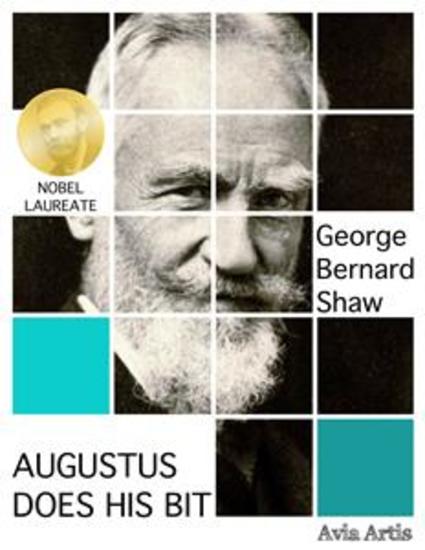
Augustus Does His Bit - cover

Augustus Does His Bit

George Bernard Shaw

Maison d'édition: Avia Artis

  • 0
  • 0
  • 0

Synopsis

“Augustus Does His Bit” is a play by George Bernard Shaw, an Irish playwright who became the leading dramatist of his generation, and in 1925 was awarded the Nobel Prize in Literature.

“Augustus Does His Bit” is a comic one-act play by George Bernard Shaw about a dim-witted aristocrat who is outwitted by a female spy during World War I.
Disponible depuis: 07/01/2022.

D'autres livres qui pourraient vous intéresser

  • Franklyn: A Path of Twisting Reality - cover

    Franklyn: A Path of Twisting...

    Richard Cliff

    • 0
    • 0
    • 0
    Franklyn was born into a gritty north of England town. His expected path through life would have him live out his years in the manner of that town's baseline existence. But it wasn't to be.Perhaps he was pre-selected to break rank so that bigger dreams could be fulfilled. Whatever the prime force may have been, he was to know a different life.Perhaps, too, the corridors of our own reality are flimsier than we believe! On the other side of the wall may lie another path.  As Franklyn himself discovers, a perceived reality can be as real as reality itself.
    Voir livre
  • A Rare Recording of Lawrence Ferlinghetti Reading His Own Poems - cover

    A Rare Recording of Lawrence...

    Lawrence Ferlinghetti

    • 0
    • 0
    • 0
    Lawrence Monsanto Ferlinghetti (March 24, 1919 - February 22, 2021), born in Yonkers, NY, was an American poet, painter, social activist, and co-founder of City Lights Booksellers & Publishers. An author of poetry, translations, fiction, theatre, art criticism, and film narration, Ferlinghetti was best known for his second collection of poems, A Coney Island of the Mind (1958), which has been translated into nine languages and sold over a million copies. The following recording includes Ferlinghetti reading the poems, Baseball Canto, Travels in America Deserta, See It Was Like This When, and Underwear.
    Voir livre
  • The Flame of Her Will - cover

    The Flame of Her Will

    Phoebe Reeves

    • 0
    • 0
    • 0
    The Flame of Her Will is an erasure of the Malleus Maleficarum, a text long used to justify witch-hunts. The poems in this collection invert and subvert the original text, paring away the misogyny and hatred until what is left is a lost woman's voice, challenging a history that requires her silence.
    Voir livre
  • The Poetry of Algeron Charles Swinburne - Trailblazing writer whose worked often touched on taboo topics of Victorian times - cover

    The Poetry of Algeron Charles...

    Algernon Charles Swinburne

    • 0
    • 0
    • 0
    Algernon Charles Swinburne was born on April 5th, 1837, in London, into a wealthy Northumbrian family.  He was educated at Eton and at Balliol College, Oxford, but did not complete a degree.  
    In 1860 Swinburne published two verse dramas but achieved his first literary success in 1865 with Atalanta in Calydon, written in the form of classical Greek tragedy. The following year "Poems and Ballads" brought him instant notoriety. He was now identified with "indecent" themes and the precept of art for art's sake.  
    Although he produced much after this success in general his popularity and critical reputation declined. The most important qualities of Swinburne's work are an intense lyricism, his intricately extended and evocative imagery, metrical virtuosity, rich use of assonance and alliteration, and bold, complex rhythms.  
    Swinburne's physical appearance was small, frail, and plagued by several other oddities of physique and temperament. Throughout the 1860s and 1870s he drank excessively and was prone to accidents that often left him bruised, bloody, or unconscious. Until his forties he suffered intermittent physical collapses that necessitated removal to his parents' home while he recovered.  
    Throughout his career Swinburne also published literary criticism of great worth. His deep knowledge of world literatures contributed to a critical style rich in quotation, allusion, and comparison. He is particularly noted for discerning studies of Elizabethan dramatists and of many English and French poets and novelists. As well he was a noted essayist and wrote two novels. 
    In 1879, Swinburne's friend and literary agent, Theodore Watts-Dunton, intervened during a time when Swinburne was dangerously ill. Watts-Dunton isolated Swinburne at a suburban home in Putney and gradually weaned him from alcohol, former companions and many other habits as well.  
    Much of his poetry in this period may be inferior but some individual poems are exceptional; "By the North Sea," "Evening on the Broads," "A Nympholept," "The Lake of Gaube," and "Neap-Tide."  
    Swinburne lived another thirty years with Watts-Dunton. He denied Swinburne's friends access to him, controlled the poet's money, and restricted his activities. It is often quoted that 'he saved the man but killed the poet'.  
    Swinburne died on April 10th, 1909 at the age of seventy-two. 
     This volume comes to you from Portable Poetry, a specialized imprint from Deadtree Publishing.  Our range is large and growing and covers single poets, themes, and many compilations.
    Voir livre
  • Harbinger - Poems - cover

    Harbinger - Poems

    Shelley Puhak

    • 0
    • 0
    • 0
     “The speaker in Shelley Puhak’s Harbinger is no closer to knowing herself than I am, than we are, which is why we trust her. Each similarly titled poem holds a triptych mirror up to the artist and, in so doing, up to us all, so we may better see ourselves as we are. In ever-changing form.” —Nicole Sealey  
    A stunning meditation on artistic creation and historical memory from the winner of the National Poetry Series, chosen by Nicole Sealey 
    From “Portrait of the artist, gaslit” to “Portrait of the artist’s ancestors” to “Portrait of the artist reading a newspaper,” the poems in Harbinger reflect the many facets of the artistic self as well as the myriad influences and experiences that contribute to that identity. 
    “Portrait of the artist as a young man” has long been the default position, but these poems carve out a different vantage point. Seen through the lens of motherhood, of working as a waitress, of watching election results come in, or of simply sitting in a waiting room, making art—and making an artist—is a process wherein historical events collide with lived experience, both deeply personal but also unfailingly political. When we make art, for what (and to whom) are we accountable? And what does art-making demand of us, especially as apocalypse looms? 
    With its surprising insights, Harbinger, the latest book from acclaimed poet Shelley Puhak, shows us the reality of the constantly evolving and unstable self, a portrait of the artist as fragmentary, impressionable, and always in flux. 
      
    Voir livre
  • Old Fashioned Landowners - Gogols story of an aging couple who must confont the harsh lessons of mortality - cover

    Old Fashioned Landowners -...

    Nikolai Gogol

    • 0
    • 0
    • 0
    Nikolai Vasilievich Gogol was born on 1st April 1809 to a father, descended from Ukrainian Cossacks and a mother with a military background in the Ukrainian town of Sorochyntsi, then part of the Russian Empire and rich in Cossack traditions and folklore.   
     
    His father wrote poetry and plays which the young Gogol helped stage at his uncle’s home theatre.  This helped ignite in him a love of literature and blossomed when he attended, what is now, the Nizhyn Gogol State University at the age of 12.  Here he participated in school theatre productions and refined his mastery of his native Ukrainian and also the Russian of his Imperial masters. 
     
    In 1828 he went to St Petersburg and unsuccessfully tried to begin a career as an actor after finding that with no money and no connections the civil service was barred to him. 
     
    Embezzling money from his mother he embarked on a trip to Germany. When the money ran out, he returned to St Petersburg but the experiences were used in a series of stories he contributed to periodicals.  These tales were steeped in his childhood memories of the Ukrainian landscape and peasantry enlivened with the supernatural of its folklore woven with realistic events of the day.  He wrote in Russian in a whimsical, colloquial style with a smattering of Ukrainian words and phrases that provided an authenticity.  Eight stories were published as ‘Evenings on a Farm near Dikanka’.  Seemingly all at once fame and fortune arrived. Gogol was hailed by his contemporaries, including Pushkin, as a pre-eminent writer of Russian literature.   
     
    His success continued with his brilliant plays ‘The Inspector General’ and the comedy ‘The Marriage for the Theatre’, both being highly acclaimed.   
     
    In 1834 he became Professor of Medieval History at the University of St. Petersburg but with little academic or teacher training, failed to adequately fulfil many of his duties and soon resigned this post.  With no obligations and using his earnings from his writing, which now included the impressionistic and immortal ‘Dead Souls’, Gogol travelled around Europe, spending the most time in Rome where he studied art, read Italian literature and developed a passion for opera.  
     
    In the 1840s Gogol became preoccupied with a need to purify his soul and embarked on a pilgrimage to Jerusalem. In tandem he fell under the influence of a strict and austere spiritual ascetic who persuaded him to observe strict fasts that, allied with his depression and deteriorating health, contributed to his death on 21st April 1852 at the age of only 43. 
     
    In ‘Old Fashioned Land Owners’ Gogol describes a peaceful setting and a peaceful couple who have grown old together.  But foreboding makes an entrance and life is now a series of cruel twists that breaks everything.
    Voir livre