¡Acompáñanos a viajar por el mundo de los libros!
Añadir este libro a la estantería
Grey
Escribe un nuevo comentario Default profile 50px
Grey
Suscríbete para leer el libro completo o lee las primeras páginas gratis.
All characters reduced
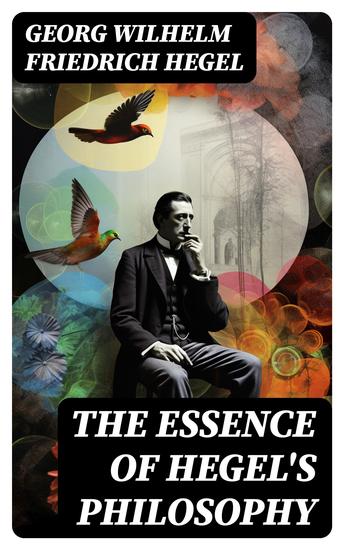
The Essence of Hegel's Philosophy - Phenomenology of Mind Philosophy of Mind Aesthetics The Criticism of Hegle's Work and Hegelianism by Schopenhauer & Nietzsche Biography - cover

The Essence of Hegel's Philosophy - Phenomenology of Mind Philosophy of Mind Aesthetics The Criticism of Hegle's Work and Hegelianism by Schopenhauer & Nietzsche Biography

Georg Wilhelm Friedrich Hegel

Traductor William Wallace, J. B. Baillie, S. W. Dyde, F. P. B. Osmaston, Ebenezer Brown Speirs, Elizabeth Haldane

Editorial: DigiCat

  • 0
  • 0
  • 0

Sinopsis

In "The Essence of Hegel's Philosophy," Georg Wilhelm Friedrich Hegel meticulously dissects the foundational principles of his philosophical system, emphasizing the dynamic interplay of reality and thought. Through a dialectical method, Hegel explores concepts such as absolute reality, self-consciousness, and the unfolding of the Spirit, inviting readers into a complex, yet profound understanding of existence. His literary style, characterized by dense, intricate prose, challenges readers to engage deeply with the material, as he situates his ideas within the broader context of German idealism, intertwining them with the historical movements and intellectual currents of his time. Hegel, a pivotal figure in Western philosophy, was influenced by Enlightenment thought, historical events, and personal experiences, all of which shaped his views on freedom, ethics, and society. Drawing from the legacies of Kant and Fichte, he sought to articulate a framework that captures the evolution of consciousness and reality, aiming to reconcile contradictions inherent in human experience. His philosophical journey reflects both a search for truth and an engagement with contemporary socio-political issues, positioning him as a critical thinker of his era. This book is an essential read for anyone interested in the intricacies of philosophical thought and the evolution of ideas. Hegel's profound insights not only offer a lens through which to understand his own works but also invite contemporary readers to confront their own existence and the nature of reality itself. Readers will find themselves enriched by Hegel's profound inquiries into the essence of consciousness and its role in shaping human experience.
Disponible desde: 28/12/2023.
Longitud de impresión: 4992 páginas.

Otros libros que te pueden interesar

  • Meade at Gettysburg - A Study in Command - cover

    Meade at Gettysburg - A Study in...

    Kent Masterson Brown

    • 0
    • 0
    • 0
    Although he took command of the Army of the Potomac only three days before the first shots were fired at Gettysburg, Union general George G. Meade guided his forces to victory in the Civil War's most pivotal battle. Commentators often dismiss Meade when discussing the great leaders of the Civil War. But in this long-anticipated book, Kent Masterson Brown draws on an expansive archive to reappraise Meade's leadership during the Battle of Gettysburg. Using Meade's published and unpublished papers along with a variety of other sources, Brown highlights how Meade's rapid advance of the army to Gettysburg on July 1, his tactical control and coordination of the army in the desperate fighting on July 2, and his determination to hold his positions on July 3 insured victory. 


    Brown argues that supply deficiencies, brought about by the army's unexpected need to advance to Gettysburg, were crippling. In spite of that, Meade pursued Lee's retreating army rapidly, and his decision not to blindly attack Lee's formidable defenses near Williamsport on July 13 was entirely correct in spite of subsequent harsh criticism. Combining compelling narrative with incisive analysis, this finely rendered work deepens our understanding of the Army of the Potomac as well as the machinations of the Gettysburg Campaign, restoring Meade to his rightful place in the Gettysburg narrative.
    Ver libro
  • French Revolution The: The History and Legacy of the World’s Most Famous Social Revolution - cover

    French Revolution The: The...

    Editors Charles River

    • 0
    • 0
    • 0
    As one of the seminal social revolutions in human history, the French Revolution holds a unique legacy, especially in the West. The early years of the Revolution were fueled by Enlightenment ideals, seeking the social overthrow of the caste system that gave the royalty and aristocracy decisive advantages over the lower classes. But history remembers the French Revolution in a starkly different way, as the same leaders who sought a more democratic system while out of power devolved into establishing an incredibly repressive tyranny of their own once they acquired it. 
    The early years of the French Revolution were fueled by Enlightenment ideals, seeking the social overthrow of the caste system that gave the royalty and aristocracy decisive advantages over the lower classes. But history remembers the French Revolution in a starkly different way, as the same leaders who sought a more democratic system while out of power devolved into establishing an incredibly repressive tyranny of their own once they acquired it. 
    The height of Republican France’s tyranny came during a 10 month period forever known as the Reign of Terror, the most notorious and arguably most memorable part of the French Revolution. One of the first victims of the Reign of Terror was its most famous: former French Queen Marie Antoinette. But Antoinette was followed by thousands more, including everyone from aristocrats to clergy to prostitutes and even instrumental revolutionaries like Danton, Desmoulins, and, most notably, Robespierre. It was Robespierre whose position on the Committee of Public Safety made him the Reign of Terror’s instrumental figure until he himself became a victim of it in July 1794. Robespierre’s date with the guillotine is often considered the official end of the Reign of Terror, but by then it is estimated that at least 16,000 people were guillotined in that time and possibly 25,000 more were summarily executed across the country.
    Ver libro
  • Galileo Galilei - History Discoveries and Scientific Revolution - cover

    Galileo Galilei - History...

    Kelly Mass

    • 0
    • 0
    • 0
    Galileo di Vincenzo Bonaiuti de' Galilei, known just as Galileo, was an astronomer, physicist, and engineer from Pisa, modern-day Italy, who was regularly described as a polymath. Galileo has been called the "creator of observational astronomy," "father of modern-day physics," "father of the clinical technique," and "father of contemporary science," to name a few titles. 
    Galileo engaged on useful science and innovation, clarifying the characteristics of pendulums and "hydrostatic balances," and also studying speed and speed, gravity and free fall, the concept of relativity, inertia, and projectile movement. He created the thermoscope and some army compasses, and he used the telescope to observe celestial things clinically. Telescopic verification of Venus' stages, observation of Jupiter's 4 biggest satellites, research study of Saturn's rings, and analysis of sunspots are amongst his contributions to observational astronomy. 
    Galileo's big testimony and support of Copernican heliocentrism (the Earth turning daily and circling the sun) drew criticism from the Catholic Church and certain astronomers. In 1615, the Roman Inquisition checked out the subject and realized that heliocentrism was silly, absurd, and profane because it went against the Holy Bible. 
    No doubt Galileo was an intelligent person, who paved the way for many discoveries and inventions. Let’s take a look at his life, his mission, and his accomplishments.
    Ver libro
  • Troubling the Water - The Urgent Work of Radical Belonging - cover

    Troubling the Water - The Urgent...

    Ben McBride

    • 0
    • 0
    • 0
    From one of the most courageous and visionary leaders of our time comes Troubling the Water, an immersive book about the violence and injustice that threaten to drown us all. Ben McBride recounts how he first waded into the water: from the Kill Zone in Oakland, where he moved with his young family, to the uprising in Ferguson, to the moral impoverishment of the white evangelical church. In the truth-telling tradition of Bryan Stevenson and Bishop William Barber, McBride leads us right into the fury and fragmentation of our moment, and then steadies us once we're there. 


    What would it take to truly belong to each other? Radical belonging, McBride argues, means looking at our implicit biases, at our faulty understandings of power, and at how we "other"—or "same"—people. Sometimes it even means troubling the waters—speaking hard truths in situations that appear calm but that cloak injustice. 


    With a blend of provocation and good humor, McBride leads us beyond inaction on the one hand and polemic on the other. What results is an indelible manifesto—a troublemaking reverend's call to the most urgent task of our time. As inequality, racism, and alienation weaken our common life, well-meaning people ask: What do I need to do to create a world where all can belong? But McBride asserts that instead, we need to ask: Who do I need to become?
    Ver libro
  • Genius Makers: Book Summary & Analysis - cover

    Genius Makers: Book Summary &...

    Briefly Summaries

    • 0
    • 0
    • 0
    This is a concise summary and analysis of Genius Makers, by Cade Metz.
     
    It is not the original book and is not affiliated with or endorsed by Cade Metz.
     
    Ideal those seeking a quick and insightful overview.
     
    Genius Makers delves into the competitive and high-stakes world of artificial intelligence, uncovering the stories of the brilliant minds and groundbreaking technologies behind the rise of AI. The book examines the battle between tech giants and researchers to create the most powerful AI systems, exploring the ethical dilemmas, power struggles, and transformative potential of this technology. It provides a compelling look at the revolution shaping our future and the people driving it.
    Ver libro
  • Adaptable - How to Lead with Curiosity Pivot with Purpose and Thrive through Change - cover

    Adaptable - How to Lead with...

    Alexa Carlin

    • 0
    • 0
    • 0
    Life’s obstacles offer two distinct directions: They can push you backward or fuel you forward. The choice is up to you. 
    At 17, Alexa Carlin became CEO of her first company, designing jewelry that made a difference, one bracelet at a time. But at 21, she was induced into a medical coma and given a one-percent chance to live. In Adaptable, she shares the stories of her journey, offering powerful insights into hope, courage, and life’s challenges. 
    Written and narrated in a heartfelt and authentic tone, Adaptable invites readers to develop a new perspective on their past and current obstacles. The stories, lessons, and action steps that fill each chapter gently guide readers back to their true selves, allowing them to connect deeply to their inner light and shine brightly with their true purpose. 
    Alexa encourages and inspires readers to use their own challenges not as a reason to abandon dreams, but as a springboard from which to thrive.
    Ver libro