Junte-se a nós em uma viagem ao mundo dos livros!
Adicionar este livro à prateleira
Grey
Deixe um novo comentário Default profile 50px
Grey
Assine para ler o livro completo ou leia as primeiras páginas de graça!
All characters reduced
Tremendous Trifles - cover
LER

Tremendous Trifles

G.K. Chesterton

Editora: Bu Classics Books

  • 0
  • 0
  • 0

Sinopse

In this charming collection of essays, the mundane becomes magical as the author finds wonder in a piece of chalk, a railway station, or a simple puppets' show. It is a manifesto for the observant, urging readers to open their eyes to the fairy tales playing out in everyday life. The prose sparkles with wit and whimsy, transforming the trivial into the tremendous.
Disponível desde: 04/03/2026.
Comprimento de impressão: 223 páginas.

Outros livros que poderiam interessá-lo

  • One Autumn Night - From their pens to your ears genius in every story - cover

    One Autumn Night - From their...

    Maxim Gorky

    • 0
    • 0
    • 0
    Alexei Maximovich Peshkov was born on 28th March 1868, in Nizhny Novgorod, Russia. 
    Better known as Maxim Gorky he was orphaned at 11 and ran away from home at 12.  At 19 he had already attempted suicide and thereafter travelled, by foot, across the Russian Empire for 5 years. 
    His first book ‘Essays & Stories’ in 1898 was a sensation and so began a long career as an author of short stories, novels and plays.  Gorky saw writing as a moral and political act that would help to change the unjust world around him.  He was an ardent early advocate of the emerging Marxist movement and publicly opposed the Tsarist regime leading several times to his arrest.  
    In 1904 he began his own theatre but the censor banned every play and Gorky was forced to abandon the project. 
    But Gorky was a financially successful author, editor, and playwright and gave monies to political parties as well as for civil rights and social reform.  The brutal shooting of workers, which set in motion the Revolution of 1905, pushed Gorky more decisively toward radical solutions.  
    In 1906 he went to the United States to raise funds for the Bolsheviks. Those experiences including a scandal over travelling with his lover and not his wife deepened his contempt for the ‘bourgeois soul.’ 
    Gorky now moved to Capri in Italy, both for health reasons and to escape the increasingly repressive times in Russia.  
    An amnesty for the 300th anniversary of the Romanov dynasty saw him return to Russia in 1914. His politics remained close to the Bolshevik cause.  But soon, after the 1918 revolution, his essays referred to Lenin as a tyrant for his senseless arrests and repression.  He was soon appealing to the outside world for food aid after the catastrophic crop failure. 
    In October 1921 Gorky returned to Italy, now in Fascist hands, and settled in Sorrento until 1932.  His health worsened with the onset of tuberculosis. 
    He wrote several successful books there but now decided to find an understanding with the communist regime. Stalin invited him home and his return was hailed as a major propaganda victory.  He was decorated with the Order of Lenin, and a province, a park, and various streets re-named in his honour. 
    But he had his faults too.  In 1933, Gorky co-edited a book on the White Sea-Baltic Canal and denied even a single prisoner died during its construction, but thousands had. As well, knowing that some Nazis were homosexual, a phrase was attributed to him that said ‘exterminate all homosexuals and fascism will vanish’.  Although he was himself was quoting another he was decidedly homophobic. 
    With the increase of Stalinist repression in 1935 Gorky was placed under unannounced house arrest. 
    Maxim Gorky died on the 18th June 1936 from pneumonia.  He was 68. 
    Stalin and Molotov were among those who carried Gorky's urn of ashes at his funeral.
    Ver livro
  • Sailing Alone Around The World - cover

    Sailing Alone Around The World

    Joshua Slocum

    • 0
    • 0
    • 0
    Joshua Slocum was the first man to sail around the world alone in a small boat. He personally rebuilt an 11.2 metre sloop-rigged fishing boat that he named the Spray. On April 24, 1895, he set sail from Boston, Massachusetts. More than three years later, he returned to Newport, Rhode Island, on June 27, 1898 having circumnavigated the world, a distance of 46,000 miles (74,000 km). 
    In 1899 he described the voyage in Sailing Alone Around the World now considered a classic of travel literature. It is a wonderful adventure story from the Age of Sail and a book of which Arthur Ransome declared, "boys who do not like this book ought to be drowned at once". (Summary by Alan Chant and Wikipedia)
    Ver livro
  • Lydia Litvyak: The Life and Legacy of the Soviet Woman Who Became World War II’s Most Successful Female Fighter Pilot - cover

    Lydia Litvyak: The Life and...

    Editors Charles River

    • 0
    • 0
    • 0
    Altogether, the Battle of Stalingrad was the deadliest battle in the history of warfare, and the Soviets’ decisive victory there is considered one of the biggest turning points in the entire war, and certainly in the European theater. Over the next two years, the German gains in Russia were steadily reversed, and the Red Army eventually began pushing west towards Berlin. Fittingly, the importance of Stalingrad was commemorated in several ways, from Churchill presenting Stalin with a “Sword of Stalingrad” to the Russians’ decision not to rebuild parts of the battle scarred city as a reminder of what happened there.  
    Partly out of dire circumstances and partly from a cultural worldview, it was the Soviet Union who first pressed female pilots into direct combat when Hitler invaded Russia. Ahead of Stalingrad, Stalin publicly declared that “women should be given the right to fly and fight for their country.” As a result, more than 800,000 women served in the Soviet military during the war years in hospitals, communication units, as road troops, anti-aircraft gunners, and snipers. 
    Of the Soviet female fighter pilots who fought the Nazis in the skies, led raids against ground targets, and stopped supply transports, the iconic Lydia Vladimirovna Litvyak stands out as the most distinguished. The most productive and highly decorated of the Soviet Union’s female pilots, Litvyak was an expert aviator by the age of 14 and trained 45 pilots in the years leading up to the war, while still a teenager. She went on to serve in several of the elite air guard regiments, and she would be credited with numerous victories as the Soviets desperately tried to hold off the German onslaught around Stalingrad. The quirky and defiant Litvyak was described as a “silent modest beauty with a blonde shock of hair and blue eyes.” She “walked with a special gait, causing delight among others,” men in particular, and she tended to look neat at all times.
    Ver livro

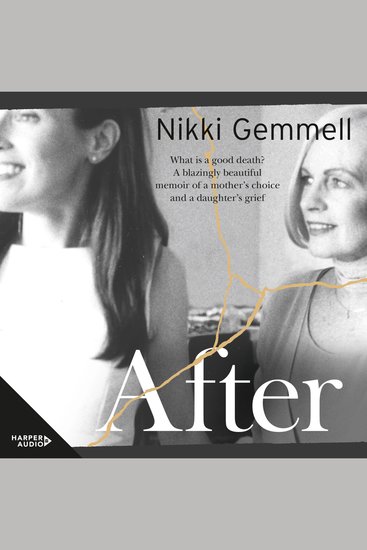
  • After - cover

    After

    Nikki Gemmell

    • 0
    • 0
    • 0
    Australia's bravest and most honest writer explores the devastating aftermath of her elderly mother's decision to end her own life. 
     Nikki Gemmell's world changed forever in October 2015 when the body of her elderly mother was found and it became clear she had decided to end her own life. After the immediate shock and devastation came the guilt and the horror, for Nikki, her family, relatives and friends. No note was left, so the questions that Elayn's death raised were endless. Was the decision an act of independence or the very opposite? Was it a desperate act driven by hopelessness and anger, or was her euthanasia a reasoned act of empowerment?After is the story of Elayn Gemmell - and the often difficult, prickly relationship between mothers and daughters, and how that changes over time. As anguished as it truthful, as powerful as it is profound, After is about life, death, elderly parents, mothers and daughters, hurt and healing, and about how little, sometimes, we know the ones we love the most.A deeply intimate, fiercely beautiful, blazingly bold and important book.'A bold work of nonfiction ... a work that will raise questions and start conversations' Bookseller + Publisher'Compassion, humanity and love shines through every page' Caroline Overington
    Ver livro
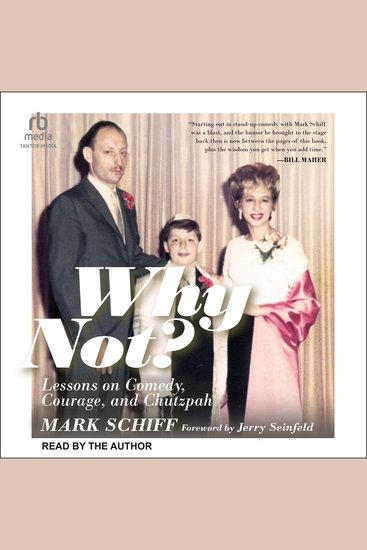
  • Why Not? - Lessons on Comedy Courage and Chutzpah - cover

    Why Not? - Lessons on Comedy...

    Mark Schiff, Jerry Seinfeld

    • 0
    • 0
    • 0
    From master comedian Mark Schiff, a long-time touring partner of Jerry Seinfeld, comes a hilarious account of decades of foolery with comedy and acting legends and how he honed his mensch skills in all of life's arenas. 


    Pursuing a career in comedy has always taken a lot of chutzpah. Today Mark Schiff looks back at his fifty-year career as a stand-up comic, actor, and writer and knows he's laughed with the best of them. His comedy and character have been widely praised by everyone from Jerry Seinfeld to Bill Maher, Paul Reiser, and Colin Quinn—as Seinfeld writes in his foreword, Mark is "the greatest comedy pal a guy could ever wish for"—but it hasn't always been easy. 


    In this brilliantly honest collection of essays inducing both heart tugs and deep belly laughs, Mark recounts growing up Jewish in the outer boroughs of New York City and shares how he survived a harrowing childhood and managed health crises, aging, marriage, parenting, and career highs and lows. With wit and wisdom, Mark reminds us that no matter the troubles at-hand, the show must always go on. The result is an unforgettable and highly relatable account from one of the best humor writers of our time that will leave listeners of all faiths energized and feeling like they've schmoozed with the best of them.
    Ver livro
  • Hitler's Girl - The British Aristocracy and the Third Reich on the Eve of WWII - cover

    Hitler's Girl - The British...

    Lauren Young

    • 0
    • 0
    • 0
    A timely, riveting book that presents for the first time an alternative history of 1930s Britain, revealing how prominent fascist sympathizers nearly succeeded in overturning British democracy—using the past as a road map to navigate the complexities of today’s turn toward authoritarianism. 
    Hitler’s Girl is a groundbreaking history that reveals how, in the 1930s, authoritarianism nearly took hold in Great Britain as it did in Italy and Germany. Drawing on recently declassified intelligence files, Lauren Young details the pervasiveness of Nazi sympathies among the British aristocracy, as significant factions of the upper class methodically pursued an actively pro-German agenda. She reveals how these aristocrats formed a murky Fifth Column to Nazi Germany, which depended on the complacence and complicity of the English to topple its proud and long-standing democratic tradition—and very nearly succeeded. 
    As she highlights the parallels to our similarly treacherous time, Young exposes the involvement of secret organizations like the Right Club, which counted the Duke of Wellington among its influential members; the Cliveden Set, which ran a shadow foreign policy in support of Hitler; and the shocking four-year affair between socialite Unity Mitford and Adolf Hitler. 
    Eye-opening and instructive, Hitler’s Girl re-evaluates 1930s England to help us understand our own vulnerabilities and poses urgent questions we must face to protect our freedom. At what point does complacency become complicity, posing real risk to the democratic norms that we take for granted? Will democracy again succeed—and will it require a similarly cataclysmic event like World War II to ensure its survival? Will we, in our own defining moment, stand up for democratic values—or will we succumb to political extremism? 
    Supplemental enhancement PDF accompanies the audiobook.
    Ver livro