Junte-se a nós em uma viagem ao mundo dos livros!
Adicionar este livro à prateleira
Grey
Deixe um novo comentário Default profile 50px
Grey
Assine para ler o livro completo ou leia as primeiras páginas de graça!
All characters reduced
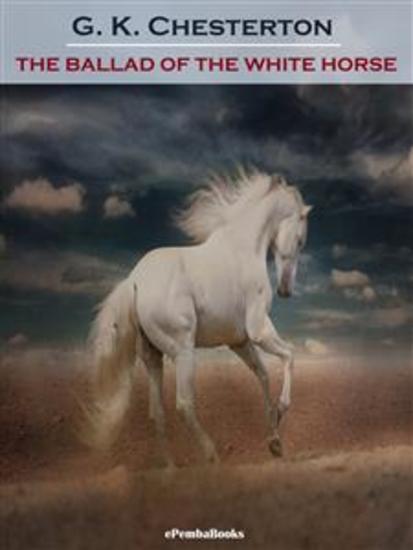
The Ballad of the White Horse (Annotated) - cover
LER

The Ballad of the White Horse (Annotated)

G. K. Chesterton

Editora: ePembaBooks

  • 0
  • 0
  • 0

Sinopse

This edition includes the following editor's introduction: G. K. Chesterton, the man beyond the writer


Originally published in 1911, "The Ballad of the White Horse" is a poem by G. K. Chesterton about the idealised exploits of the Saxon King Alfred the Great and is considered to be his best work of poetry.

Written in ballad form, "The Ballad of the White Horse" tells the story of how the King defeated the invading Danes at the Battle of Ethandun in the Valley of the White Horse, beneath an ancient equine image on the Berkshire hills.

This epic ballad has been described as one of the last great traditional epic poems ever written in the English language.
Disponível desde: 16/08/2022.

Outros livros que poderiam interessá-lo

  • Purgatory - cover

    Purgatory

    Daniel Ruczko

    • 0
    • 0
    • 0
    Abigail, a children's book author haunted by past traumas, returns to her childhood home to care for her ailing father, who is suffering from Alzheimer's. 
    Shortly after her arrival, she is thrust into a nightmarish reality as she uncovers chilling family secrets. 
    Her journey becomes an intense battle for sanity, pulling her into a confrontation with her deepest fears and long-buried traumas. As she pieces together the past, she realizes her family's legacy is entwined with something far more sinister, leaving her to question what's real and what lies in the shadows of her mind. 
    This isn't a story about monsters in the closet. It's about the ones that linger behind your eyelids when you're too terrified to sleep. Within her father's unraveling mind and the suffocating walls of her childhood home, she senses something rotting, something watching. Each sleepless night pulls her deeper into a fractured reality where memory and hallucination blur, unearthing horrors that refuse to stay buried. 
    Relentlessly unsettling, Purgatory is a horror story without mercy-an exploration of memory, identity, and the terrifying possibility that once you've crossed certain lines, there's no coming back. The end of daze.
    Ver livro
  • HOMER: The Iliad & the Odyssey - cover

    HOMER: The Iliad & the Odyssey

    Homer

    • 0
    • 0
    • 0
    Nearly three thousand years after they were composed, The Iliad and The Odyssey remain two of the most celebrated and widely read stories ever told, yet next to nothing is known about their author. He was certainly an accomplished Greek bard, and he probably lived in the late eighth and early seventh centuries BCE Authorship is traditionally ascribed to a blind poet named Homer, and it is under this name that the works are still published. Greeks of the third and second centuries BCE, however, already questioned whether Homer existed and whether the two epics were even written by a single individual. 
    Most modern scholars believe that even if a single person wrote the epics, his work owed a tremendous debt to a long tradition of unwritten, oral poetry. Stories of a glorious expedition to the East and of its leaders’ fateful journeys home had been circulating in Greece for hundreds of years before The Iliad and The Odyssey were composed. Casual storytellers and semiprofessional minstrels passed these stories down through generations, with each artist developing and polishing the story as he told it. According to this theory, one poet, multiple poets working in collaboration, or perhaps even a series of poets handing down their work in succession finally turned these stories into written works, again with each adding his own touch and expanding or contracting certain episodes in the overall narrative to fit his taste.
    Ver livro
  • A Rhyme A Dozen ― Cats - 12 Poets 12 Poems 1 Topic - cover

    A Rhyme A Dozen ― Cats - 12...

    Edward Lear, W B Yeats, Percy...

    • 0
    • 0
    • 0
    ‘A dime a dozen’ as known in America, is perhaps equal to the English ‘cheap as chips’ but whatever the lingua franca of your choice in this series we hereby submit ‘A Rhyme a Dozen’ as 12 poems on many given subjects that are a well-rounded gathering, maybe even an essential guide, from the knowing pens of classic poets and their beautifully spoken verse to the comfort of your ears. 
    1 - A Rhyme a Dozen - 12 Poets, 12 Poems , 1 Topic.  Cats - An Introduction 
    2 - The Owl and the Pussycat by Edward Lear 
    3 - The Rat-Catcher and Cats by John Gay 
    4 - The Cat and the Old Rat by Jean de la Fontaine 
    5 - Verses on a Cat by Percy Bysshe Shelley 
    6 - The Cat by Charles Baudelaire 
    7 - The Cat and the Moon by W B Yeats 
    8 - Milk For the Cat by Harold Munro 
    9 - The Cats Have Come to Tea by Kate Greenaway 
    10 - The Vain Cat by Ambrose Bierce 
    11 - Mrs Reynold's Cat by John Keats 
    12 - To My Cat by Rosamund Marriott Watson 
    13 - An Oxford Don Curses His Cat by Thomas Master
    Ver livro
  • The Milk Hours - Poems - cover

    The Milk Hours - Poems

    John James

    • 0
    • 0
    • 0
    Winner of the Max Ritvo Poetry Prize, The Milk Hours is an elegant debut that searches widely to ask what it means to exist in a state of loss. 
    “We lived overlooking the walls overlooking the cemetery.” So begins the title poem of this collection, whose recursive temporality is filled with living, grieving things, punctuated by an unseen world of roots, bodies, and concealed histories. Like a cemetery, too, The Milk Hours sets unlikely neighbors alongside each other: Hegel and Murakami, Melville and the Persian astronomer al-Sufi, enacting a transhistorical poetics even as it brims with intimacy. These are poems of frequent swerves and transformations, which never stray far from an engagement with science, geography, art, and aesthetics, nor from the dream logic that motivates their incessant investigations. 
    Indeed, while John James begins with the biographical—the haunting loss of a father in childhood, the exhausted hours of early fatherhood—the questions that emerge from his poetic synthesis are both timely and universal: what is it to be human in an era where nature and culture have fused? To live in a time of political and environmental upheaval, of both personal and public loss? How do we make meaning, and to whom—or what—do we turn, when such boundaries so radically collapse?
    Ver livro
  • The Poetry of Edith Wharton - Pulitzer prize winning author Wharton known for novels such as Age Of Innocence and Ethan Frome was a woman of many talents an expert poet aswell we explore a wonderful selection here - cover

    The Poetry of Edith Wharton -...

    Edith Wharton

    • 0
    • 0
    • 0
    Edith Newbold Jones was born in New York on 24th January 1862.   Born into wealth, this background of privilege gave her a wealth of experience to eventually, after several false starts, produce many works based on it culminating in her 1921 Pulitzer Prize winning novel ‘The Age of Innocence’ 
     
    Marriage to Edward Robbins Wharton, who was 12 years her senior in 1885 seemed to offer much and for some years they travelled extensively.  After some years it was apparent that her husband suffered from acute depression and so the travelling ceased and they retired to ‘The Mount’, their estate designed by Edith.  By 1908 his condition was said to be incurable and prior to divorcing Edward in 1913 she began an affair, in 1908, with Morton Fullerton, a Times journalist, who was her intellectual equal and allowed her writing talents to push forward and write the novels for which she is so well known.  
     
    Acknowledged as one of the great American writers Wharton was also a dazzling though largely unrecognised poet.  Her talents allowed her to create poems that both capture and explore many situations of life and society.  
     
    Edith Wharton died of a stroke in 1937 at the Domaine Le Pavillon Colombe, her 18th-century house on Rue de Montmorency in Saint-Brice-sous-Forêt, in France. 
     
    1 - The Poetry of Edith Wharton - An Introduction 
    2 - Terminus by Edith Wharton 
    3 - Some Busy Hands by Edith Wharton 
    4 - A Failure by Edith Wharton 
    5 - A Hunting Song by Edith Wharton 
    6 - Happiness by Edith Wharton 
    7 - Mould and Vase by Edith Wharton 
    8 - Jade by Edith Wharton 
    9 - Aeropagus by Edith Wharton 
    10 - Non Dolet by Edith Wharton 
    11 - Botticlelli’s Madonna in the Louvre by Edith Wharton 
    12 - Patience by Edith Wharton 
    13 - The Comrade by Edith Wharton 
    14 - Mona Lisa by Edith Wharton 
    15 - Life by Edith Wharton 
    16 - The Bread of Angels by Edith Wharton 
    17 - Chartres by Edith Wharton 
    18 - Survival by Edith Wharton 
    19 - All Saints by Edith Wharton 
    20 - All Souls by Edith Wharton 
    21 - The Young Dead by Edith Wharton 
    22 - Belgium by Edith Wharton 
    23 - Battle Sleep by Edith Wharton 
    24 - Experience by Edith Wharton 
    25 - A Torchbearer by Edith Wharton 
    26 - A Grave by Edith Wharton 
    27 - An Autumn Sunset by Edith Wharton 
    28 - Grief by Edith Wharton
    Ver livro
  • Canopy - Poems - cover

    Canopy - Poems

    Linda Gregerson

    • 0
    • 0
    • 0
    A long-awaited yet startlingly urgent new collection from “a contemporary master”*—a fierce, big-hearted eye on our last, tumultuous decade, and our fragile environment *Los Angeles Review of Books Linda Gregerson’s long-awaited new collection is a tour de force, a compendium of lives touched by the radical fragility of the planet and, ultimately, the endless astonishment and paradox of being human within the larger ecosystem, “in a world where every breath I take is luck.” From the Syrian refugee and ecological crises, to police brutality and COVID, to the Global Seed Vault buried under permafrost, the poems ask: How does consciousness relate to the individual body, the individual to the communal, the community to our environment? How do we mourn a loved one, and how do we mourn strangers? The magnificent poems in Canopy catalogue and reckon with humanity and the natural world, mortality, rage, love, grief, and survival.
    Ver livro