

¡Acompáñanos a viajar por el mundo de los libros!
Añadir este libro a la estantería
Grey
Escribe un nuevo comentario Default profile 50px
Grey
Suscríbete para leer el libro completo o lee las primeras páginas gratis.
All characters reduced
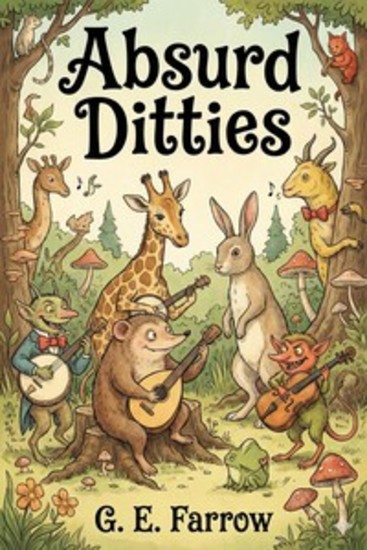
Absurd Ditties - cover

Absurd Ditties

G. E. Farrow

Editorial: Bu Classics Books

  • 0
  • 0
  • 0

Sinopsis

Dive into a whimsical world where logic is abandoned for the sake of rhyme and rhythm. Fantastic creatures and eccentric characters dance through pages filled with clever nonsense and playful satire. The humor is sharp, mocking the absurdities of daily life through a lens of delightful chaos. A lighthearted escape for those who appreciate the wit of the unexpected.
Disponible desde: 04/03/2026.
Longitud de impresión: 79 páginas.
Otros libros que te pueden interesar

  • Sketches Of The Fair Sex - cover

    Sketches Of The Fair Sex

    Anonymous

    • 0
    • 0
    • 0
    Sketches of the fair sex, in all parts of the world. To which are added rules for determining the precise figure, the degree of beauty, the habits, and the age of women, notwithstanding the aids and disguise of dress. It is our design to present a pleasing and interesting miscellany, which will serve to beguile the leisure hour, and will at the same time couple instruction with amusement. We have used but little method in the arrangement: Choosing rather to furnish the reader with a rich profusion of narratives and anecdotes, all tending to illustrate the FEMALE CHARACTER, to display its delicacy, its sweetness, its gentle or sometimes heroic virtues, its amiable weaknesses, and strange defects—than to attempt an accurate analysis of the hardest subject man ever attempted to master, viz—WOMAN. (Summary from the book)
    Ver libro
  • The Witch of Exmoor - cover

    The Witch of Exmoor

    Margaret Drabble

    • 0
    • 1
    • 0
    A Los Angeles Times Best Book of the Year: “Part social satire, part thriller, and entirely clever” (Elle).   It is a midsummer’s evening in the English countryside, and the three grown Palmer children are coming to the end of an enjoyable meal in the company of their partners and offspring. From this pleasant vantage point they play a dinner-party game: What kind of society would you be willing to accept if you didn’t know your place in it? But the abstract question of justice, like all their family conversations, is eventually brought back to the more pressing problem of their eccentric mother, Frieda, the famous writer, who has abandoned them and her old life, and gone to live alone in Exmoor.   Frieda has always been a powerful and puzzling figure, a monster mother with a mysterious past. What is she plotting against them now? Has some inconvenient form of political correctness led her to favor her enchanting half-Guyanese grandson? What will she do with her money? Is she really writing her memoirs? And why has she disappeared? Has the dark spirit of Exmoor finally driven her mad?  The Witch of Exmoor brilliantly interweaves high comedy and personal tragedy, unraveling the story of a family whose comfortable, rational lives, both public and private, are about to be violently disrupted by a succession of sinister, messy events. “Leisurely and mischievous,” it is a dazzling, wickedly gothic tale of a British matriarch, her three grasping children, and the perils of self-absorption (The New Yorker).   “As meticulous as Jane Austen, as deadly as Evelyn Waugh.” —Los Angeles Times
    Ver libro
  • Poison in the Pansies - cover

    Poison in the Pansies

    Dale Mayer

    • 0
    • 0
    • 0
    Book 16: Lovely Lethal GardensRiches to rags … Chaos has calmed … At least while out on the lake … Until poison is found, blowing up the peace again …​​​​​​​Enjoying a beautiful day on the lake, while Doreen tries her hand at paddleboarding, ends up on an odd note after finding poison in a bed of pansies. She garners a tidbit of information out of her BFF, Corporal Mack Moreau, about a man who’d recently walked into the emergency room, complaining he’d been poisoned.Only on a threat of good behavior (surely it doesn’t count if given under duress), Doreen agrees to stay out of his case. But, as it happens, the mention of poison to her beloved Nan brings up another recent death and an old woman who’d been saying someone was poisoning her for months. Only no one listened. Now she is dead.When Doreen’s case and Mack’s collide, she’s delighted, and so is he. Not. But, when Nan decides to join in the sleuthing, with her pal, Richie, it’s Doreen’s turn to worry—and with good reason!
    Ver libro
  • Absalom and Achitophel - cover

    Absalom and Achitophel

    John Dryden

    • 0
    • 0
    • 0
    John Dryden published Absalom and Achitophel: A Poem in 1681. It is an elaborate historical allegory using the political situation faced by King David (2 Samuel 14-18) to mirror that faced by Charles II. Each monarch had a son whom a high-ranking minister attempted to use against him. James Scott, first Duke of Monmouth, Charles II's illegitimate son, was detected planning a rebellion late in 1681, supposedly instigated by the Earl of Shaftesbury, who was tried for high treason, and it is believed that Dryden wrote the poem in an effort to sway the jury in his trial. The fates of both Absalom (Monmouth) and Achitophel (Shaftesbury) are left unspecified at the end of the poem (Monmouth did rebel in 1685, after his father's death, and was executed, and Shaftesbury was acquitted), but we are left to surmise that their fates would resemble those of their Biblical counterparts: Absalom was killed against David's instructions and Achitophel hanged himself.The poem can be enjoyed without any special knowledge of either the Bible or seventeenth-century English history, but it is useful to understand why Monmouth (AKA Absalom) was such a useful tool to use against his father: Charles had many illegitimate offspring, but his wife was barren, so at his death the crown would pass (did pass) to his brother, James, who was Catholic, but Monmouth was Protestant as well as well-beloved by both the king and the people. England had good reason to dread a return of officially enforced Catholicism. The narrator's urbane attitude toward David's amatory adventures in the opening of the poem and his burlesque of the supposed Jebusitical plot (the "Popish Plot" of 1678) establish clearly his Tory bias in favor of the Establishment and his disdain of the panic caused by fear of Catholicism (Dryden himself converted to the Catholic faith at some time before 1685).
    Ver libro
  • In a Steamer Chair and Other Stories - cover

    In a Steamer Chair and Other...

    Robert Barr

    • 0
    • 0
    • 0
    Thirteen short stories by one of the most famous writers in his day. Robert Barr was a British Canadian short story writer and novelist, born in Glasgow, Scotland. In London of the 1890s Barr became a more prolific author - publishing a book a year - and was familiar with many of the best selling authors of his day, including Bret Harte and Stephen Crane. Most of his literary output was of the crime genre, then quite in vogue. When Arthur Conan Doyle's Sherlock Holmes stories were becoming well known, Barr published in the Idler the first Holmes parody, "The Adventures of Sherlaw Kombs" (1892), a spoof that was continued a decade later in another Barr story, "The Adventure of the Second Swag" (1904)(For these two stories, see in LibriVox Barr's The Triumphs of Eugène Valmont). Despite the jibe at the growing Holmes phenomenon Barr and Doyle remained on very good terms. Doyle describes him in his memoirs Memories and Adventures as, "a volcanic Anglo - or rather Scot American, with a violent manner, a wealth of strong adjectives, and one of the kindest natures underneath it all." (Summary by Wikipedia and David Wales)
    Ver libro
  • A Genie Ruins Everything - cover

    A Genie Ruins Everything

    Martina Fetzer

    • 0
    • 0
    • 0
    Phenomenal Cosmic Power... Itty Bitty Moral Compass. 
    With paranormal activity at an all-time high, Arturo Brooks and Edward Smith decide to stop working for others and form their own paranormal detective agency. They're not the only ones. The market is saturated, and they struggle to find even a single client. 
    That changes following a chance encounter with a genie that doesn't grant wishes so much as do whatever the hell it wants. The detectives' reality is completely upended—for better and worse. Better for them. Worse for the world. 
    Brooks and Smith have to set things right, but their attempts at doing so are complicated by a genie-thieving venture capitalist, self-sabotage, and a newer, stupider detective in town. Some wishes really can’t come true. 
    About the Series 
    From the mind of award-winning author* Martina Fetzer, the Brooks & Smith series brings fast-paced science fiction and fantasy with an emphasis on humor. It follows two detectives and their makeshift family on a series of increasingly absurd adventures. These books are often silly, sometimes dark, and never child friendly. A Genie Ruins Everything is Book #3. 
    *1996, 1997, 1998 Oakview Elementary Perfect Attendance Award 
    About the Audiobook 
    Narrated by James Urbaniak (The Venture Bros., Difficult People), A Genie Ruins Everything is guaranteed to induce laughter. Real laughter. Not just a slight exhale. It is not recommended that you listen while chopping down a tree, conducting a train carrying radioactive waste, or anything else requiring intense focus.
    Ver libro
