Junte-se a nós em uma viagem ao mundo dos livros!
Adicionar este livro à prateleira
Grey
Deixe um novo comentário Default profile 50px
Grey
Assine para ler o livro completo ou leia as primeiras páginas de graça!
All characters reduced
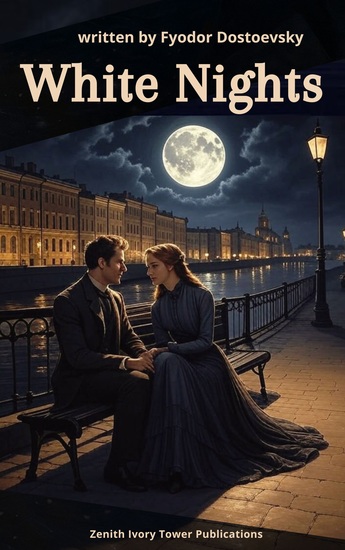
White Nights - A Poetic Tale of Loneliness Love and Fleeting Dreams in St Petersburg - cover
LER

White Nights - A Poetic Tale of Loneliness Love and Fleeting Dreams in St Petersburg

Fyodor Dostoevsky, Zenith Ivory Tower Publications

Editora: Zenith Ivory Tower Publications

  • 0
  • 0
  • 0

Sinopse

One city. Four nights. A dreamer's heart waiting to awaken.
In White Nights, Fyodor Dostoevsky delivers one of the most tender and emotionally resonant love stories in classic literature—a gentle exploration of longing, illusion, and the ache of solitude.

Set against the hauntingly beautiful backdrop of St. Petersburg's "white nights," where the summer sky never truly darkens, the story follows a lonely, nameless narrator who meets a young woman named Nastenka. Over the course of four magical evenings and one wistful morning, the two strangers open their hearts, sharing their dreams, fears, and silent sorrows.

First published in 1848, this early work by Dostoevsky showcases the raw sensitivity and psychological insight that would later define his masterpieces. White Nights is a story for every hopeless romantic and quiet soul who has ever wandered the night hoping to be seen.

"A delicate, aching portrait of loneliness and love unfulfilled." — The Paris Review
"Dostoevsky at his most romantic and human." — Literary Hub
"A timeless short story that captures the beauty of brief connection." — Goodreads Reviewer

Perfect for lovers of classic romance, Russian literature, and introspective storytelling, White Nights is a bittersweet gem that lingers long after the final page.

Click 'Buy Now' and lose yourself in a fleeting romance beneath the midnight sun.
Disponível desde: 24/07/2025.
Comprimento de impressão: 160 páginas.
Outros livros que poderiam interessá-lo

  • Top 10 Short Stories The - The Mad Scientist - The top ten short stories about mad scientists - cover

    Top 10 Short Stories The - The...

    Robert Louis Stevenson, Jack...

    • 0
    • 0
    • 0
    Short stories have always been a sort of instant access into an author’s brain, their soul and heart.  A few pages can lift our lives into locations, people and experiences with a sweep of landscape, narration, feelings and emotions that is difficult to achieve elsewhere. 
     
    In this series we try to offer up tried and trusted ‘Top Tens’ across many different themes and authors. But any anthology will immediately throw up the questions – Why that story? Why that author?  
     
    The theme itself will form the boundaries for our stories which range from well-known classics, newly told, to stories that modern times have overlooked but perfectly exemplify the theme.  Throughout the volume our authors whether of instant recognition or new to you are all leviathans of literature. 
     
    Some you may disagree with but they will get you thinking; about our choices and about those you would have made.  If this volume takes you on a path to discover more of these miniature masterpieces then we have all gained something. 
     
    In this volume the Mad Scientist takes centre stage.  Naturally the stories come in all shapes and sizes and in the pens of our classic authors the scientists more usually arrive as dark, twisted and evil as they go about their work illuminating humanity as only a mad scientist can. 
     
    1 - The Top 10 Short Stories - Mad Scientists - An Introduction 
    2 - The Strange Case of Dr Jekyll & Mr Hyde - Part 1 by Robert Louis Stevenson 
    3 - The Strange Case of Dr Jekyll & Mr Hyde - Part 2  by Robert Louis Stevenson 
    4 - A Thousand Deaths by Jack London 
    5 - A Diagnosis of Death by Ambrose Bierce 
    6 - The Facts In The Case of Monsieur Valdemar by Edgar Allan Poe 
    7 - The Mortal Immortal by Mary Shelley 
    8 - Carnivorine by Lucy Hamilton Hooper 
    9 - The Man Without a Body by Edward Page Mitchell 
    10 - Rappaccini's Daughter - Part 1 by Nathaniel Hawthorne 
    11 - Rappaccini's Daughter - Part 2 by Nathaniel Hawthorne 
    12 - The Blue Laboratory by L T Meade 
    13 - Herbert West - Reanimator - Part 1 by H P Lovecraft 
    14 - Herbert West - Reanimator - Part 2 by H P Lovecraft
    Ver livro
  • Evening Guest An - From their pens to your ears genius in every story - cover

    Evening Guest An - From their...

    Alexander Kuprin

    • 0
    • 0
    • 0
    Alexander Kuprin was born in Narovchat, Penza in Russia on 7th September 1870. 
    At 3 his Father died and he and mother moved to Moscow. By 10 he was enrolled at the Second Moscow Military High School and there his interest in literature began. The Alexander Military Academy followed and two years later he was a sub-lieutenant and posted to an Infantry Regiment for a further four years. 
    Despite his duties he was a now a keen writer and published his first short story at this time. His military duties also garnered him experiences for his breakthrough work ‘The Duel’.  Leaving the military he left for Kiev to work for local newspapers.  He continued to publish both stories and novels and by 1901 he was in St Petersburg becoming part of a group that included Chekhov, Ivan Bunin, Maxim Gorky and Leonid Andreyev.  
    In the years that followed further controversial works and acclaim followed.  His comments on the regime meant he was also put under secret police surveillance.   
    As World War I erupted, Kuprin opened a military hospital but was then given command of an infantry company in Finland. He was soon discharged on grounds of ill health.  
    The October Revolution saw him praise Lenin, but he warned that the Bolsheviks threatened Russian culture and might cause further widespread suffering to the peasants.  As Civil War raged he took his family to Helsinki and then on to Paris. 
    Exile saw his talents decline further and his succumbing to alcoholism. He became lonely and withdrawn. The family's poverty increased his malaise.   
    In May 1937, the Kuprin’s returned to Moscow.  He now saw his work published but wrote almost nothing new.  In 1938 his health rapidly deteriorated.  Already suffering from a kidney problems and sclerosis, he had now developed cancer of the oesophagus.  
    Alexander Kuprin died on 25th August 1938.
    Ver livro
  • A Daemon in Jade - A Short Horror Story - cover

    A Daemon in Jade - A Short...

    Michael van der Voort

    • 0
    • 0
    • 0
    What is evil? Is it simply a concept, a description applied to the actions of men or to incidents that impact them or is it something more? An external force eternal and ever present that can weave itself in slithering pathways into our thoughts and deeds? Is it possible for instance, for an object to be evil? For it to reek, on a level detectable beyond our normal senses of corruption, or wickedness and of rot? could it leave upon the skin and the mind like a residue a clinging film of something that is not only older than man but hateful of him? 
    These are the questions that circulate around the Daemon in Jade, the massive sculpture that the ancients chose to bury head down and disregard. Not simply forgetting, but deliberately, purposely shunning the hideous thing as wretched and unclean.
    Ver livro
  • The Prussian Officer - cover

    The Prussian Officer

    D H Lawrence

    • 0
    • 0
    • 0
    'The Prussian Officer'. There is an anti-militarism theme, unpopular as the nation drew near to war and an examination of latent homosexuality as the officer in the story struggles with his feelings for his orderly. The young soldier is driven beyond breaking point but finds a kind of redemption in his final return to natural surroundings and, symbolically, he finds equality in death with his tormentor as they are put side by side in the mortuary.
    Ver livro
  • A Wicked Woman - From their pens to your ears genius in every story - cover

    A Wicked Woman - From their pens...

    Jack London

    • 0
    • 0
    • 0
    John Griffith Chaney was born on January 12th, 1876 in San Francisco.   
    His father, William Chaney, was living with Flora Wellman when she became pregnant.  Chaney insisted she have an abortion.  Flora's response was to turn a gun on herself.  Although her wounds were not severe the trauma made her temporarily deranged. 
    In late 1876 his mother married John London and the young child was brought to live with them as they moved around the Bay area, eventually settling in Oakland where now, calling himself Jack, he completed grade school. 
    Jack worked hard at several jobs, sometimes 12-18 hours a day, but his dream was university.  He studied hard and borrowed the money to enrol in the summer of 1896 at the University of California in Berkeley. 
    In 1897, at 21, Jack searched out newspaper accounts of his mother's suicide attempt and for the name of his biological father. He wrote to Chaney, then living in Chicago, who claimed he could not be Jack’s father because he was impotent and casually asserted that London's mother had relations with other men.  Jack, devastated by the response, quit Berkeley and went to the Klondike. Other accounts suggest that his dire finances presented Jack with the excuse he needed to leave. 
    In the Klondike Jack began to gather material for his writing but also accumulated many health problems, including scurvy, which together with hip and leg problems he would carry for the rest of his life. 
    During the late 1890's Jack was regularly publishing short stories and by the turn of the century full blown novels. 
    By 1904 Jack had married, fathered two children and was now in the process of divorcing.  A stint as a reporter on the Russo-Japanese war of 1904 was equal amounts trouble and experience. But that experience was always put to good use in a continuing and remarkable output of work. 
    In 1905 he married Charmian Kittredge who at last was a soul and companion who brought him some semblance of peace despite his advancing alcoholism and his incurable wanderlust. 
    Twelve years later Jack had amassed both wealth and a literary reputation through such classics as ‘The Call of the Wild’, ‘White Fang’ and many others. He had a reputation as a social activist and was a tireless friend of the workers.   
    Jack London died suffering from dysentery, late-stage alcoholism and uremia, aged only 40, on November 22nd 1916 at his property in Glen Elen in California.
    Ver livro
  • A Fragment of Stained Glass - From their pens to your ears genius in every story - cover

    A Fragment of Stained Glass -...

    D H Lawrence

    • 0
    • 0
    • 0
    David Herbert Lawrence was born on the 11th September 1885 in Eastwood, Nottinghamshire, a coal mining town where the reality of a harsh life was only useful as experiences for future literary works. 
    He was educated at Beauvale Board School and became the first local boy to receive a scholarship to attend Nottingham High School. After 3 years he became a junior clerk in Haywood’s surgical appliances factory. He was also attempting a literary career which, in the short term, led to a teacher training position in Eastwood and later a teaching qualification from University College, Nottingham.  
    Lawrence’s first efforts were poems, short stories and a draft of ‘The White Peacock’. Moving to London and a teaching position in Croydon his writing attracted the attention of Ford Madox Ford, editor of The English Review, and he commissioned him to write ‘Odour of Chrysanthemums’.  
    Wanting to write full-time he now began work on what would become ‘Sons and Lovers.   
    In 1912 he met the older and married mother-of-three Frieda Weekley. They eloped to Germany and here Lawrence could see for himself the growing tensions with France.  So keen was his interest that he was arrested and accused of being a British spy.  
    In early 1914 Frieda obtained her divorce and they returned to Britain to be married just days before the outbreak of war. Owing to her German parentage, and his own public dislike of militarism and violence, the couple were treated with contempt and suspicion throughout the war years.  
    Despite this he continued to write but his reputation in England was so tarnished and, mirrored by his own disdain for the country, he and Frieda left England in November 1919, first for Europe and then America via Ceylon and Australia. 
    They bought a ranch in Taos, New Mexico and visited Mexico several times. The third visit in March 1925 caused a near fatal attack of malaria. To convalesce they moved to Florence. Here he continued work on ‘Lady Chatterley’s Lover’ which for many years would cause controversy. A renewed interest in oil painting resulted in an exhibition in 1929 which was raided by the police and several works were confiscated.  
    D H Lawrence died of complications arising from a bout of tuberculosis on the 2nd of March 1930 in Vence, France.  He was 44.
    Ver livro