Join us on a literary world trip!
Add this book to bookshelf
Grey
Write a new comment Default profile 50px
Grey
Subscribe to read the full book or read the first pages for free!
All characters reduced
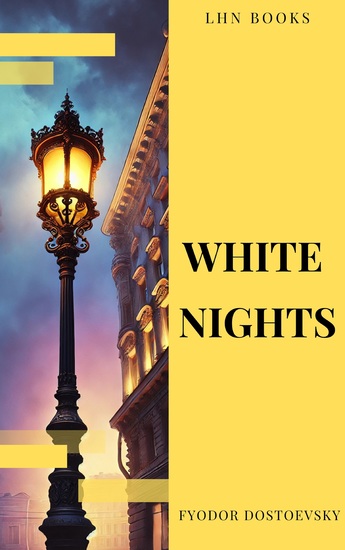
White Nights - A Haunting Tale of Love and Longing - Classic Dostoevsky Novella - cover

White Nights - A Haunting Tale of Love and Longing - Classic Dostoevsky Novella

Fyodor Dostoevsky, LHN Books

Publisher: LHN Books

  • 0
  • 0
  • 0

Summary

In the luminous summer nights of St. Petersburg, a story of impossible love unfolds that will forever change how you see the human heart.
Step into the world of Dostoevsky's most intimate and deeply moving novella, where four nights of chance encounters between a passionate dreamer and a young woman searching for happiness become a powerful exploration of love, loneliness, and the eternal human desire for connection.
This carefully crafted edition features:
✓ New annotated content bringing 19th-century St. Petersburg to life
✓ Literary analysis helping you uncover deeper meanings
✓ Historical context that enriches your reading experience
✓ Thoughtful translation preserving Dostoevsky's masterful prose
Praised by The Guardian as "a perfect gateway to Dostoevsky's greater works," White Nights showcases the author's genius for psychological insight in a concise, deeply moving tale that can be read in a single sitting.
Join the millions of readers who have discovered why Dostoevsky remains one of literature's most compelling voices. Whether you're a longtime fan of Russian literature or new to classical fiction, this edition offers a fresh perspective on a timeless story.
Experience the summer nights that changed literature forever. Click 'Buy Now' to begin your journey into one of the most beautiful love stories ever written.
Available since: 01/14/2025.
Print length: 90 pages.

Other books that might interest you

  • Frankenstein - cover

    Frankenstein

    Mary Shelley

    • 0
    • 0
    • 0
    Frankenstein tells the story of Victor Frankenstein, a young scientist who creates a sapient creature in an unorthodox scientific experiment. Shelley started writing the story when she was 18, and the first edition was published anonymously in London on 1 January 1818, when she was 20. Her name first appeared in the second edition, which was published in Paris in 1821.Shelley travelled through Europe in 1815, moving along the river Rhine in Germany, and stopping in Gernsheim, 17 kilometres (11 mi) away from Frankenstein Castle, where, two centuries before, an alchemist had engaged in experiments.[note She then journeyed to the region of Geneva, Switzerland, where much of the story takes place. Galvanism and occult ideas were topics of conversation for her companions, particularly for her lover and future husband Percy B. Shelley. In 1816 Mary, Percy and Lord Byron had a competition to see who could write the best horror story. After thinking for days, Shelley was inspired to write Frankenstein after imagining a scientist who created life and was horrified by what he had made.Though Frankenstein is infused with elements of the Gothic novel and the Romantic movement, Brian Aldiss has argued for regarding it as the first true science-fiction story. In contrast to previous stories with fantastical elements resembling those of later science fiction, Aldiss states, the central character "makes a deliberate decision" and "turns to modern experiments in the laboratory" to achieve fantastic results. The novel has had a considerable influence on literature and on popular culture; it has spawned a complete genre of horror stories, films, and plays.Since the publication of the novel, the name "Frankenstein" has often been used, erroneously, to refer to the monster, rather than to his creator/father.
    Show book
  • 3 Stories - Without Character Names - A trio of classic tales perfect for a commute walk or quiet night in - cover

    3 Stories - Without Character...

    Edgar Allan Poe, Franz Kafka,...

    • 0
    • 0
    • 0
    There is something about the number 3.    
     
    The Ancient Greeks believed 3 was the perfect number, and in China 3 has always been a lucky number, and they know a thing or two.   
     
    Most religions also have 3 this and 3 that and, of course, in these more modern times, three’s a crowd may be too many, except when it’s a ménage à trois.  It seems good things usually come in threes. 
     
    Whatever history and culture says WE think 3, a hat-trick of stories, is a great number to explore themes and literary avenues that classic authors were so adept at creating. 
     
    From their pens to your your ears.   
     
    01 - 3 Stories - Stories Without Character Names 
    02 - In the Penal Colony by Franz Kafka 
    03 - The Lady, or the Tiger by Frank Stockton 
    04 - The Black Cat by Edgar Allan Poe
    Show book
  • A Legacy to Remember - Recollections of a Common Man - cover

    A Legacy to Remember -...

    Pamela K Orgeron

    • 0
    • 0
    • 0
    A Legacy to Remember: Recollections of a Common Man is the story of a man who rose above all odds stacked against him. The Great Depression, divorced parents, living in poverty, World War II, the death of a child, divorce, etc.—commonly known occurrences many individuals in American history have faced. Many people would have been bitter having lived through such tragedies. But not Duard Vinson Gillum! He not only survived but he thrived through his faith in God to become a wonderful family man with a successful career in the aeronautics industry, even working on the Apollo moon landing project and the space shuttle project.This biography follows Tiny’s autobiography, Recollections of a Common Man (Xlibris, 2011), self-published before his death with a final chapter and additional photos documenting Mr. Gillum’s life.Reared in Ashland, KY, during the Great Depression, Mr. Gillum's extended family of 11 occupied a three-room shack located next to the city dump. After the Depression, his family experienced the Great Flood of 1937, where many locales along the Ohio River, including Ashland, faced much devastation. When WWII started he had only completed a ninth-grade education before joining the navy, lying about his age.Following his honorable discharge from the navy after WWII ended, with only his ninth-grade education, Mr. Gillum became a well-accomplished career man in the aeronautics field while also volunteering in his community as a baseball coach for 18 years; that also included coaching his son.Referring to Mr. Gillum as a mere survivor is an understatement, to say the least. He thrived in the midst of adversity to overcome much tragedy while maintaining an optimistic attitude that reflected to others around him. No doubt Mr. Gillum touched a lot of lives. He also left a lot of life lessons that many individuals in today's society will glean from listening to A Legacy to Remember: Recollections of a Common Man.
    Show book
  • Half My Life - How Jesus Conquored My Soul - cover

    Half My Life - How Jesus...

    Thomas Murosky

    • 0
    • 0
    • 0
    How can I introduce my life without tipping my hand to enough detail that you will not need to the rest of this book? I am thinking this as I write the Introduction: Take Two. I wrote so much, and that which I wrote, I absolutely loved, but it was too much, it tipped my hand, it was a spoiler of the story to come. So I hit the delete key to write a simple message instead. 
    Within the pages of this book I will tell you my story. It’s a story of a latch-key kid born out of time; a boy who lived a latch-key life before that term was coined by social scientists concerned about all these kids coming home from school to an empty house. I am here to say that their fears are justified. Indeed, I agree that idle time is the Devil’s plaything, and my life shows how unsupervised children can become rotten to the core. I reject that we are blank slates waiting for moral input. If I was unsure of that as a child, I am convinced of it now, as I look back! 
    I do not mean to suggest that growing up with supervision will prevent us from being sinners, nor that every unsupervised child will grow up as I did, but rather, I want to show you the impact untempered sin has in a young boy’s life. I want to show you that growing up without God leads to a life of sin. I want to show you that sin begets sin. I want you to learn that following God is truly the most important thing you can do!
    Show book
  • The Bravest Scout at Gallipoli - cover

    The Bravest Scout at Gallipoli

    Ryan Butta

    • 0
    • 0
    • 0
    The many lives and tragic death of Harry Freame, the Anzac hero betrayed by his nation. 
     
    Harry Freame was the first Australian to win the Distinguished Conduct Medal at Gallipoli. Raised as a samurai, he risked his life again and again to scout the beaches and hills of the battlefield, reporting invaluable intelligence back to his officers and relieving stranded soldiers who otherwise would surely have died. Some say he should have got the VC but didn't because he was half-Japanese, a fact he tried hard to conceal. 
     
    After the war, Harry (real name Henry Wykeham Koba Freame) became a soldier settler and champion apple grower. But when Japan emerged as a perceived threat to Australia, Harry was recruited into Australian intelligence to spy on the Japanese community in Sydney. Before Japan's entry into World War II, Australia opened a diplomatic legation in Tokyo, and Harry was sent as a translator - but his real role was a spy. Extraordinarily, his cover was leaked by the Australian press, and the Japanese secret police tried to assassinate him not long after his arrival in Tokyo in 1941. Harry died back in Australia a few weeks later, but his sacrifice has never been acknowledged by Australia. 
     
    Until now. Featuring never-before-seen material, The Bravest Scout at Gallipoli is a fascinating and immersive investigation into a grievous historical wrong.
    Show book
  • Autonomy - Portrait of a Buzzcock - cover

    Autonomy - Portrait of a Buzzcock

    Steve Diggle

    • 0
    • 0
    • 0
    From bass player to lead guitarist, singer and last remaining founding member, Steve Diggle has been the driving force keeping Buzzcocks alive since he first met Pete Shelley in 1976. Together they would ignite the Manchester music scene, kickstart indie and become one of the best loved and most influential punk groups of all time. 
     
    Following Shelley's untimely death in 2018, Autonomy is Diggle's definitive inside account of their shared musical legacy and complex friendship through the band's rise, fall, and rise again - from their punk origins supporting Sex Pistols with original singer Howard Devoto to Top of the Pops, the excess of success, break-up, reformation and life beyond bereavement. 
     
    Funny, honest and touchingly philosophical, it is also Diggle's very personal story of working class escape, dreams, redemption and loss - an ultimately heroic survivor's tale from an irrepressible rock 'n' roll spirit.
    Show book