Junte-se a nós em uma viagem ao mundo dos livros!
Adicionar este livro à prateleira
Grey
Deixe um novo comentário Default profile 50px
Grey
Assine para ler o livro completo ou leia as primeiras páginas de graça!
All characters reduced
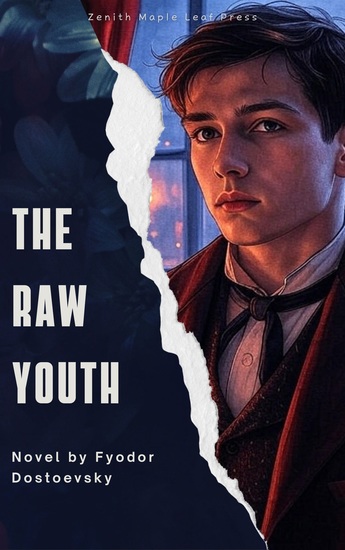
The Raw Youth - A Powerful Tale of Idealism Morality and the Struggles of the Human Spirit - cover
LER

The Raw Youth - A Powerful Tale of Idealism Morality and the Struggles of the Human Spirit

Fyodor Dostoevsky, Zenith Maple Leaf Press

Editora: Zenith Maple Leaf Press

  • 0
  • 0
  • 0

Sinopse

When youthful ideals collide with the complexities of life, the result is both inspiring and tragic.
Also known as The Adolescent, Fyodor Dostoevsky's The Raw Youth is a profound exploration of ambition, morality, and the search for purpose. The story follows Arkady Dolgoruky, a 19-year-old illegitimate son of a wealthy landowner, who dreams of achieving greatness through his self-proclaimed "idea." Yet his path is fraught with family conflict, romantic entanglements, and the stark realities of society.

First published in 1875, this novel blends Dostoevsky's signature psychological depth with themes of generational tension, personal honor, and the lure of material wealth. Through Arkady's journey, Dostoevsky examines the fragile line between youthful purity and the compromises of adulthood.

"A rich, complex, and deeply human portrait of youth's dreams and disillusionments."
– The Guardian

"Dostoevsky at his most introspective and philosophical."
– The New York Times

✅ Why Readers Love It:
🧠 A deep psychological portrait of a young man's inner world

🇷🇺 An essential work from one of Russia's greatest novelists

📚 Themes of identity, morality, and generational change

🎯 Click 'Buy Now' to discover Dostoevsky's masterful examination of youth, ambition, and the timeless struggle for meaning.
Disponível desde: 12/08/2025.
Comprimento de impressão: 368 páginas.
Outros livros que poderiam interessá-lo

  • The Thirty-Nine Steps - cover

    The Thirty-Nine Steps

    John Buchan

    • 0
    • 0
    • 0
    The Thirty-Nine Steps begins John Buchan’s series of spy novels featuring adventurer Richard Hannay. Having just returned from South Africa, he finds life dull until a mysterious American tells him about an assassination plot before being murdered in Hannay’s London flat. The obvious suspect, Hannay flees to his native Scotland pursued by the police and his ruthless enemies. His life and the security of Britain are seriously threatened, and it is vital to uncover the mystery behind ‘the thirty-nine steps’. Filled with suspense, unexpected twists, and fast-paced action, Buchan’s classic novel of 1915 has captivated readers for generations, laying the groundwork for the modern spy thriller genre and inspiring numerous film, TV, stage and radio versions. It is read by Rupert Degas, whose ‘quick-change brilliance’ in Patrick Barlow’s long-running stage adaptation was so highly praised.
    Ver livro
  • The Antichrist - cover

    The Antichrist

    Friedrich Nietzsche

    • 0
    • 0
    • 0
    Friedrich Nietzsche's "The Antichrist" is a philosophical work that presents his critical analysis of Christianity and its impact on Western culture. Written in 1888, towards the end of Nietzsche's productive life, "The Antichrist" reflects his deep-seated criticisms of traditional Christian values and morality. In the text, Nietzsche vehemently opposes what he sees as the life-denying aspects of Christianity. He argues that the Christian emphasis on otherworldly concerns, asceticism, and moral values such as humility and self-sacrifice are detrimental to the flourishing of human life. Nietzsche contends that Christianity has fostered a culture of weakness, passivity, and resentment, suppressing the natural instincts and drives that lead to individual strength and vitality. 
     
    "The Antichrist" also delves into Nietzsche's critique of the figure of Jesus Christ, whom he views as a symbol of weakness and a distortion of true strength. Nietzsche contends that the Christian notion of God represents a negation of life, promoting an idealized realm beyond this world at the expense of embracing earthly existence. Nietzsche's writing style in "The Antichrist" is often controversial and provocative, reflecting his desire to challenge established beliefs and provoke critical thinking. The work serves as a forceful critique of organized religion, morality, and the cultural influence of Christianity in Western societies. 
     
    It's essential to approach Nietzsche's "The Antichrist" within the broader context of his philosophical works, as it contributes to his overarching critique of morality, metaphysics, and the prevailing cultural values of his time. While the title may suggest a direct opposition to Christian beliefs, Nietzsche intends to provoke thought and encourage a reevaluation of existing values rather than presenting a straightforward condemnation.
    Ver livro
  • Haunted House The (Unabridged) - cover

    Haunted House The (Unabridged)

    Charles Dickens

    • 0
    • 0
    • 0
    "The Haunted House" is a story series published in 1859 for the weekly periodical All the Year Round. It was "Conducted by Charles Dickens", with Charles Dickens writing the opening and closing stories, framing stories by Dickens himself and five other authors.
    The story appeared in the Extra Christmas Number on 13 December 1859. Dickens began a tradition of Christmas publications with A Christmas Carol in 1843 and his Christmas stories soon became a national institution. The Haunted House was his 1859 offering.
    In Dickens's opening story, The Mortals in the House, the narrator's ("John") health "required a temporary residence in the country." Knowing this, a friend of the narrator had chanced to drive by the house-situated close to a railroad stop mid-way between Northern England and London-and had written to the narrator suggesting he travel down from the North and look the place over. It was a large mid-eighteenth-century manor house on two square acres with a "sadly neglected garden," recently cheaply repaired, and "much too closely and heavily shadowed by trees." The house itself is "stiff ... cold ... [and] formal" and "in as bad taste, as could possibly be desired by the most loyal admirer of the whole quartet of [King] Georges." It was "ill-placed, ill-built, ill-planned, and ill-fitted." It was "damp ... not free from dry rot" and redolent with the "flavour of rats."
    Ver livro
  • Around the World in Eighty Days - cover

    Around the World in Eighty Days

    Jules Verne

    • 0
    • 0
    • 0
    Embark on an exhilarating global adventure with Around the World in Eighty Days, Jules Verne’s beloved tale of determination, ingenuity, and the thrill of discovery. Follow the unflappable Phileas Fogg and his loyal servant, Passepartout, as they race against time to circumnavigate the world in just eighty days. Facing unexpected obstacles, from storms at sea to encounters with outlaws, Fogg’s remarkable journey tests their courage and resourcefulness at every turn. 
    Verne’s iconic story captures the spirit of the 19th-century age of exploration, blending suspense, humor, and a sense of wonder. Around the World in Eighty Days is an enduring classic that continues to inspire and entertain readers of all ages. 
    Narrated with energy and charm, this audiobook brings each locale and colorful character to life, making it the perfect listen for adventurers and dreamers alike. 
    Start listening to Around the World in Eighty Days today and join a whirlwind journey that spans the globe!
    Ver livro
  • Buddenbrooks - The Decline of a Family Part 2 - cover

    Buddenbrooks - The Decline of a...

    Thomas Mann

    • 0
    • 0
    • 0
    First published in 1900, when Thomas Mann was 25, Buddenbrooks is a minutely imagined chronicle of four generations of a North German mercantile family - a work so true to life that it scandalized the author's former neighbours in his native Lübeck. As he charts the Buddenbrooks' decline from prosperity to bankruptcy, from moral and psychic soundness to sickly piety, artistic decadence and madness, Mann ushers the reader into a world of rich vitality, pieced together from births and funerals, weddings and divorces, recipes, gossip and earthy humour. It is perhaps the first great family saga of modern literature, and it brought to public notice a writer of world stature who, three decades later, was to be awarded the Nobel Prize for Literature. David Rintoul gives one of his finest performances in this committed and deeply moving reading.
    Ver livro
  • Pygmalion - cover

    Pygmalion

    George Bernard Shaw

    • 0
    • 0
    • 0
    Pygmalion is a play by George Bernard Shaw, named after the Greek mythological figure. It premiered at the Hofburg Theatre in Vienna on 16 October 1913 and was first presented in German on stage to the public in 1913. Its English-language premiere took place at Her Majesty's Theatre in the West End in April 1914 and starred Herbert Beerbohm Tree as phonetics professor Henry Higgins and Mrs Patrick Campbell as Cockney flower girl Eliza Doolittle.
    In ancient Greek mythology, Pygmalion fell in love with one of his sculptures, which then came to life. The general idea of that myth was a popular subject for Victorian era British playwrights, including one of Shaw's influences, W. S. Gilbert, who wrote a successful play based on the story called Pygmalion and Galatea that was first presented in 1871. Shaw would also have been familiar with the musical Adonis and the burlesque version, Galatea, or Pygmalion Reversed. Shaw's play has been adapted numerous times, most notably as the 1938 film Pygmalion, the 1956 musical My Fair Lady and its 1964 film version.
    Shaw mentioned that the character of Professor Henry Higgins was inspired by several British professors of phonetics: Alexander Melville Bell, Alexander J. Ellis, Tito Pagliardini, but above all, the cantankerous Henry Sweet.
    Ver livro