Begleiten Sie uns auf eine literarische Weltreise!
Buch zum Bücherregal hinzufügen
Grey
Einen neuen Kommentar schreiben Default profile 50px
Grey
Jetzt das ganze Buch im Abo oder die ersten Seiten gratis lesen!
All characters reduced
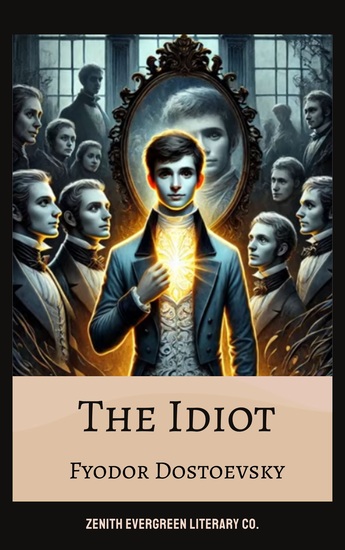
The Idiot - A Psychological Masterpiece of Innocence and Tragedy by Fyodor Dostoevsky - cover

The Idiot - A Psychological Masterpiece of Innocence and Tragedy by Fyodor Dostoevsky

Fyodor Dostoevsky, Zenith Evergreen Literary Co.

Verlag: Zenith Evergreen Literary Co.

  • 0
  • 0
  • 0

Beschreibung

🧠 "What happens when a man too good for this world steps into its darkest corners?"
Welcome to the poignant, profound, and powerful world of The Idiot, where purity collides with corruption, and love battles pride. 💔✨

Meet Prince Lev Myshkin, a man of unwavering honesty and childlike goodness. Returning to Russian society after years of treatment for epilepsy, he's immediately drawn into a web of romance, betrayal, and tragic misunderstandings. 💫💣

Set in the glittering yet morally decaying aristocracy of 19th-century Russia, The Idiot is a psychological drama that dissects the human soul with surgical precision. Dostoevsky challenges the very meaning of sanity, morality, and goodness in a society that mistakes virtue for madness.

🌪️ Intense relationships, philosophical depth, and heart-wrenching twists await you in this timeless classic. Perfect for fans of deep character studies, emotional fiction, and Russian literature, this is more than just a novel—it's a revelation.

👉 Buy now and discover why this Dostoevsky classic still resonates through the ages! 🕰️💡
Verfügbar seit: 14.04.2025.
Drucklänge: 720 Seiten.

Weitere Bücher, die Sie mögen werden

  • 25+ The World's Greatest Short Stories Vol 1 - The Legend of Sleepy Hollow The Gold Bug Daisy Miller The Yellow Wallpaper The Call of Cthulhu and other - cover

    25+ The World's Greatest Short...

    Washington Irving, Edgar Allan...

    • 0
    • 0
    • 0
    Contents:
    
    - Washington Irving. The Legend of Sleepy Hollow
    - Edgar Allan Poe. The Gold Bug
    - Herman Melville. Bartleby, the Scrivener
    - Bret Harte. The Luck of Roaring Camp
    - Leo Tolstoy. The Death of Ivan Ilyich  
    - Fyodor Dostoevsky. The Dream of a Ridiculous Man
    - Rudyard Kipling. Rikki-Tikki-Tavi
    - Charlotte Perkins Gilman. The Yellow Wallpaper
    - Anton Chekhov. The Lady with the Dog
    - D.H. Lawrence. The Prussian Officer
    - James Joyce. Araby
    - Ivan Turgenev. First Love
    - Nikolay Gogol. The Mantle
    -  Mikhail Bulgakov. The Embroidered Towel
    - Ivan Bunin. The Gentleman from San Francisco
    - Joseph Sheridan Le Fanu. Carmilla
    - O.Henry. The Gift of the Magi
    - Ambrose Gwinnett Bierce. An Occurrence at Owl Creek Bridge
    - Robert Louis Stevenson. The Strange Case of Dr. Jekyll and Mr. Hyde
    - H.G. Wells. The Magic Shop
    - W.W. Jacobs. The Monkey's Paw
    - Arthur Conan Doyle. His Last Bow
    - Henry James. Daisy Miller
    - H.P. Lovecraft. The Call of Cthulhu
    - Alexsandr Pushkin. The Queen of Spades
    - G.K. Chesterton. The Blue Cross
    Zum Buch
  • The Plush Usurper - cover

    The Plush Usurper

    E. Nesbit

    • 0
    • 0
    • 0
    King Alban was a good king, ruling over Albanatolia with kindness, fairness, and above all, efficiency, thanks to the white magic. Everyone had enough to wear, enough to eat, enough to do, and had their washing done for free at the Palace, on Mondays from 10 to 4. One day, the king's lavish and vain long-lost brother returned to the kingdom to bring a bit of colour to the realm with his own particular brand of magic, while stirring up discontent among the citizens, so that he might take the throne for himself.  This amusing allegory by E. Nesbit explores themes of political propaganda, populism and responsible leadership, all told with Nesbit's signature charm, wit and whimsy. The Plush Usurper was first published in Nine Unlikely Tales, 1901.
    Zum Buch
  • Eugene Onegin - cover

    Eugene Onegin

    Alexander Puschkin

    • 0
    • 0
    • 0
    In this timeless Russian classic, the charismatic but aloof Eugene Onegin rejects love, friendship, and opportunity in favor of cynicism and self-isolation. When he returns to his rural estate, he crosses paths with the idealistic Tatyana, who falls deeply in love with him. But Onegin's cold dismissal of her leads to a tragic sequence of events that changes all their lives.
    
    With sharp wit and vivid characters, Eugene Onegin is a rich exploration of love, regret, and the consequences of neglecting what truly matters.
    Zum Buch
  • A Little Woman - A man tries to appease a woman frustrated with him in true Kafkaesque fashion - cover

    A Little Woman - A man tries to...

    Franz Kafka

    • 0
    • 0
    • 0
    Franz Kafka was born on 3rd July 1883 in Prague, then in Bohemia, the eldest of 6, into a middle-class Jewish family. 
     
    Life for the young Kafka and his passion for literature was often made an ordeal by his over-bearing and domineering entrepreneur of a father.   
     
    In 1889 Kafka was sent to the Deutsche Knabenschule, an elementary school in Prague. His father would only allow him to be educated in German-speaking schools and even went so far as to limit visits to the synagogue to four a year. 
     
    In 1901 he graduated from the classics-oriented Altstädter Gymnasium. Kafka did well there and across a large range of subjects.  He now enrolled at the Charles Ferdinand University, to study chemistry, but quickly switched to law for which he obtained his degree in June 1906 and then performed the mandatory year of unpaid service as clerk at the civil and criminal courts. 
     
    A job at an Italian insurance company left him little time to write and after a year he took another job with the Worker's Accident Insurance Institute for the Kingdom of Bohemia where he stayed until ill health led to his resignation in 1922. 
     
    Although he saw work as a means to pay the bills and to allow him time to write, he received several promotions and was noted as a good employee. 
     
    By 1917 Kafka was suffering from tuberculosis, which required frequent periods of convalescence. Interspersed with this, were several intense affairs before he settled in Berlin with Dora Diamant, a 25-year-old kindergarten teacher who herself having left the ghetto now influenced Kafka's interest in the book of Jewish law, the Talmud. 
     
    Kafka’s on-going health was littered with problems. Apart from TB there were several other ailments, including migraines, insomnia, boils, depression, all usually brought on by excessive stresses and strains. He attempted to counteract all of this by naturopathic treatments, a vegetarian diet and consuming large quantities of unpasteurized milk. 
     
    His tuberculosis still worsened. He returned to Prague, where he died on 3rd June 1924. He was 40. 
     
    His literary works are few in number but towering in influence.  His masterpieces include ‘The Trial’, ‘The Metamorphosis’ as well as a number of short stories which reveal facets of humankind that truthfully could only be born from Kafka’s brain and pen.
    Zum Buch
  • Rats in the Walls The (Unabridged) - cover

    Rats in the Walls The (Unabridged)

    H. P. Lovecraft

    • 0
    • 0
    • 0
    In 1923, an American named Delapore, the last descendant of the De la Poer family, moves to his ancestral estate in England following the death of his only son during World War I. To the dismay of nearby residents, he restores the estate, called Exham Priory. After moving in, Delapore and his cat frequently hear the sounds of rats scurrying behind the walls. Upon investigating further, and through recurring dreams, Delapore learns that his family maintained an underground city for centuries, where they raised generations of "human cattle"-some regressed to a quadrupedal state-to supply their taste for human flesh. This was stopped when Delapore's ancestor killed his entire family in their sleep and left the country in order to end the horror, leaving the remaining human livestock and a surviving relative to be devoured by the rats inhabiting the city's cesspits. Maddened by the revelations of his family's past, a hereditary cruelty, and his anger over his son's death, Delapore attacks one of his friends in the dark of the cavernous city and begins eating him while rambling in a mixture of Middle English, Latin, and Gaelic, before devolving into a cacophony of animalistic grunts. He is subsequently subdued and placed in a mental institution. At least one other investigator, Thornton, has gone insane as well. Soon after, Exham Priory is destroyed and the investigators decide to cover up the existence of the underground city. Delapore maintains his innocence, proclaiming that it was "the rats, the rats in the walls", who ate the man. He continues to be plagued by the sound of rats in the walls of his cell.
    Zum Buch
  • Oedipus Rex (unabridged) - cover

    Oedipus Rex (unabridged)

    Sophocles

    • 0
    • 0
    • 0
    Rediscover an enduring classic in a transformative new light. "Oedipus Rex," the remarkable tragedy penned by Sophocles, has been masterfully revitalized in this riveting and immersive audiobook experience.Regarded as a cornerstone of Western literature, Oedipus Rex's timeless tale of fate, power, and the relentless pursuit of truth continues to captivate audiences millennia after its initial conception. Delve into the heart of Thebes, navigating the winding paths of power, prophecy, and self-discovery alongside the tragic figure of Oedipus, the King who must grapple with the devastating consequences of his past actions.This meticulously crafted audiobook takes the immersive nature of this tragic masterpiece to new heights. Brought to life through a vibrant, dynamic narration, each character springs forth in brilliant clarity, their complexities and inner turmoil echoing in every inflection, every pause.Our talented narrator breathes life into ancient Thebes, with a performance rich in passion and authenticity. From the anguished cries of Oedipus to the sage wisdom of Tiresias, every dialogue and soliloquy is delivered with a precision that captures the spirit of the original text.What sets this version of Oedipus Rex apart is not only the emotive narration but also the crisp and clear audio quality. Our top-notch production team has endeavored to ensure that every word, every pause, every breath is captured with utmost clarity. Rigorously edited to remove any distractions, the audio quality is pristine, heightening your immersion in the tragic narrative.The seamless integration of an emotionally charged performance with expert audio editing creates an auditory experience that is as captivating as it is transformative. This polished rendition of Oedipus Rex does more than recount a tale—it resonates, it echoes, it transforms.
    Zum Buch