Join us on a literary world trip!
Add this book to bookshelf
Grey
Write a new comment Default profile 50px
Grey
Subscribe to read the full book or read the first pages for free!
All characters reduced
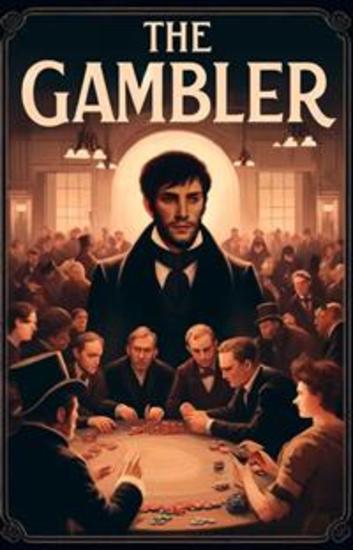
The Gambler(Illustrated) - cover

The Gambler(Illustrated)

Fyodor Dostoevsky

Publisher: Micheal Smith

  • 0
  • 0
  • 0

Summary

Illustrated Edition: Contains 20 unique illustrations, each capturing key moments from the chapters.
	Includes Detailed Chapter Summaries: A concise summary for each chapter to enhance your reading experience.
	Comprehensive Character List: An in-depth look at the personalities that bring this story to life.
	Author Biography: Delve into the intriguing life of Fyodor Dostoevsky, the literary genius behind this masterpiece.

Step into the whirlwind world of high stakes and higher passions with Fyodor Dostoevsky's timeless classic, "The Gambler." This beautifully illustrated edition brings to life the intense drama and psychological depth of Dostoevsky's narrative.
Set in the opulent and decadent backdrop of a European casino town, "The Gambler" tells the story of Alexei Ivanovich, a young tutor caught in the web of gambling. As he navigates through a society obsessed with wealth and status, Alexei's fortunes at the roulette table reflect his turbulent romance with the enigmatic Polina Alexandrovna, the stepdaughter of his employer.
Dostoevsky, writing under the weight of his personal gambling debts, creates a story that delves deeply into the psychology of addiction and love while also serving as a social commentary. The fascinating characters in the book—from the cunning Mademoiselle Blanche to the despondent General waiting for his inheritance—are vividly brought to life in this version thanks to eye-catching images that heighten the story's emotional and atmospheric depth.
Accompanying the novel are detailed chapter summaries, providing insights and reflections on the key themes and events. A comprehensive character list offers a deeper understanding of the complex figures that populate this world, making the novel accessible to both first-time readers and returning fans.
Furthermore, this edition includes a biography of Fyodor Dostoevsky, offering a glimpse into the life of one of literature's greatest minds and how his experiences shaped the creation of "The Gambler."
Whether you're a lover of classic literature or exploring Dostoevsky for the first time, this illustrated edition of "The Gambler" is a captivating journey into the depths of human emotion and the all-consuming nature of obsession. Prepare to be enthralled by this masterful blend of psychological insight and dramatic storytelling.
 
Available since: 01/12/2024.

Other books that might interest you

  • The House of the Dead - cover

    The House of the Dead

    Fyodor Dostoevsky

    • 0
    • 0
    • 0
    The House of the Dead (Russian: Записки из Мёртвого дома, Zapiski iz Myortvovo doma) is a semi-autobiographical novel published in 1860-62 in the journal Vremya by Russian author Fyodor Dostoevsky. It has also been published in English under the titles Notes from the House of the Dead, Memoirs from the House of the Dead and Notes from a Dead House, which are more literal translations of the Russian title.
    The novel portrays the life of convicts in a Siberian prison camp. It is generally considered to be a fictionalised memoir; a loosely-knit collection of descriptions, events and philosophical discussion, organised around theme and character rather than plot, based on Dostoevsky's own experiences as a prisoner in such a setting. Dostoevsky spent four years in a forced-labour prison camp in Siberia following his conviction for involvement in the Petrashevsky Circle. This experience allowed him to describe with great authenticity the conditions of prison life and the characters of the convicts.
    Show book
  • A Lesson on a Tortoise - From their pens to your ears genius in every story - cover

    A Lesson on a Tortoise - From...

    D H Lawrence

    • 0
    • 0
    • 0
    David Herbert Lawrence was born on the 11th September 1885 in Eastwood, Nottinghamshire, a coal mining town where the reality of a harsh life was only useful as experiences for future literary works. 
    He was educated at Beauvale Board School and became the first local boy to receive a scholarship to attend Nottingham High School. After 3 years he became a junior clerk in Haywood’s surgical appliances factory. He was also attempting a literary career which, in the short term, led to a teacher training position in Eastwood and later a teaching qualification from University College, Nottingham.  
    Lawrence’s first efforts were poems, short stories and a draft of ‘The White Peacock’. Moving to London and a teaching position in Croydon his writing attracted the attention of Ford Madox Ford, editor of The English Review, and he commissioned him to write ‘Odour of Chrysanthemums’.  
    Wanting to write full-time he now began work on what would become ‘Sons and Lovers.   
    In 1912 he met the older and married mother-of-three Frieda Weekley. They eloped to Germany and here Lawrence could see for himself the growing tensions with France.  So keen was his interest that he was arrested and accused of being a British spy.  
    In early 1914 Frieda obtained her divorce and they returned to Britain to be married just days before the outbreak of war. Owing to her German parentage, and his own public dislike of militarism and violence, the couple were treated with contempt and suspicion throughout the war years.  
    Despite this he continued to write but his reputation in England was so tarnished and, mirrored by his own disdain for the country, he and Frieda left England in November 1919, first for Europe and then America via Ceylon and Australia. 
    They bought a ranch in Taos, New Mexico and visited Mexico several times. The third visit in March 1925 caused a near fatal attack of malaria. To convalesce they moved to Florence. Here he continued work on ‘Lady Chatterley’s Lover’ which for many years would cause controversy. A renewed interest in oil painting resulted in an exhibition in 1929 which was raided by the police and several works were confiscated.  
    D H Lawrence died of complications arising from a bout of tuberculosis on the 2nd of March 1930 in Vence, France.  He was 44.
    Show book
  • Caterpillars - From their pens to your ears genius in every story - cover

    Caterpillars - From their pens...

    E F Benson

    • 0
    • 0
    • 0
    Edward Frederic Benson was born in Berkshire, England on 24th July 1867. 
    Educated at Marlborough and Kings College Cambridge he began his career as a writer at an early age and was published whilst still studying. 
    Benson was also a gifted athlete and represented his country at figure skating. 
    His career was prodigious and widely acknowledged.  Perhaps he is best known for his collection of novels about ‘Mapp & Lucia’ which have proved very popular throughout the decades.   
    Benson was also well regarded as a writer of ghost stories—‘spook stories’ in the then vernacular—as well as biographies.  His ghost and supernatural fiction covered a range of subjects but all were exceptionally well-written, drenched in atmosphere, riven with chills and have stood the test of popularity over the decades as testament to his literary talents.  
    Benson was never married and practised his homosexuality discreetly. 
    E F Benson died on 29th February 1940 at University College Hospital, London of throat cancer.  He was 72.
    Show book
  • God Sees the Truth But Waits - From their pens to your ears genius in every story - cover

    God Sees the Truth But Waits -...

    Leo Tolstoy

    • 0
    • 0
    • 0
    Leo Tolstoy was born in 1828 in the Russian province of Tula to a wealthy noble family. As a child, he had private tutors but he showed little interest in any formal education. When he went to the University of Kazan in 1843 to study oriental languages and law, he left without completing his courses.  Life now was relaxed and idle but with some writing also taking place.  Gambling debts forced an abrupt change of path and he joined the army to fight in the Crimean War.  He was commended for his bravery and promoted but was appalled at the brutality and loss of life.  He recorded these and other earlier experiences in his diaries which formed the basis of several of his works. 
    In 1852 ‘Childhood’ was published to immediate success and was followed by ‘Boyhood’ and ‘Youth’. 
    His experience in the army and the horrors he witnessed resulted in ‘The Cossacks’ in 1862 and the trilogy ‘Sevastopol Tales’. After the war he travelled around Europe, visiting London and Paris and meeting such luminaries as Victor Hugo and Charles Darwin.  
    It was now that Tolstoy began his masterpiece, ‘War and Peace’. Published in 1869 it was an epic work that changed literature. He quickly followed this with ‘Anna Karenina’.  
    These successes made Tolstoy rich and helped him accomplish many of his dreams but also brought problems as he grappled with his faith and the lot of the oppressed poor. These revolutionary views became so popular that the authorities now kept him under surveillance.  
    He led a life of asceticism and vegetarianism and put his socialist ideals into practice by establishing numerous schools for the poor and food programmes. He also believed in giving away his wealth, which caused much discord with his wife.  
    His writing continued to bring forth classics such as ‘The Death of Ivan Ilyich’ and many brilliant and incisive short stories such as ‘How Much Land Does A Man Need’.  
    In 1901 Tolstoy was excommunicated from the Church and controversially deselected for the Nobel Prize for Literature. 
    Whilst undertaking a pilgrimage by train in October 1910 with his daughter Aleksandra he caught pneumonia in the nearby town of Astapovo.  Leo Tolstoy died on November 9th, 1910, he was 82.
    Show book
  • A Very Short Romance - From their pens to your ears genius in every story - cover

    A Very Short Romance - From...

    Vsevolod Garshin

    • 0
    • 0
    • 0
    Vsevolod Mikhailovich Garshin was born on 14th February 1855 in what is now Dnipro in the Ukraine, but then part of the Russian Empire. 
    After attending secondary school he studied at the Saint Petersburg Mining Institute.  
    Wars between and on behalf of Empires were a regular feature of the decades then.  Garshin volunteered to serve in the Russian army at the beginning of the Russo-Turkish War in 1877.  
    He began as a private in the Balkans campaign and was wounded in action.  By the end of the war, in 1878, he had been promoted to officer rank.  
    By now Garshin, having previously published some articles and reviews in newspapers, wished to devote himself to a literary career.  The decision made he resigned his army commission. 
    His time as a soldier provided rich experiences for his early stories. His first ‘Four Days’ was related as the interior monologue of a wounded soldier left for dead on the battlefield for four days, face to face with the corpse of a Turkish soldier he had killed, gained him early admiration as an author of note.  
    He wrote perhaps only 20 stories, but their influence was immense, although in these more modern times he is barely remembered and lives in the more prolific shadows of others.  His characters are superbly worked into stories that come alive in the intensity and reality of his prose.   
    Garshin’s most well-known story is ‘The Red Flower’, also known as ‘Scarlet Blossom’ and is easily amongst the first rank of stories dealing with mental health issues.  
    Despite early literary success, he himself experienced periodical bouts of mental illness.   
    In one such bout Garshin attempted to commit suicide by throwing himself down the stone stairs leading into his apartment building.  Although not immediately fatal, Vsevolod Garshin died as a result of his injuries in a St Petersburg hospital on 5th April 1888.  He was 33.
    Show book
  • The Rubaiyat of Omar Khayyam - cover

    The Rubaiyat of Omar Khayyam

    Omar Khayyam, Edward FitzGerald

    • 0
    • 0
    • 0
    The Rubaiyat of Omar Khayyam is a collection of quatrains (four-line verses) attributed to the 12th-century Persian poet, mathematician, and astronomer, Omar Khayyam. While the original Persian text is complex and open to interpretation, it is the English translation by Edward Fitzgerald that popularized the work in the Western world. 
    Fitzgerald's translation portrays a world view that is often characterized as: 
    Carpe Diem: Seize the day, emphasizing the fleeting nature of life and the importance of enjoying the present moment. 
    Skepticism: Questioning traditional beliefs and religious dogma, particularly in relation to the afterlife. 
    Epicureanism: Focusing on pleasure and the senses as the primary goods in life. 
    Fatalism: Accepting one's fate and the inherent unpredictability of existence.
    Show book