Join us on a literary world trip!
Add this book to bookshelf
Grey
Write a new comment Default profile 50px
Grey
Subscribe to read the full book or read the first pages for free!
All characters reduced
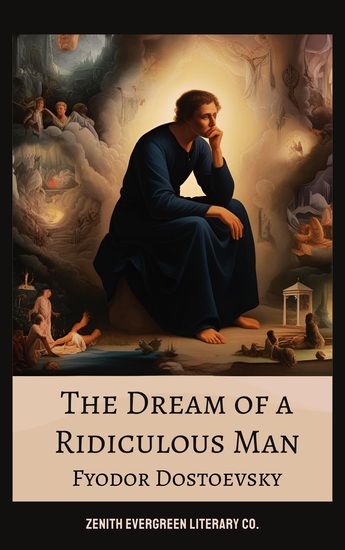
The Dream of a Ridiculous Man - A Philosophical Tale of Redemption & Human Hope by Fyodor Dostoevsky - cover

The Dream of a Ridiculous Man - A Philosophical Tale of Redemption & Human Hope by Fyodor Dostoevsky

Fyodor Dostoevsky, Zenith Evergreen Literary Co.

Publisher: Zenith Evergreen Literary Co.

  • 0
  • 0
  • 0

Summary

🌌 "What if the end of hope was just the beginning of truth?"
Dive into the surreal world of one man's descent into despair… and his miraculous awakening. 💫

🧠 Fyodor Dostoevsky's The Dream of a Ridiculous Man is a powerful philosophical short story that explores the meaning of life, guilt, love, and human salvation. Through a haunting dream, the narrator journeys into a utopian world 🌍—only to witness its fall due to the same corruption plaguing Earth.

📖 This deeply introspective tale will resonate with fans of thought-provoking literature, challenging modern values while shining a light on the eternal power of compassion and redemption. 💖

💬 Celebrated for its psychological depth and spiritual richness, this masterpiece continues to move readers across generations. A must-read for anyone searching for deeper understanding and emotional truth. 🕊️

➡️ Buy now to experience Dostoevsky's brilliant mind in one of his most mystical and life-affirming works!
Available since: 04/14/2025.
Print length: 27 pages.

Other books that might interest you

  • The Sister of the Baroness - cover

    The Sister of the Baroness

    Katherine Mansfield

    • 0
    • 0
    • 0
    In The Sister of the Baroness by Katherine Mansfield we have the theme of appearance, identity, self-importance, class and escape. Taken from her In a German Pension collection the story is narrated in the first person by an unnamed English woman and after reading the story the reader realises that Mansfield may be exploring the theme of appearance. With the exception of the narrator all the visitors at the Pension are in awe of the Baroness’ sister.
    Show book
  • Hand and Heart - From their pens to your ears genius in every story - cover

    Hand and Heart - From their pens...

    Elizabeth Gaskell

    • 0
    • 0
    • 0
    Elizabeth Stevenson was born in Chelsea in London on 29th September 1810.  
    Both parents embedded their strong Unitarian beliefs into Elizabeth who rebelliously was often reluctant to display these religious convictions.  
    The early death of Elizabeth’s mother saw her sent away to be brought up by her maternal aunt in Knutsford, Cheshire.  
    Her father now remarried but Elizabeth spent most of her childhood in Cheshire away from her father and his new family but was supportive towards her half-siblings.  
    Elizabeth’s aunt encouraged her education and particularly to read and express herself through writing.   
    In 1828, her brother John, who worked in the merchant navy, disappeared on a journey to India. This disastrous loss depressed her father, and she went to his household to nurse him for the next year before he died.  
    In 1832, she fell in love with William Gaskell, a Unitarian minister like her father, and married him.  They settled in Manchester. This booming industrial city had a great impact on Elizabeth who felt the need to speak up for poor workers and their exploitation by large industrial companies. A collection of poems and short stories, ‘Sketches among the Poor’ appeared in 1837, co-authored by her husband.  Her first major work, under a pseudonym, was ‘Mary Barton: A Tale of Manchester Life’ published in 1848. 
    During her career she worked continually with Charles Dickens and published much in his various magazines. With him she published ‘Lizzie Leigh’ in 1850 which dealt with the taboo subject of prostitution.  She was an excellent writer and impressed her many Victorian literary peers. Much of her writing reflects her work as a social critic highlighting the exploitation of the working class and the situation of women in society.  
    On 12th November 1865, Elizabeth Gaskell died in Holybourne, Hampshire, after suffering from a heart attack a month earlier.
    Show book
  • The Red Badge of Courage - cover

    The Red Badge of Courage

    Stephen Crane

    • 0
    • 0
    • 0
    The Red Badge of Courage is the story of an eighteen-year-old boy whose romantic ideas about military life move him to join the Civil War, a conflict that is, to this day, the deadliest war in American history. Henry Fleming, the boy, often referred to as “the youth,” is from New York, the state to suffer the most casualties. When “the youth” finds himself in the middle of his first battle against a regiment of Confederate soldiers, he panics and deserts his regiment. From this premise, Stephen Crane explores the boy’s struggle to gain courage and maturity. There is no critical consensus on if and how Henry comes to better understand himself and the world. But readers have long praised the novel’s depiction of the chaos and psychological intensity of war. 
    Cover illustrated by: Sheila Wong 
    Sheila Wong is a graphic designer and illustrator based in the Pacific Northwest. Her work often pulls from a variety of experiences - from growing up as a child of Chinese immigrants in the Midwest, to years working in tech support and then design in the heart of Silicon Valley. When not at work, she is usually looking for new places to go camping, or building mechanical keyboards.
    Show book
  • The Time Machine - cover

    The Time Machine

    H. G. Wells

    • 0
    • 0
    • 0
    Journey into the unknown with The Time Machine, H.G. Wells’s groundbreaking novel that introduced the concept of time travel to the world. Follow the adventures of an unnamed Time Traveller as he steps into the distant future, encountering strange civilizations, breathtaking wonders, and unsettling truths about humanity’s fate. From the peaceful Eloi to the mysterious Morlocks lurking underground, each stop on his journey challenges his understanding of civilization and survival. 
    Wells’s visionary storytelling and exploration of complex themes, such as social inequality and the relentless march of time, make The Time Machine a timeless classic. This science fiction masterpiece captures the excitement and perils of stepping beyond the boundaries of knowledge and into the future. 
    Narrated with vivid intensity, this audiobook brings Wells’s imaginative world to life for listeners of all ages. 
    Start listening to The Time Machine today, and experience the adventure that redefined science fiction!
    Show book
  • A Model Crime - From their pens to your ears genius in every story - cover

    A Model Crime - From their pens...

    William Pett Ridge

    • 0
    • 0
    • 0
    William Pett Ridge was born at Chartham, near Canterbury, Kent, on 22nd April 1859.  
    His family’s resources were certainly limited. His father was a railway porter, and the young Pett Ridge, after schooling in Marden, Kent became a clerk in a railway clearing-house. The hours were long and arduous, but self-improvement was Pett Ridge’s goal.  After working from nine until seven o’clock he would attend evening classes at Birkbeck Literary and Scientific Institute and then to follow his passion; the ambition to write.  He was heavily influenced by Dickens and several critics thought he had the capability to be his successor.  
    From 1891 many of his humourous sketches were published in the St James's Gazette, the Idler, Windsor Magazine and other literary periodicals of the day. 
    Pett Ridge published his first novel in 1895, A Clever Wife. By the advent of his fifth novel, Mord Em'ly, a mere three years later in 1898, his success was obvious.  His writing was written from the perspective of those born with no privilege and relied on his great talent to find humour and sympathy in his portrayal of working class life. 
    Today Pett Ridge and other East End novelists including Arthur Nevinson, Arthur Morrison and Edwin Pugh are being grouped together as the Cockney Novelists.   
    In 1924, Pugh set out his recollections of Pett Ridge from the 1890s: “I see him most clearly, as he was in those days, through a blue haze of tobacco smoke. We used sometimes to travel together from Waterloo to Worcester Park on our way to spend a Saturday afternoon and evening with H. G. Wells. Pett Ridge does not know it, but it was through watching him fill his pipe, as he sat opposite me in a stuffy little railway compartment, that I completed my own education as a smoker... Pett Ridge had a small, dark, rather spiky moustache in those days, and thick, dark, sleek hair which is perhaps not quite so thick or dark, though hardly less sleek nowadays than it was then”. 
    With his success, on the back of his prolific output and commercial success, Pett Ridge gave generously of both time and money to charity. In 1907 he founded the Babies Home at Hoxton.  This was one of several organisations that he supported that had the welfare of children as their mission.  
    His circle considered Pett Ridge to be one of life's natural bachelors. In 1909 they were rather surprised therefore when he married Olga Hentschel.  
    As the 1920’s arrived Pett Ridge added to his popularity with the movies. Four of his books were adapted into films.  
    Pett Ridge now found the peak of his fame had passed. Although he still managed to produce a book a year he was falling out of fashion and favour with the reading public and his popularity declined rapidly.  His canon runs to over sixty novels and short-story collections as well as many pieces for magazines and periodicals. 
    William Pett Ridge died, on 29th September 1930, at his home, Ampthill, Willow Grove, Chislehurst, at the age of 71. 
    He was cremated at West Norwood on 2nd October 1930.
    Show book
  • Mosses from an Old Manse - cover

    Mosses from an Old Manse

    Nathaniel Hawthorne

    • 0
    • 0
    • 0
    Immerse yourself in the haunting world of Nathaniel Hawthorne's masterpiece, Mosses from an Old Manse. Crafted from the depth of human complexities, this collection shines a ghostly light on the darker facets of our nature through allegories that captivate and challenge. Set against the historical backdrop of The Old Manse in Concord, these tales emerge from a place deeply entwined with American history and personal significance to Hawthorne. 
    Heralded by literary giants like Herman Melville for its "shrouded in blackness, ten times black" narrative, Mosses from an Old Manse offers readers a journey through stories that intricately blend the bright and somber aspects of human existence. Each tale reveals the genius of Hawthorne's craft, making it an essential exploration for those fascinated by the enduring themes of history, morality, and the complexities that lie within us all. 
    Discover why Mosses from an Old Manse stands as an immortal testament to American romanticism and dark romanticism. Let Hawthorne's ethereal prose guide you through a reflective journey into the human soul. 
    This audiobook was narrated and produced by RAM Studios, where humans and artificial intelligence collaborate to create an excellent listening experience. (The reading is done primarily by AI)
    Show book