¡Acompáñanos a viajar por el mundo de los libros!
Añadir este libro a la estantería
Grey
Escribe un nuevo comentario Default profile 50px
Grey
Suscríbete para leer el libro completo o lee las primeras páginas gratis.
All characters reduced
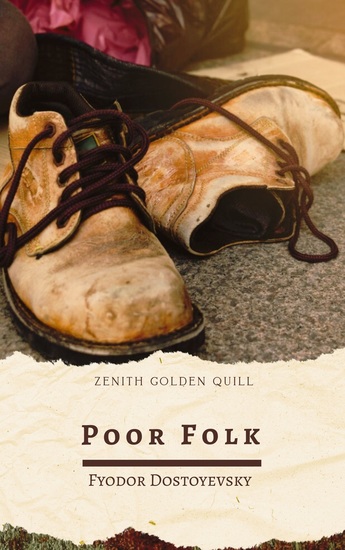
Poor Folk - Fyodor Dostoevsky's Heartbreaking Debut on Poverty Dignity and Human Connection - cover

Poor Folk - Fyodor Dostoevsky's Heartbreaking Debut on Poverty Dignity and Human Connection

Fyodor Dostoevsky, Zenith Golden Quill

Editorial: Zenith Golden Quill

  • 0
  • 0
  • 0

Sinopsis

Two voices. One fragile correspondence. A portrait of poverty written with power and compassion.

Poor Folk is Dostoevsky's stunning debut novel, presented in epistolary form through letters exchanged between Makar Devushkin, a downtrodden government clerk, and his distant cousin, Varvara Dobroselova. Through their humble words, the novel reveals the struggles of the poor in tsarist Russia—not just materially, but emotionally, spiritually, and socially.

With sharp social commentary, emotional vulnerability, and the early signs of Dostoevsky's psychological genius, Poor Folk is a powerful meditation on class, dignity, and the human condition.

📘 This Edition Features:
✔ Complete and unabridged text
✔ Kindle-optimized formatting with clickable table of contents
✔ Ideal for readers of Russian literature, epistolary novels, and literary social realism

💬 What Readers Say:
"A masterful first novel—tender, painful, and deeply human."
"More than a story of poverty—it's a story of resilience and connection."
"The seeds of Dostoevsky's greatness are all here."

📥 Download Poor Folk today and discover the literary roots of one of the world's greatest novelists.
Disponible desde: 09/05/2025.
Longitud de impresión: 182 páginas.

Otros libros que te pueden interesar

  • Bound for the Great Salt Lake (Unabridged) - cover

    Bound for the Great Salt Lake...

    Charles Dickens

    • 0
    • 0
    • 0
    Charles Dickens was a writer and social critic who created some of the world's best-known fictional characters and is regarded as the greatest novelist of the Victorian era. His works enjoyed unprecedented popularity during his lifetime, and by the twentieth century critics and scholars had recognised him as a literary genius. His novels and short stories enjoy lasting popularity.
    BOUND FOR THE GREAT SALT LAKE: Behold me on my way to an emigrant ship, on a hot morning early in june. my road lies through that part of london generally known to the initiated as down by the docks.
    Ver libro
  • Turnip The - Story Time Episode 53 (Unabridged) - cover

    Turnip The - Story Time Episode...

    Brothers Grimm

    • 0
    • 0
    • 0
    Two brothers, one rich, one poor, served as soldiers, but the poor one had to become a farmer to escape his poverty. One of his turnips grew to an enormous size, and he gave it to the king. The king gave him rich presents in return.
    Ver libro
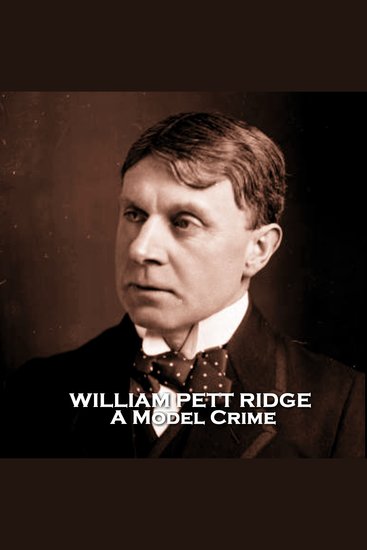
  • A Model Crime - From their pens to your ears genius in every story - cover

    A Model Crime - From their pens...

    William Pett Ridge

    • 0
    • 0
    • 0
    William Pett Ridge was born at Chartham, near Canterbury, Kent, on 22nd April 1859.  
    His family’s resources were certainly limited. His father was a railway porter, and the young Pett Ridge, after schooling in Marden, Kent became a clerk in a railway clearing-house. The hours were long and arduous, but self-improvement was Pett Ridge’s goal.  After working from nine until seven o’clock he would attend evening classes at Birkbeck Literary and Scientific Institute and then to follow his passion; the ambition to write.  He was heavily influenced by Dickens and several critics thought he had the capability to be his successor.  
    From 1891 many of his humourous sketches were published in the St James's Gazette, the Idler, Windsor Magazine and other literary periodicals of the day. 
    Pett Ridge published his first novel in 1895, A Clever Wife. By the advent of his fifth novel, Mord Em'ly, a mere three years later in 1898, his success was obvious.  His writing was written from the perspective of those born with no privilege and relied on his great talent to find humour and sympathy in his portrayal of working class life. 
    Today Pett Ridge and other East End novelists including Arthur Nevinson, Arthur Morrison and Edwin Pugh are being grouped together as the Cockney Novelists.   
    In 1924, Pugh set out his recollections of Pett Ridge from the 1890s: “I see him most clearly, as he was in those days, through a blue haze of tobacco smoke. We used sometimes to travel together from Waterloo to Worcester Park on our way to spend a Saturday afternoon and evening with H. G. Wells. Pett Ridge does not know it, but it was through watching him fill his pipe, as he sat opposite me in a stuffy little railway compartment, that I completed my own education as a smoker... Pett Ridge had a small, dark, rather spiky moustache in those days, and thick, dark, sleek hair which is perhaps not quite so thick or dark, though hardly less sleek nowadays than it was then”. 
    With his success, on the back of his prolific output and commercial success, Pett Ridge gave generously of both time and money to charity. In 1907 he founded the Babies Home at Hoxton.  This was one of several organisations that he supported that had the welfare of children as their mission.  
    His circle considered Pett Ridge to be one of life's natural bachelors. In 1909 they were rather surprised therefore when he married Olga Hentschel.  
    As the 1920’s arrived Pett Ridge added to his popularity with the movies. Four of his books were adapted into films.  
    Pett Ridge now found the peak of his fame had passed. Although he still managed to produce a book a year he was falling out of fashion and favour with the reading public and his popularity declined rapidly.  His canon runs to over sixty novels and short-story collections as well as many pieces for magazines and periodicals. 
    William Pett Ridge died, on 29th September 1930, at his home, Ampthill, Willow Grove, Chislehurst, at the age of 71. 
    He was cremated at West Norwood on 2nd October 1930.
    Ver libro

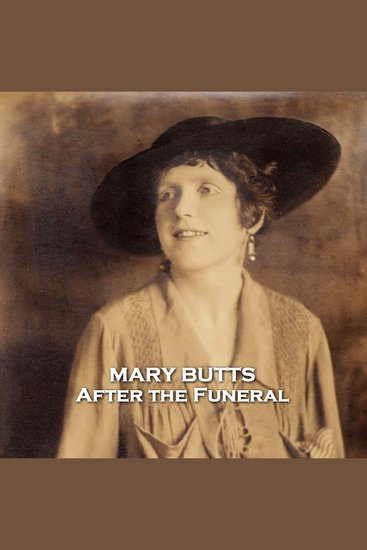
  • After the Funeral - From their pens to your ears genius in every story - cover

    After the Funeral - From their...

    Mary Butts

    • 0
    • 0
    • 0
    Mary Frances Butts was born on 13th December 1890 in Poole, Dorset. 
    Her early years were spent at Salterns, an 18th-century house overlooking Poole Harbour.  Sadly in 1905 her father died, and she was sent for boarding at St Leonard's school for girls in St Andrews. 
    Her mother remarried and, from 1909, Mary studied at Westfield College in London, and here, first became aware of her bisexual feelings.  She was sent down for organising a trip to Epsom races and only completed her degree in 1914 when she graduated from the London School of Economics.  By then Mary had become an admirer of the occultist Aleister Crowley and she was given a co-authorship credit on his ‘Magick (Book 4)’. 
    In 1916, she began the diary which would now detail her future life and be a constant reference point for her observations and her absorbing experiences. 
    During World War I, she was doing social work for the London County Council in Hackney Wick, and involved in a lesbian relationship.  Life changed after meeting the modernist poet, John Rodker and they married in 1918. 
    In 1921 she spent 3 months at Aleister Crowley's Abbey of Thelema in Sicily; she found the practices dreadful and also acquired a drug habit.  Mary now spent time writing in Dorset, including her celebrated book of short stories ‘Speed the Plough’ which saw fully develop her unique Modernist prose style. 
    Europe now beckoned and several years were spent in Paris befriending many artists and writing further extraordinary stories.   
    She was continually sought after by literary magazines and also published several short story collections as books. Although a Modernist writer she worked in other genres but is essentially only known for her short stories.  Mary was deeply committed to nature conservation and wrote several pamphlets attacking the growing pollution of the countryside. 
    In 1927, she divorced and the following year her novel ‘Armed with Madness’ was published.  A further marriage followed in 1930 and time was spent attempting to settle in London and Newcastle before setting up home on the western tip of Cornwall.  By 1934 the marriage had failed. 
    Mary Butts died on 5th March 1937, at the West Cornwall Hospital, Penzance, after an operation for a perforated gastric ulcer. She was 46.
    Ver libro
  • The Premature Burial - cover

    The Premature Burial

    Sampi Books, Edgar Allan Poe

    • 0
    • 0
    • 0
    In Edgar Allan Poe's "The Premature Burial", a man obsessed with the fear of being buried alive recounts known cases of premature burial. His fixation drives him to extremes to avoid his fate, until he confronts the reality of his greatest phobia in a shocking way.
    Ver libro
  • Love and Friendship - cover

    Love and Friendship

    Jane Austen

    • 0
    • 0
    • 0
    Explore the youthful exuberance and satire in "Love and Friendship" by Jane Austen. This early work, written in the form of a series of letters, follows the misadventures of the impulsive and melodramatic Laura. As she recounts her wild romantic exploits to her friend Marianne, the story unfolds with exaggerated humor and sharp wit. Austen's playful critique of romantic conventions and social norms offers a delightful glimpse into her developing literary genius, blending comedy with incisive social commentary.
    Ver libro