Junte-se a nós em uma viagem ao mundo dos livros!
Adicionar este livro à prateleira
Grey
Deixe um novo comentário Default profile 50px
Grey
Assine para ler o livro completo ou leia as primeiras páginas de graça!
All characters reduced
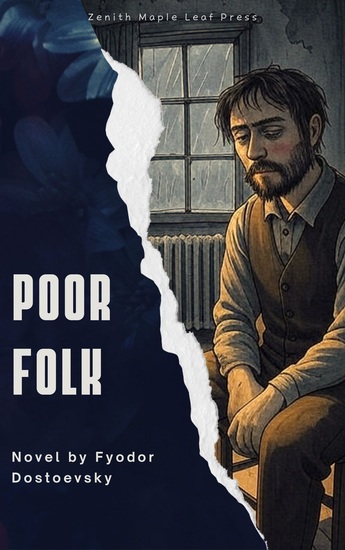
Poor Folk - A Heartfelt Epistolary Novel of Poverty Dignity and the Human Spirit - cover
LER

Poor Folk - A Heartfelt Epistolary Novel of Poverty Dignity and the Human Spirit

Fyodor Dostoevsky, Zenith Maple Leaf Press

Editora: Zenith Maple Leaf Press

  • 0
  • 0
  • 0

Sinopse

Two souls bound by letters, love, and hardship.
In Poor Folk, Fyodor Dostoevsky's debut novel, the struggles of poverty are brought vividly to life through an intimate exchange of letters between Makar Devushkin, a humble government clerk, and Varvara Dobroselova, a young woman facing her own trials. Through their correspondence, we witness a tender friendship—and possibly love—blossoming in the shadow of social inequality.

First published in 1846, Poor Folk earned Dostoevsky immediate acclaim and introduced the compassion, psychological insight, and social awareness that would define his later masterpieces. This deeply human story captures the dignity, resilience, and quiet tragedies of everyday life among Russia's poor.

"The novel that announced Dostoevsky's genius to the world."
– The Guardian

"A compassionate and timeless portrait of the human condition."
– The New York Times

✅ Why Readers Love It:
💌 Told entirely through moving personal letters

🇷🇺 A touching glimpse into 19th-century Russian life

📚 Dostoevsky's remarkable literary debut

🎯 Click 'Buy Now' to discover the heartfelt story that began Dostoevsky's journey as one of literature's greatest voices.
Disponível desde: 12/08/2025.
Comprimento de impressão: 133 páginas.

Outros livros que poderiam interessá-lo

  • Northanger Abbey - cover

    Northanger Abbey

    Jane Austen

    • 0
    • 0
    • 0
    "Northanger Abbey" is one of Jane Austen's earlier works, published posthumously in 1818. The novel is a coming-of-age story that follows the naive and imaginative Catherine Morland during her adventures in Bath and, later, at the eponymous Northanger Abbey. While the book embraces elements of the Gothic novel—a popular genre of its time—it also satirizes the genre's excesses and the naivety of its young heroine. Themes of social class, wealth, and morality are explored against a backdrop of Regency England manners and mores.
    Ver livro
  • Howards End - cover

    Howards End

    E. M. Forster

    • 0
    • 0
    • 0
    The disregard of a dying woman's bequest, a girl's attempt to help an impoverished clerk, and the marriage of an idealist and a materialist - all these narratives intersect at an estate called Howards End. The fate of this country home symbolizes the future of England in an exploration of social, economic, and philosophical trends during the post-Victorian era.
    
    This 1910 novel established Forster's reputation as a writer held in the highest regard, and that he later referred to as "my best novel."
    Ver livro
  • Tropic of Cancer - cover

    Tropic of Cancer

    Henry Miller

    • 0
    • 1
    • 0
    Henry Miller’s famously banned book is “a matter-of-fact celebration of chucking one’s dreary life and following your heart to Paris” (Richard Price).   Now hailed as an American classic, Tropic of Cancer, Henry Miller’s masterpiece, was banned as obscene in this country for twenty-seven years after its first publication in Paris in 1934. Only a historic court ruling that changed American censorship standards, ushering in a new era of freedom and frankness in modern literature, permitted the publication of this first volume of Miller’s famed mixture of memoir and fiction, which chronicles with unapologetic gusto the bawdy adventures of a young expatriate writer, his friends, and the characters they meet in Paris in the 1930s. Tropic of Cancer is now considered, as Norman Mailer said, “one of the ten or twenty great novels of our century.”
    Ver livro
  • The Comedy of Errors - cover

    The Comedy of Errors

    William Shakespeare

    • 0
    • 0
    • 0
    The Comedy of Errors is one of Shakespeare's earliest and shortest plays. This comedy utilizes slapstick humor, word play, and mistaken identities to create a series of farcical accidents. Over time, the play's title has become an idiom used to describe "an event or series of events made ridiculous by the number of errors that were made throughout."
    In Ephesus, the law forbids entry to any merchants from Syracuse, and if they are discovered within the city, they must pay a thousand marks or be put to death. Aegeon, an old Syracusian merchant, is arrested and Solinus, the Duke of Ephesus, listens to his story of coming to the city. Long ago, Aegeon was on a sea voyage. Traveling with him was his wife, his twin sons, and their twin slaves. The family becomes separated during a tempest; Aegeon, one son, and one slave were rescued together, and the others were never to be seen again. Years later his son Antipholus and his slave Dromio left to search for their long lost siblings; after the boys didn't return, Aegeon set out to bring his son back home. Moved by this story, the duke allows Aegeon one day to get the money to pay his fine and to find his family.
    Ver livro
  • The Island of Doctor Moreau - cover

    The Island of Doctor Moreau

    H. G. Wells

    • 0
    • 0
    • 0
    The Island of Doctor Moreau is an 1896 science fiction novel by English author H. G. Wells. The text of the novel is the narration of Edward Prendick, a shipwrecked man rescued by a passing boat who is left on the island home of Doctor Moreau, a mad scientist who creates human-like hybrid beings from animals via vivisection. The novel deals with a number of philosophical themes, including pain and cruelty, moral responsibility, human identity, and human interference with nature. Wells described it as "an exercise in youthful blasphemy."
    The Island of Doctor Moreau is a classic of early science fiction and remains one of Wells' best-known books. The novel is the earliest depiction of the science fiction motif "uplift" in which a more advanced race intervenes in the evolution of an animal species to bring the latter to a higher level of intelligence.
    Famous works of the author Herbert Wells: "The Time Machine", "The War of the Worlds", "The War in the Air", "The Island of Dr. Moreau", "The Complete Science Fiction Treasury of H.G. Wells", "The Invisible Man", "When the Sleeper Wakes", "The First Men in the Moon", "The Food of the Gods", "The Magic Shop".
    Ver livro
  • Hunchback of Notre-Dame The (Book 1) - cover

    Hunchback of Notre-Dame The...

    Victor Hugo

    • 0
    • 0
    • 0
    Book 1: The Hunchback of Notre-Dame or Notre-Dame de Paris is a French Gothic novel by Victor Hugo, published in 1831. - The story is set in Paris in 1482 during the reign of Louis XI. The gypsy Esmeralda (born as Agnes) captures the hearts of many men, including those of Captain Phoebus and Pierre Gringoire, but especially Quasimodo and his guardian Archdeacon Claude Frollo. Frollo is torn between his obsessive lust for Esmeralda and the rules of Notre Dame Cathedral. He orders Quasimodo to kidnap her, but Quasimodo is captured by Phoebus and his guards, who save Esmeralda. Gringoire, who attempted to help Esmeralda but was knocked out by Quasimodo, is about to be hanged by beggars when Esmeralda saves him by agreeing to marry him for four years.
    Ver livro