Junte-se a nós em uma viagem ao mundo dos livros!
Adicionar este livro à prateleira
Grey
Deixe um novo comentário Default profile 50px
Grey
Assine para ler o livro completo ou leia as primeiras páginas de graça!
All characters reduced
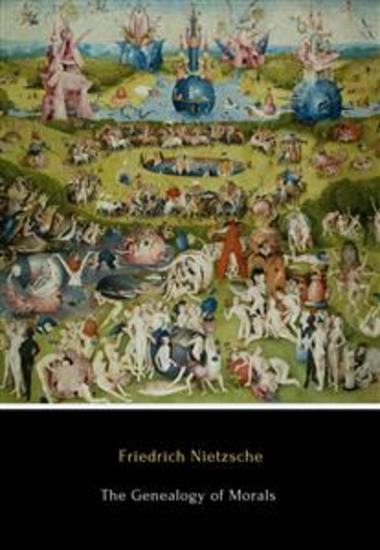
The Genealogy of Morals - cover
LER

The Genealogy of Morals

Friedrich Nietzsche

Editora: Logos

  • 0
  • 1
  • 0

Sinopse

Written in response to a book on the origins of morality by his erstwhile friend Paul Rée, the three essays comprising The Genealogy of Morals — all three advancing the critique of Christian morality set forth in Beyond Good and Evil — are among Nietzsche's most sustained and cohesive work. In the first essay — starting from a linguistic analysis of words such as "good," "bad," and "evil" — Nietzsche sets up a contrast between what he calls "master" morality and "slave" morality and shows how strength and action have often been replaced by passivity and nihilism. The next essay, looking into the origins of guilt and punishment, shows how the concept of justice was born — and how internalization of this concept led to the development of what people called "the soul." In the third essay, Nietzsche dissects the meaning of ascetic ideals. It is not Nietzsche's intention to reject ascetic ideals, "slave" morality, or internalized values out of hand; his main concern is to show that culture and morality, rather than being eternal verities, are human-made. Whether or not you agree with all of his conclusions, his writing is of such clarity and brilliance that you will find reading The Genealogy of Morals nothing short of exhilarating.
Disponível desde: 28/10/2022.

Outros livros que poderiam interessá-lo

  • Economics Reimagined: - Nature Progress and Living Standards - cover

    Economics Reimagined: - Nature...

    Rick Teller

    • 0
    • 0
    • 0
    Forget GDP, and focus instead on living standards, people’s ability to get what they want. When you do that you’ll see why, contrary to universal belief, capitalism helps the living standards of the less well-off much more than those of the rich. You’ll also see why no matter who or what the government taxes, or even if it taxes nobody, nearly the entire cost of government is paid for in the form of reduced living standards for the poor or anyone else on a tight budget. 
    Despite covering serious issues that affect the lives of everyone, the book is designed to be easy and entertaining even for those who know little about economics. That’s because the laws of economics are ultimately based on universal aspects of human nature. If you are a human, you’ll get it.
    Ver livro
  • Couples Therapy and Infidelity Recovery Workbook: The Ultimate Guide to Rebuild Restore and Strengthen Your Relationship - cover

    Couples Therapy and Infidelity...

    Emma Lancaster

    • 0
    • 0
    • 0
    Rebuild Trust and Restore Intimacy: Your Path to a Thriving Relationship 
    Two manuscripts in one audiobook:Couples Therapy Workbook: Building Trust, Intimacy, and Communication for Thriving RelationshipsInfidelity Recovery: A Comprehensive Workbook for Healing, Rebuilding Trust, and Restoring Intimacy in Your Relationship 
    In the first part of this audiobook, you will:Unlock the Power of Trust – Dive deep into the essence of trust and learn how to cultivate it in your relationship.Navigate Conflicts with Grace – Discover effective strategies to turn conflicts into opportunities for growth and understanding.Ignite the Flame of Intimacy – Explore new dimensions of closeness and deepen the bond with your partner.Master the Art of Communication – Transform your conversations into meaningful exchanges that foster connection and clarity.Embrace Individuality – Learn to balance personal needs with the needs of your relationship, ensuring a harmonious partnership. 
    In the second part of this audiobook, you will learn more about:The Many Faces of Infidelity – Unmask the many faces of infidelity.Emotions and Betrayal – Make sense of the emotions you feel after the fact of betrayal.Effects of Infidelity – Be more aware of the different ways infidelity affects you.Decoding Your Emotions – Decode your emotions to allow healing.Understand Triggers – Learn how triggers work and how to handle them.Tools and Strategies – Use effective tools and strategies to explore and process your feelings. 
    Scroll up and click the “add to cart” button to begin your path to a stronger, more loving partnership today!
    Ver livro
  • Transform Your Choices: Unlocking Your Mind's Hidden Potential - "Elevate your decision-making! Access powerful lessons that unlock your hidden mental strengths" - cover

    Transform Your Choices:...

    Jasper Haverford

    • 0
    • 0
    • 0
    Transform Your Choices: Unlocking Your Mind's Hidden Potential 
    ⭐⭐ Simplified Audio Guide & Explanations Included ⭐⭐   
    Are you eager to advance in your career and enhance your understanding by successfully navigating your mind's hidden potential?   
    Searching for a complete guide that encapsulates all the essential elements for unlocking the dynamics of your mind?   
    Your quest ends here!                                                                                                                                                                               
    This guide is your ultimate companion for deepening your knowledge, applying vital skills, and engaging in practical exercises. With this resource, you're set for success.   
    Updated to align with the latest insights into uncovering your potential.   
    Key Features of This Enhanced Guide: 
    - In-depth exploration of how to unlock your potential through understanding your mind's dynamics   
    - Comprehensive explanations of the principles related to personal growth   
    - Effective strategies for preparing yourself mentally and overcoming challenges   
    Our guide stands out with its holistic coverage, crucial for your journey to self-discovery. Concepts are not just lightly touched upon; they are thoroughly examined with clarity.   
    Crafted with a straightforward structure and user-friendly language, our guide ensures seamless transitions between various topics. 
    So, why hesitate? Click the BUY NOW button, secure your guide, and embark on your journey to realizing the hidden potential of your mind!
    Ver livro
  • Rome’s Best Emperors: The History and Legacy of the Roman Empire’s Most Able Leaders - cover

    Rome’s Best Emperors: The...

    Editors Charles River

    • 0
    • 0
    • 0
    The importance of Gaius Julius Caesar Augustus (or as he was known from birth, Gaius Octavius “Octavian” Thurinus) to the course of Western history is hard to overstate. His life, his rise to power, his political, and his social and military achievements all laid the foundations for the creation of an empire which would endure for almost five centuries, and whose traditions, laws, architecture and art continue to influence much of Europe and the world today. Octavian was the first true Roman Emperor, and the first man since the Etruscan Tarquins five centuries earlier to establish a successful hereditary ruling dynasty in what had been a proud Republic for over half a millennium. He was a canny strategist, an excellent orator, a fine writer, a generous patron of the arts and enthusiastic promoter of public works, but above all he was a master politician. Octavian’s great-uncle (and adoptive father) Julius Caesar was a great general, and his rival Mark Antony was a great soldier, but as a politician Octavian outmatched them all. He still stands in bronze on Rome’s Via dei Fori Imperiali to this day, along with the likes of Caesar, Hadrian, Trajan and Marcus Aurelius, and he is forever immortalized in all Western calendars as the patron of the month of August, which was dedicated to him when he was deified, following his death, as Divus Augustus.  
    	“The Five Good Emperors,” a reference to the five emperors who ruled the Roman Empire between 96 and 180 CE (Nerva, Trajan, Hadrian, Antoninus Pius, and Marcus Aurelius), was a term first coined by Machiavelli and later adopted and popularized by historian Edward Gibbon, who said that under these men, the Roman Empire “was governed by absolute power under the guidance of wisdom and virtue.” This period of 84 years is generally regarded as the high point of the Roman Empire, at least after Augustus.
    Ver livro
  • Flee North: Book Summary & Analysis - cover

    Flee North: Book Summary & Analysis

    Alexander Pike

    • 0
    • 0
    • 0
    This content is an independent and unofficial summary created for informational and educational purposes only. It is not affiliated with, authorized, approved, licensed, or endorsed by the original author or publisher. All rights to the original work belong to its respective copyright holders. This summary is not intended to substitute the original book, but to offer a concise overview and interpretation of its main ideas. 
     
    Before the Civil War, before the name “Underground Railroad” echoed across history books, a courageous free Black man named Thomas Smallwood dared to write—and act—against slavery. Flee North tells the riveting, true story of how Smallwood risked everything to help enslaved families escape to freedom, while publicly mocking slaveholders in fiery, witty essays that inspired a nation and enraged the powerful. 
    Teaming up with Charles Torrey, a white abolitionist journalist, Smallwood built one of the first organized escape networks in America. Together, they liberated hundreds—while the nation watched, divided and trembling.
    Ver livro
  • The Representativeness Heuristic - Judging Likelihood on Similarity - cover

    The Representativeness Heuristic...

    William Rands

    • 0
    • 0
    • 0
    The representativeness heuristic is one of the most influential concepts in cognitive psychology, profoundly shaping the way individuals make judgments and decisions. First introduced by psychologists Amos Tversky and Daniel Kahneman, this heuristic explains how people often assess probabilities and likelihoods based on how closely an event or object resembles a prototype or existing mental model. While this cognitive shortcut can be useful in navigating a complex world, it also introduces biases that distort reasoning and lead to systematic errors. 
    At its core, the representativeness heuristic simplifies decision-making by allowing individuals to rely on surface-level similarities rather than delving into deeper, more complex analyses. For example, if someone observes a well-dressed, articulate individual discussing financial markets, they might assume the person is a financial expert, even without any concrete evidence. This judgment stems from the resemblance of the observed traits to the prototype of a financial expert. However, such assumptions often overlook critical information, such as actual expertise or experience. 
    The origins of the heuristic lie in the evolutionary need for humans to make rapid decisions in uncertain environments. In situations where time and resources are limited, relying on similarity and pattern recognition can provide a survival advantage. While these mechanisms were effective in ancestral contexts, their application to modern, complex scenarios often leads to cognitive pitfalls. In many cases, the representativeness heuristic prompts individuals to ignore statistical data, base rates, and other relevant information in favor of intuitive judgments.
    Ver livro