Junte-se a nós em uma viagem ao mundo dos livros!
Adicionar este livro à prateleira
Grey
Deixe um novo comentário Default profile 50px
Grey
Assine para ler o livro completo ou leia as primeiras páginas de graça!
All characters reduced
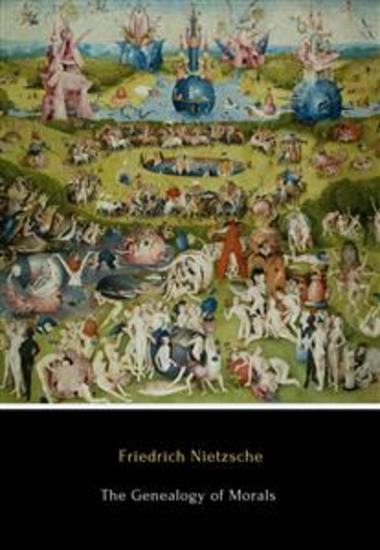
The Genealogy of Morals - cover
LER

The Genealogy of Morals

Friedrich Nietzsche

Editora: Logos

  • 0
  • 1
  • 0

Sinopse

Written in response to a book on the origins of morality by his erstwhile friend Paul Rée, the three essays comprising The Genealogy of Morals — all three advancing the critique of Christian morality set forth in Beyond Good and Evil — are among Nietzsche's most sustained and cohesive work. In the first essay — starting from a linguistic analysis of words such as "good," "bad," and "evil" — Nietzsche sets up a contrast between what he calls "master" morality and "slave" morality and shows how strength and action have often been replaced by passivity and nihilism. The next essay, looking into the origins of guilt and punishment, shows how the concept of justice was born — and how internalization of this concept led to the development of what people called "the soul." In the third essay, Nietzsche dissects the meaning of ascetic ideals. It is not Nietzsche's intention to reject ascetic ideals, "slave" morality, or internalized values out of hand; his main concern is to show that culture and morality, rather than being eternal verities, are human-made. Whether or not you agree with all of his conclusions, his writing is of such clarity and brilliance that you will find reading The Genealogy of Morals nothing short of exhilarating.
Disponível desde: 28/10/2022.


Outros livros que poderiam interessá-lo

  • No Place Like Murder - True Crime in the Midwest - cover

    No Place Like Murder - True...

    Janis Thornton

    • 0
    • 1
    • 0
    “This engrossing collection of historical Midwest murders reads like a thriller. True crime at its best. I couldn’t put it down.” —Susan Furlong, author of the Bone Gap Travellers novels 
     
    A modern retelling of 20 sensational true crimes, No Place Like Murder reveals the inside details behind nefarious acts that shocked the Midwest between 1869 and 1950. The stories chronicle the misdeeds, examining the perpetrators’ mindsets, motives, lives, apprehensions, and trials, as well as what became of them long after. 
     
    True crime author Janis Thornton profiles notorious murderers such as Frankie Miller, who was fed up when her fiancé stood her up for another woman. As fans of the song “Frankie and Johnny” already know, Frankie met her former lover at the door with a shotgun. 
     
    Thornton’s tales reveal the darker side of life in the Midwest, including the account of Isabelle Messmer, a plucky young woman who dreamed of escaping her quiet farm-town life. After she nearly took down two tough Pittsburgh policemen in 1933, she was dubbed “Gun Girl” and went on to make headlines from coast to coast. In 1942, however, after a murder conviction in Texas, she vowed to do her time and go straight. Full of intrigue and revelations, No Place Like Murder also features such folks as Chirka and Rasico, the first two Hoosier men to die in the electric chair after they brutally murdered their wives in 1913. The two didn’t meet until their fateful last night. 
     
    An enthralling and chilling collection, No Place Like Murder is sure to thrill true crime lovers. 
     
    “Thornton wittily describes heretofore unheralded true crime stories from Indiana’s small towns.” —Keven McQueen, author of Horror in the Heartland
    Ver livro
  • Coloring Life - How Loss Invites Us to Live More Vibrant Lives - cover

    Coloring Life - How Loss Invites...

    Dr. Alise Cortez

    • 0
    • 0
    • 0
    Coloring Life: How Loss Invites Us to Live More Vibrant Lives is Dr. Alise Cortez's newest work on grief, meaning, and resilience. It's first a story, an intimate sharing of her experience of losing her parents and how she struggled to make sense of their death. Reading it is like coming home to an old friend and being wrapped in a hug for solace and comfort. Nestled in that embrace to help you connect and better understand your loss, the book's second part offers "whispers of wisdom" she gained through her loss. Death is a great teacher. Losing the ones we love the most can inspire us to treasure our relationships, expand our consciousness, and live more fully.
    Ver livro
  • The Prince - cover

    The Prince

    Niccolò Machiavelli

    • 0
    • 0
    • 0
    The most famous book on politics ever written, The Prince remains as lively and shocking today as when it was written almost five hundred years ago. Initially denounced as a collection of sinister maxims and a recommendation of tyranny, it has more recently been defended as the first scientific treatment of politics as it is practiced rather than as it ought to be practiced. Harvey C. Mansfield’s brilliant translation of this classic work, along with the new materials added for this edition, make it the definitive version of The Prince, indispensable to scholars, students, and those interested in the dark art of politics. 
     
    This revised edition of Mansfield’s acclaimed translation features an updated bibliography, a substantial glossary, an analytic introduction, a chronology of Machiavelli’s life, and a map of Italy in Machiavelli’s time. 
     
    “Of the other available [translations], that of Harvey C. Mansfield makes the necessary compromises between exactness and readability, as well as providing an excellent introduction and notes.”—Clifford Orwin, The Wall Street Journal 
     
    ”Mansfield’s work . . . is worth acquiring as the best combination of accuracy and readability.”—Choice 
     
    ”There is good reason to assert that Machiavelli has met his match in Mansfield. . . . [He] is ready to read Machiavelli as he demands to be read—plainly and boldly, but also cautiously.”—John Gueguen, The Sixteenth Century Journal
    Ver livro
  • Is Thought Detrimental? - Gstaad 1965 - Small Group Discussion 1 - cover

    Is Thought Detrimental? - Gstaad...

    Jiddu Krishnamurti

    • 0
    • 0
    • 0
    "Is thought detrimental? - 15 August 1965  
    • Why does one seek pleasure? 
    • Can the mind only face facts and not thought? 
    • Why have I never said, ‘Thought is poison,’ to myself? 
    • Meeting something one doesn’t know, facing something which has no answer. 
    • Acting without knowing. 
    • What is a state of mind which is silent? 
    • Time is detrimental. 
    • Are we twisting everything to our core of pleasure?"
    Ver livro
  • Volunteer Work - A Trip to Combat Child Trafficking and Prostitution in Thailand - cover

    Volunteer Work - A Trip to...

    Carson Bristol

    • 0
    • 0
    • 0
    Notes from an anti-child-prostitution volunteer in Thailand 
    If you have ever considered volunteer work abroad, it would be good to learn about it from someone who has actually done it. 
    In this story, a volunteer describes his first impressions of Thailand, the problems the country faces when it comes to ethnic minorities and child prostitution, the organization he worked for, and the happy and sad times he experienced in his six-month stay while diligently studying the Thai language and contributing to the community.  
    This short book will give you new insights. It will bypass the central tourists' route and take you to the unseen backroads of a country torn between financial disparity and sexual culture.
    Ver livro
  • Code Work - Hacking across the US México Techno-Borderlands - cover

    Code Work - Hacking across the...

    Héctor Beltrán

    • 0
    • 0
    • 0
    How Mexican and Latinx hackers apply concepts from coding to their lived experiences 


    In Code Work, Héctor Beltrán examines Mexican and Latinx coders' personal strategies of self-making as they navigate a transnational economy of tech work. Beltrán shows how these hackers apply concepts from the code worlds to their lived experiences, deploying batches, loose coupling, iterative processing (looping), hacking, prototyping, and full-stack development in their daily social interactions—at home, in the workplace, on the dating scene, and in their understanding of the economy, culture, and geopolitics. Merging ethnographic analysis with systems thinking, he draws on his eight years of research in México and the United States—during which he participated in and observed hackathons, hacker schools, and tech entrepreneurship conferences—to unpack the conundrums faced by workers in a tech economy that stretches from villages in rural México to Silicon Valley. 


    Beltrán's highly original, wide-ranging analysis uniquely connects technology studies, the anthropology of capitalism, and Latinx and Latin American studies.
    Ver livro