Junte-se a nós em uma viagem ao mundo dos livros!
Adicionar este livro à prateleira
Grey
Deixe um novo comentário Default profile 50px
Grey
Assine para ler o livro completo ou leia as primeiras páginas de graça!
All characters reduced
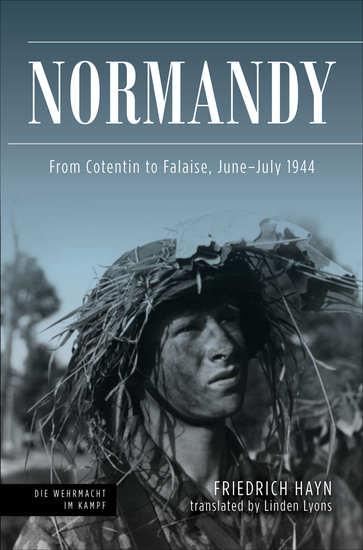
Normandy - From Cotentin to Falaise June–July 1944 - cover
LER

Normandy - From Cotentin to Falaise June–July 1944

Friedrich Hayn

Tradutor Linden Lyons

Editora: Casemate

  • 0
  • 0
  • 0

Sinopse

A German perspective of D-Day, written by an Army Corps intelligence officer in Normandy when the Allies invaded, published in English for the first time. A unique perspective on the decisive early weeks of the invasion in 1944, written by a German Army Corps Intelligence officer stationed in Normandy at the time of the Allied invasion, who during the invasion was the department head for enemy messages processing (Ic) in the staff of the LXXXIV AK. It discusses in detail the events leading up to the creation of Falaise Pocket, described by the author as a “tragic turning point of an entire front.” It discusses in detail the conditions in the American landing section and explains how the German troops based there came to be defeated.Praise for Normandy “Should be read by scholars working on the fighting between the Americans and Germans on the western side of the Normandy front.” —Journal of Military History “The interaction among German command is interesting as it scrambles to patch lines. The book covers battles over D-Day beaches, U.S. paratrooper drops, Cherbourg, hedgerows, Operations Cobra and Luttich, and Falaise Pocket formation and collapse.” —Historical Miniatures Gaming Society “[A] unique, informative, and inherently fascinating study . . . absolutely essential and core addition to personal, professional, community, college, and university library World War II history collections.” —Midwest Book Review
Disponível desde: 16/06/2022.
Comprimento de impressão: 200 páginas.

Outros livros que poderiam interessá-lo

  • Fighter - The True Story of the Battle of Britain - cover

    Fighter - The True Story of the...

    Len Deighton

    • 0
    • 0
    • 0
    "The most honest attempt yet to tell how the Battle of Britain really was" —Andrew Wilson, Observer 


    History is swamped by patriotic myths about the aerial combat fought between the RAF and the Luftwaffe over the summer of 1940. In his gripping history of the Battle of Britain, Len Deighton drew on a decade of research and his own wartime experiences to puncture these myths and point towards a more objective, and even more inspiring, truth. 


    "Revolutionised thinking about the Battle of Britain in a way that has not been seriously challenged since" —The Times
    Ver livro
  • Episode 9 - Environment & Ecology - cover

    Episode 9 - Environment & Ecology

    Anjum Sharma

    • 0
    • 0
    • 0
    Environment and Biodiversity have been hot topics of discussion amongst the entire world community for the last few decades. Many related events took place in the year 2020.  Find out about important environmental events and fundamentals in this episode.
    Ver livro
  • Mysterious Losses of the USS Thresher and USS Scorpion The: The History of the Only American Nuclear Submarines Lost at Sea - cover

    Mysterious Losses of the USS...

    Editors Charles River

    • 0
    • 0
    • 0
    In April 1963, one of the most advanced U.S. hunter-killer nuclear submarines and the 129 men onboard vanished while on a routine voyage. The USS Thresher was one of the country’s most advanced ships, but it had the misfortune of becoming the first American nuclear submarine to be lost at sea, prompting obvious questions over what had happened. Had it accidentally collided with a Soviet ship? Was it destroyed by a new and secret Soviet weapon? Was it secretly captured and taken back to the Soviet Union to reveal its secrets? 
    For those who choose to make the careers as submariners, there is no more beloved service. That is, one hopes, how it was for the 99 men who were serving on the USS Scorpion on May 22, 1968, the fateful day the submarine is believed to have sank. It appears that the crew members died quickly, but however it happened, the grief experienced by their family members dragged on for decades, exacerbated both by the Navy’s lack of information about the submarine’s final moments and the government’s unwillingness to share what little knowledge it had. 
    It is easy in hindsight to criticize the military for its secrecy, but it must be remembered that the Scorpion disappeared at the height of the Cold War, and therefore, little could be said publicly about its fate. Coincidentally, 3 other nuclear submarines suffered mysterious sinkings the same year, and the Cold War adversaries were interested in locating them and gleaning any secrets or technology that they could from the other side’s bad luck. Indeed, it was only after the fall of the Soviet Union that the truth could be told, bringing closure to family members and a dark lesson in espionage to the American people.
    Ver livro
  • Behind the Bill of Rights - Timeless Principles that Make it Tick - cover

    Behind the Bill of Rights -...

    Jeremy Nelson Bill Norton

    • 0
    • 0
    • 0
    The principles behind the Bill of Rights have helped elevate human civilization to a level of liberty never seen in history. The American experiment inspired the spread of written constitutions and declarations of rights throughout the world, which has raised billions out of poverty, chaos, and oppression. However, without understanding the principles behind the Bill of Rights, all nations, including our own, continue to struggle. 
    Behind the Bill of Rights uncovers the timeless principles that make the Bill of Rights tick. The authors reveal lost meanings, elaborate on new understandings, and bring to light many fundamentals that have been overlooked for decades. 
    You will discover hidden gems that will invigorate your mind. For example:The paradox of toleranceThe mindset that leads to slaveryThe voting rights timeline you never knewReligious freedom: both sides are right-and wrongThe Third Amendment is a pattern for all laws, not just the quartering of troopsThe fascinating history of the jury & how it protects usThe lost meaning of the Ninth AmendmentAnd much more 
    Knowing these principles will give you a profound appreciation for the genius of the first ten amendments to the Constitution, and a greater ability to protect your own rights.
    Ver livro
  • The Ancient Wisdom Collection - Meditations the Art of War The Book of Five Rings Tao Te Ching & Many More Classic Works - cover

    The Ancient Wisdom Collection -...

    Sun Tzu, Marcus Aurelius,...

    • 0
    • 0
    • 0
    What if you could draw from a vast reservoir of ancient wisdom to excel in leadership, strategy, and personal growth? 
    This unparalleled anthology unites the most time-tested works on strategy, warfare, self-mastery, and the pursuit of power. Adapted for modern readers, each text provides unique perspectives—ranging from the peaceful introspection of Tao Te Ching to the calculated tactics of The Art of War. Together, they form a guidebook for overcoming challenges and fostering success in any arena. 
    What You’ll Discover in This Comprehensive Collection: 
    - The Art of War – Sun Tzu – A timeless masterpiece on strategic warfare and leadership. 
    - Meditations – Marcus Aurelius – Stoic reflections on discipline, resilience, and self-mastery. 
    - The Book of Five Rings – Miyamoto Musashi – Samurai wisdom on combat, strategy, and personal growth. 
    - Tao Te Ching – Laozi – A foundational text on balance, leadership, and the power of non-action. 
    - The Kybalion – Hermetic Philosophy – Esoteric teachings on universal laws and mental discipline. 
    - Arthashastra – Kautilya – An ancient Indian treatise on statecraft, economics, and military strategy. 
    - The Maxims of War – Napoleon Bonaparte – Insights from one of - history’s greatest military commanders. 
    - Instructions to His Generals – Frederick the Great – Tactical guidance from the Prussian king and military strategist. 
    - The Commentaries of Julius Caesar – Firsthand accounts of war, leadership, and conquest. 
    - History of the Peloponnesian War – Thucydides – A historical analysis of power, politics, and military conflict. 
    Imagine having an entire library of proven wisdom at your fingertips, offering guidance on how to lead, strategize, and live with purpose. This collection is a timeless companion for those seeking mastery in life’s battles—both internal and external. 
    Claim the power of the ages. Get your copy now and embark on an extraordinary journey through the best of ancient strategic thought.
    Ver livro
  • Great Escapes of World War I The: The History of the Most Famous Prisoner Breakouts during the Great War - cover

    Great Escapes of World War I...

    Editors Charles River

    • 0
    • 0
    • 0
    In the first half of the 20th century, war was fought on a global and industrial scale. Millions of men were flung into the grinder of World War I and World War II, leading to commensurately huge numbers of prisoners of war (POWs). Camps were built to hold thousands of captives, with their own barracks blocks, parade grounds, and even farms. In World War I, there were several fronts in the war - Britain, France, Belgium, and Germany faced each other on the Western Front, fought mostly in northeast France and Belgium, while Germany and Austria Hungary faced Russia on the Eastern Front, where much of the war was fought in East Prussia and what is now Poland. The Italians and Austrians fought in the region of northeast Italy, and the Austrians and Bulgarians faced Serbia and then later an Allied army based in Salonica in the Balkans. The Ottomans faced Russia in northeast Anatolia, the British and Allied forces in the Mesopotamian campaign (mainly in today’s Iraq), the British in Palestine, and the Allies at Gallipoli.  
    	Regardless of rank, throughout the war, many of these men did not sit idle. Many spent their time preparing elaborate escape plans in the hopes of returning to their home nations and back to the fight. Following World War I, several books were published giving romantic accounts of successful escapes. For example, the wildly popular film The Great Escape (1963), has been a main factor in how the public views prisoners of war, and while that film was based on a book that details a mass escape of British and Allied prisoners from a World War II German prison camp for aviators, Stalag Luft III, a real escape from a German prisoner camp in World War I inspired the 1944 great escape from Stalag Luft III. 
    Ver livro