Join us on a literary world trip!
Add this book to bookshelf
Grey
Write a new comment Default profile 50px
Grey
Subscribe to read the full book or read the first pages for free!
All characters reduced
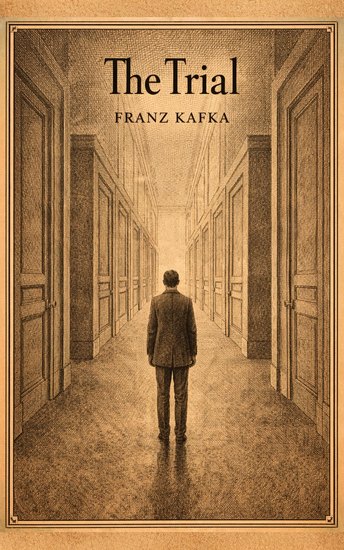
The Trial - cover

The Trial

Franz Kafka

Publisher: CLXBX

  • 0
  • 0
  • 0

Summary

The Trial by Franz Kafka is a haunting and thought-provoking masterpiece of twentieth-century literature that explores guilt, power, and the unsettling nature of modern bureaucracy. First published posthumously in 1925, this profound and unsettling novel tells the story of a man trapped in a mysterious legal system that operates beyond logic, transparency, or mercy.

The novel opens with a startling event: Josef K., an ordinary bank official, is arrested one morning without being informed of the crime he has allegedly committed. Though he is not taken into custody, he is suddenly entangled in a shadowy judicial process that seems to exist everywhere and nowhere at once. Court officials appear in attics and tenement buildings, hearings take place in suffocating rooms filled with onlookers, and legal procedures unfold according to rules that no one fully understands.

As Josef K. attempts to defend himself, he encounters a series of enigmatic characters—warders, clerks, lawyers, painters, and strangers—each offering vague guidance but no clarity. The deeper he ventures into the system, the more incomprehensible and oppressive it becomes. The court's authority is absolute, yet its structure remains invisible, creating a world governed by anxiety, ambiguity, and silent judgment.

Kafka masterfully captures the psychological strain of living under constant accusation. Josef K.'s growing sense of isolation and helplessness reflects broader themes of alienation in modern society. The novel examines the individual's struggle against faceless institutions, questioning the nature of justice, authority, and personal responsibility. Is Josef K. truly innocent, or does guilt exist independently of wrongdoing? Kafka leaves the answer deliberately unresolved, heightening the novel's existential tension.

Written in a stark yet surreal style, The Trial blends realism with nightmarish absurdity. Everyday settings—boarding houses, offices, and courtrooms—take on a dreamlike quality, emphasizing the fragile boundary between normal life and irrational fear. Kafka's exploration of bureaucracy and power has made the term "Kafkaesque" synonymous with situations that are illogical, oppressive, and disorienting.

More than a legal drama, The Trial is a profound meditation on the human condition. It confronts readers with unsettling questions about freedom, accountability, and the search for meaning in a world governed by hidden forces. With its timeless themes and chilling atmosphere, The Trial remains one of the most influential and enduring works of modern literature.
Available since: 02/14/2026.
Print length: 280 pages.

Other books that might interest you

  • The Gold-Bug - cover

    The Gold-Bug

    Edgar Allan Poe

    • 0
    • 0
    • 0
    The narrative of Edgar Allan Poe's novella, which unfolds on Sullivan's Island (South Carolina), revolves around deciphering an encrypted message and searching for a buried treasure. The story was first published in the Philadelphia Dollar Newspaper in June 1843, after Poe won a contest announced by the newspaper, receiving a prize of $100.
    Show book
  • History of Mr Polly The (Unabridged) - cover

    History of Mr Polly The...

    H. G. Wells

    • 0
    • 0
    • 0
    Mr Polly is an ordinary middle-aged man who is tired of his wife's nagging and his dreary job as the owner of a regional gentleman's outfitters. Faced with the threat of bankruptcy, he concludes that the only way to escape his frustrating existence is by burning his shop to the ground, and killing himself. Unexpected events, however, conspire at the last moment to lead the bewildered Mr Polly to a bright new future - after he saves a life, fakes his death, and escapes to a life of heroism, hope and ultimate happiness.
    Show book
  • The Tale of Peter Rabbit - cover

    The Tale of Peter Rabbit

    Beatrix Potter

    • 0
    • 0
    • 0
    The children's story The Tale of Peter Rabbit is written by Beatrix Potter. 
    The naughty bunny Peter goes into the garden of Mr. McGregor even though his mother told him not to. He gets lost and he almost gets caught by Mr. McGregor! 
    A short, funny story for young kids. Great story to listen to before going to bed.
    Show book
  • The Scarlet Plague - cover

    The Scarlet Plague

    Jack London

    • 0
    • 0
    • 0
    "The world was full of people... and then, in a moment, the world was empty."
    
    The year is 2073. An old man, clad in goatskins and wandering the ruins of a wild California, tells his skeptical, savage grandsons about a world they can hardly imagine: a world of airships, teeming cities, and a miracle called "science." He is Professor James Howard Smith, one of the few survivors of the "Scarlet Death" that decimated the global population in 2013. As he recounts the terrifying speed with which the plague spread and the brutal chaos that followed, London delivers a stark warning about the fragility of our modern world and the enduring power of nature.
    
    A Blueprint for Post-Apocalyptica: Jack London was the first to master the "shattered world" aesthetic. He describes iconic landmarks like the San Francisco Bay Area reclaimed by forests and wolves. The novel explores the "Great Regression," where the descendants of scholars and billionaires have become illiterate hunters, losing the hard-won knowledge of their ancestors in just two generations.
    
    The Biological Terror: Unlike many Victorian "plague" stories, London focuses on the terrifying efficiency of the pathogen. The Scarlet Death kills within hours, turning the skin red and paralyzing the body. Through the Professor's eyes, we witness the terrifying realization that no amount of wealth or technology can stop a microscopic enemy once it reaches critical mass.
    
    Witness the end of the world. Purchase "The Scarlet Plague" today and discover the roots of modern survival fiction.
    Show book
  • Dracula – Chapter 7: Cutting from The Dailygraph 8 August - A Chapter-by-Chapter Reading of Bram Stoker’s Classic - cover

    Dracula – Chapter 7: Cutting...

    Bram Stoker

    • 0
    • 0
    • 0
    In this chapter, the narrative leaves personal journals behind and shifts into a gripping newspaper account — a dramatic report of a violent storm at sea and the arrival of a ghostly ship. The Russian vessel Demeter crashes onto the Whitby shore with no crew left aboard, its captain found dead and lashed to the wheel. A huge dog-like creature leaps from the wreck and disappears into the night, leaving only fear and speculation behind. 
    Through eyewitness testimony and sensational reporting, we witness the creeping intrusion of the supernatural into everyday Victorian life. Mina and Lucy remain unaware of the dark presence now stalking their peaceful seaside town, while the shadow of Dracula spreads farther into England with every passing moment. 
    This is Chapter 7 of Bram Stoker’s Dracula, narrated by Amazon bestselling horror author Jonathan Dunne — part of a complete chapter-by-chapter audiobook series that brings the Gothic classic to life with haunting atmosphere, rich characterization, and cinematic storytelling. 
    Experience the mystery of the doomed ship, the storm-lashed terror, and the sinister arrival that marks the beginning of England’s nightmare. 
    📖 Public domain text. Original publication: 1897.
    Show book
  • Concerning the American Language - From their pens to your ears genius in every story - cover

    Concerning the American Language...

    Mark Twain

    • 0
    • 0
    • 0
    Samuel Langhorne Clemens was born in Florida, Missouri on the 30th November 1835 and is far better known by his pen name of Mark Twain.  An American writer and humorist of the first order he is perhaps best known for his novels ‘The Adventures of Tom Sawyer’ and its sequel ‘The Adventures of Huckleberry Finn’ which are often described with that mythic line The Great American Novel. 
    Twain grew up in Hannibal, Missouri which would later provide the backdrop to these great novels.  Apprenticed to a printer he also became a typesetter and then a master riverboat pilot on the Mississippi.  Later, heading west with his brother Orion to make his fortune, he failed at gold mining and instead turned to journalism and thence his true calling as a writer of humorous stories where his wit and humor sparkled from every paragraph, his craft evident with every page and punctured target. 
    A staunch supporter of copyright protections this helped him keep much of the wealth his writing created, though much money was also lost on investments that he pursued in his love for science and technology as well as investing in his own inventions. 
    Twain was born during a visit by Halley’s comet, and he predicted that he would go out with it as well.  He died the day after its subsequent return on 21st April 1910, at his house, Stormfield, located in Redding, Connecticut.
    Show book