¡Acompáñanos a viajar por el mundo de los libros!
Añadir este libro a la estantería
Grey
Escribe un nuevo comentario Default profile 50px
Grey
Suscríbete para leer el libro completo o lee las primeras páginas gratis.
All characters reduced
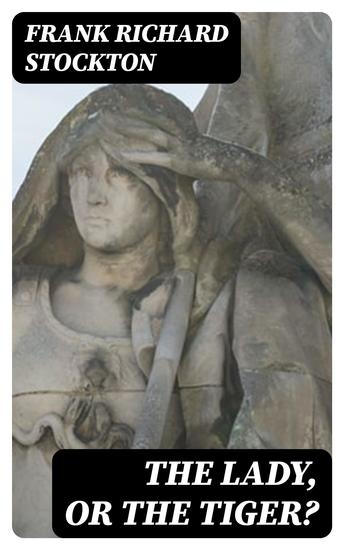
The Lady or the Tiger? - cover

The Lady or the Tiger?

Frank Richard Stockton

Editorial: DigiCat

  • 0
  • 0
  • 0

Sinopsis

Frank Richard Stockton's "The Lady, or the Tiger?" is a masterful blend of allegory and narrative that explores the complexities of human emotion, morality, and choice. Set in a semi-medieval society, the story revolves around a predicament faced by the protagonist, consigned to a unique trial dictated by the whims of a semi-barbaric king. The plot intricately weaves themes of love, jealousy, and the dichotomy of human nature, culminating in an open-ended conclusion that leaves the reader grappling with the implications of choice, guilt, and societal judgement. Stockton's playful yet provocative prose employs vivid imagery and irony, making his style both engaging and thought-provoking, which reflects the conventions of 19th-century American literature while subverting traditional narrative expectations. Stockton, an influential American writer, was known for his playful storytelling and keen insights into the human condition. Born in 1834, he was a prominent figure in the literary culture of his time, exploring themes of morality and existentialism through his works. His background in humor, parables, and fairy tales informed the creation of this iconic story, which encourages readers to ponder the intricacies of decision-making and the often paradoxical nature of love and desire. "The Lady, or the Tiger?" is a compelling read for anyone curious about the human psyche and ethical dilemmas. It invites a deeper reflection on personal choices, prompting readers to consider their own values and judgments. This tale's provocative ending will linger long after the final page, making it a must-read for lovers of literature that challenges conventions and stirs intellectual debate.
Disponible desde: 16/09/2022.
Longitud de impresión: 105 páginas.
Otros libros que te pueden interesar

  • North and South - cover

    North and South

    Elizabeth Gaskell

    • 0
    • 0
    • 0
    "North and South" is a social novel by English writer Elizabeth Gaskell, published in 1855. The story is set in the fictional industrial town of Milton in the North of England and contrasts the way of life in the industrial North with that in the rural South. The novel follows Margaret Hale, a young woman from rural southern England, who moves to the northern industrial town and encounters the stark realities of industrialization, class conflict, and social upheaval. The novel explores themes of industrialization, class differences, gender roles, and societal change. Margaret’s evolving relationships, particularly with the mill owner John Thornton, form the crux of the narrative
    Ver libro
  • Old New York - cover

    Old New York

    Edith Wharton

    • 0
    • 0
    • 0
    Spanning four decades in the mid-nineteenth century, the interconnected novellas of Old New York lay out the complex and inscrutable codes, customs, and taboos of New York society in classic Wharton style.
    
    In False Dawn (1840s), Mr. Halston Raycie sends his son Lewis to Europe to buy art, as Mr. Raycie aims to ascend to the upper crust of society by means of a well-respected art collection. But when Lewis returns from Europe with daring pieces by artists unknown to the New York socialites and tastemakers, his appalled father disinherits him, only to discover, too late, the wisdom of his son's intuition.
    The Old Maid (1850s), the best known of the four novellas, follows the life of Tina, a young woman caught between the mother who adopted her--the beautiful, upstanding Delia--and her true mother, her plain, unmarried aunt Charlotte, who gave Tina up to provide her with a socially acceptable life. The three women live quietly together until Tina's wedding day, when Delia's and Charlotte's hidden jealousies rush to the surface.
    
    Then in The Spark (1860s), Mr. Hayley Delane recounts how his life has turned out since he was wounded in the Civil War, where, during his rehabilitation, he chances to meet a certain American poet whose memory stays with him all his life.
    
    And finally in New Year's Day (1870s), Mrs. Lizzie Hazeldean's suspected affair with the unmarried Henry Prest is the center of scandal and gossip in the city, but the true nature of the relationship is not what it may seem.
    Ver libro
  • The Pilgrims Progress - cover

    The Pilgrims Progress

    John Bunyan

    • 0
    • 0
    • 0
    "The Pilgrim's Progress" by John Bunyan is one of the most important works of English literature. Initially published in 1678, this religious allegory details the journey of the protagonist, Christian, from his hometown to the Celestial City. Along the way, Christian encounters various symbolic characters and obstacles that represent the trials and tribulations faced by a soul on its path to the Christian faith. The work is divided into two parts: the first follows Christian's journey, while the second part, published in 1684, follows the journey of his wife, Christiana. It's a deeply spiritual and moral text that has had a significant influence on Christianity and literature
    Ver libro
  • The Adventure of the Abbey Grange - cover

    The Adventure of the Abbey Grange

    Arthur Conan Doyle

    • 0
    • 0
    • 0
    The Adventure of the Abbey Grange, one of the 56 Sherlock Holmes short stories written by Sir Arthur Conan Doyle, is one of 13 stories in the cycle collected as The Return of Sherlock Holmes.Holmes wakes Doctor Watson up early one winter morning to rush to a murder scene at the Abbey Grange near Chislehurst. Sir Eustace Brackenstall has been killed, apparently by burglars. Inspector Stanley Hopkins believes that it was the infamous Randall gang who have committed several other burglaries in the neighborhood.Holmes and Watson arrive at Abbey Grange. There, Lady Brackenstall tells Holmes that her marriage was not happy. Sir Eustace Brackenstall was a violent, abusive drunkard. She then tells that about 11 o'clock, in the dining room, she encountered an elderly man coming in the French window, followed by two younger men. The older man struck her in the face, knocking her out. When she came to, she was tied to an oaken chair with the bellrope, which they had torn down, and gagged. Then Sir Eustace came into the room, and rushed at the intruders. One of them struck and killed him with a poker. Lady Brackenstall fainted again for a minute or two. She saw the intruders drinking wine from a bottle taken from the sideboard. Then they left, taking some silver plate...Famous works of the author Arthur Conan Doyle: A Study in Scarlet, The Sign of the Four, The Adventures of Sherlock Holmes, The Memoirs of Sherlock Holmes, The Hound of the Baskervilles, The Return of Sherlock Holmes, The Valley of Fear, His Last Bow, The Case-Book of Sherlock Holmes, Stories of Sherlock Holmes, The Lost World.
    Ver libro
  • The Old Adam - cover

    The Old Adam

    D H Lawrence

    • 0
    • 0
    • 0
    ‘The Old Adam’  The story is set in lodgings in Croydon and the incident may again be autobiographical but the story examines for the first time in Lawrence’s writing, the different and conflicting loves between men and women.
    Ver libro
  • A Doll's House - cover

    A Doll's House

    Henrik Ibsen

    • 0
    • 0
    • 0
    A door slams, and the echoes never fade. Henrik Ibsen's A Doll's House (1879) is a play that doesn't shout—it lingers, unsettling and undeniable. Beneath the surface of a seemingly ordinary household lies a quiet storm, gathering strength with every polite exchange, every carefully placed smile.
    Nora Helmer is a wife, a mother, a woman adored. Her home is warm, her life is comfortable, her husband sings her praises. But when a long-kept secret begins to unravel, so does the delicate balance of her world. What happens when the roles we play no longer fit? When the words we speak don't match the voices inside us?
    Ibsen doesn't lecture, doesn't plead—he simply opens a door and lets us look inside. What we see is up to us. Is it a tale of liberation or betrayal? A tragedy or a beginning? More than a century later, the questions still stand, just as urgent, just as sharp.
    With A Doll's House, Ibsen didn't just write a play. He set a stage for countless conversations, forcing audiences to lean in, to question, to wonder. And when the final moment comes, when the door closes behind Nora, it isn't just her world that shifts. It's ours, too.
    Ver libro