Junte-se a nós em uma viagem ao mundo dos livros!
Adicionar este livro à prateleira
Grey
Deixe um novo comentário Default profile 50px
Grey
Assine para ler o livro completo ou leia as primeiras páginas de graça!
All characters reduced
A New Capitalism - Creating A Just Economy That Works for All - cover
LER

A New Capitalism - Creating A Just Economy That Works for All

Frank Altman

Editora: Forbes Books

  • 0
  • 0
  • 0

Sinopse

Invest With Social Responsibility, It Can Be A Tool For GoodIn 1977, two years after I graduated from Brown University, college students around the country launched a movement against Apartheid. Their campaign focused on divestment: convincingAmerican corporations to sell shares of companies doing business with South Africa's Apartheid government. The foundation of their argument was moral and straightforward, that no one should profit from a system that brutally oppresses people. By the mid-1980s, the divestment campaign became made pariahs of the companies still willing to transact with the Apartheid regime. Reflecting on the movement, in 2010 Archbishop Desmond Tutu wrote, “We could not have achieved our freedom and just peace without the help of people around the world, who through the use of non-violent means, such as boycotts and divestment, encouraged their governments and other corporate actors to reverse decades-long support for the Apartheid regime.”Socially responsible investing is rooted in the recognition that money, because it holds power in people’s imaginations, can be a tool for accomplishing good.
Disponível desde: 26/09/2023.
Comprimento de impressão: 283 páginas.

Outros livros que poderiam interessá-lo

  • State of the Union 1985 - cover

    State of the Union 1985

    Ronald Reagan

    • 0
    • 0
    • 0
    The 1985 State of the Union Address delivered February 6, 1985, on Reagan’s 74th birthday, reports the strongest economic growth in 34 years, 3-year inflation of 3.9%, and more citizens working than ever before.  Despite progress Reagan notes “millions in our inner cities who long for real jobs, safe neighborhoods, and schools that truly teach” and people around the world “who struggle to break free from totalitarianism”.  
    “Our economy is not getting older and weaker; it's getting younger and stronger.” Reagan calls for further tax cuts to make America the investment capital of the world. He calls for enterprise zones, rejects policies that break up families and increase dependency, and says that “blacks, Hispanics, and all minorities will not have full and equal power until they have full economic power.” 
    “National security is government's first responsibility”. We “only have a military-industrial complex until a time of danger, and then it becomes the arsenal of democracy.” Reagan advocates the Strategic Defense Initiative against ballistic missiles as “the most hopeful possibility of the nuclear age” and looks forward to “the day when nuclear weapons are banned from this Earth forever.” Some say it will take a long time. The “answer to that is: Let’s get started.” 
    “Many countries in east Asia and the Pacific have few resources other than the enterprise of their own people. But through low tax rates and free markets they've soared ahead of centralized economies.” … “We've seen the benefits of free trade and lived through the disasters of protectionism. Tonight I ask all our trading partners, developed and developing alike, to join us in a new round of trade negotiations to expand trade and competition and strengthen the global economy …”   
    Audio recording courtesy of the Ronald Reagan Presidential Library. 
    AspenLeafMedia.com
    Ver livro
  • Hillbilly Nationalists Urban Race Rebels and Black Power - Interracial Solidarity in 1960s-70s New Left Organizing - cover

    Hillbilly Nationalists Urban...

    James Tracy, Amy Sonnie

    • 0
    • 0
    • 0
    Some of the most important and little-known activists of the 1960s were poor and working-class radicals. Inspired by the Civil Rights movement, the Black Panthers, and progressive populism, they started to organize significant political struggles against racism and inequality during the 1960s and into the 1970s. 


    Historians of the period have traditionally emphasized the work of white college activists who courageously took to the streets to protest the war in Vietnam and continuing racial inequality. Poor and working-class whites have often been painted as spectators, reactionaries, and, even, racists. But authors James Tracy and Amy Sonnie disprove that narrative. 


    Through over ten years of research, interviewing activists along with unprecedented access to their personal archives, Tracy and Sonnie tell a crucial, untold story of the New Left. Their deeply sourced narrative history shows how poor and working-class individuals from diverse ethnic, rural and urban backgrounds cooperated and drew strength from one another. The groups they founded redefined community organizing, and transformed the lives and communities they touched.
    Ver livro
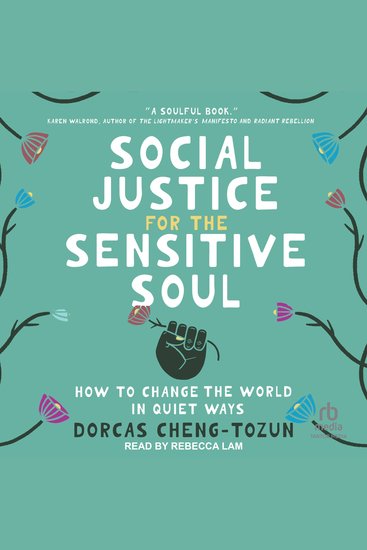
  • Social Justice for the Sensitive Soul - How to Change the World in Quiet Ways - cover

    Social Justice for the Sensitive...

    Dorcas Cheng-Tozun

    • 0
    • 0
    • 0
    Social justice work, we often assume, is raised voices and raised fists. But what does it look like for those of us who don't feel comfortable battling in the trenches? Sustaining justice work can be particularly challenging for the sensitive, and it requires a deep level of self-awareness. 


    In Social Justice for the Sensitive Soul, writer Dorcas Cheng-Tozun offers six possible pathways for sensitive types: Connectors: relational activists whose interactions and conversations build the social capital necessary for change; Creatives: artists and creators whose work inspires, sheds light, makes connections, and brings issues into the public consciousness; Record Keepers: archivists who preserve essential information and hold our collective memory and history; Builders: inventors, programmers, and engineers who center empathy as they develop society-changing products and technologies; Equippers: educators, mentors, and elders who build skills and knowledge within movements and shepherd the next generation of changemakers; and Researchers: data-driven individuals who utilize information as a persuasive tool to effect change and propose options for improvement. 


    Cheng-Tozun expands the possibilities of how to have a positive social impact, affirming the particular gifts and talents that sensitive souls offer to a hurting world.
    Ver livro
  • The Illusion of Control - Why Financial Crises Happen and What We Can (and Can't) Do About It - cover

    The Illusion of Control - Why...

    Jon Danielsson

    • 0
    • 0
    • 0
    A challenge to the conventional wisdom surrounding financial risk, providing insight into why easy solutions to control the financial system are doomed to fail 


    Finance plays a key role in the prosperity of the modern world—but it also brings grave dangers. We seek to manage those threats with a vast array of sophisticated mathematical tools and techniques of financial risk management. Too often, though, we fail to address the greatest risk—the peril posed by our own behavior. 


    Jón Daníelsson argues that critical risk is generated from within, through the interactions of individuals and perpetuated by their beliefs, objectives, abilities, and prejudices. He asserts that the widespread belief that risk originates outside the financial system frustrates our ability to measure and manage it, and the likely consequences of new regulations will help alleviate small-scale risks but, perversely, encourage excessive risk taking. Daníelsson uses lessons from past and recent crises to show that diversity is the best way to safeguard our financial system.
    Ver livro
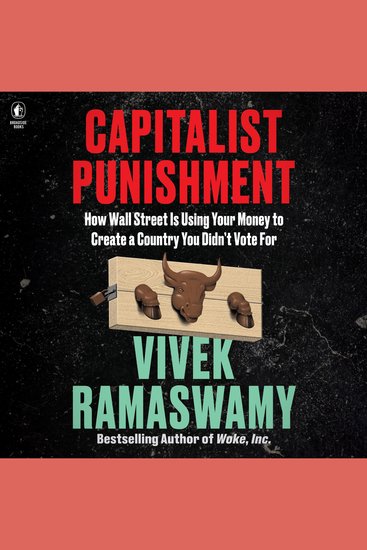
  • Capitalist Punishment - How Wall Street Is Using Your Money to Create a Country You Didn't Vote For - cover

    Capitalist Punishment - How Wall...

    Vivek Ramaswamy

    • 0
    • 0
    • 0
    A Wall Street cartel has quietly seized control of the American economy, and they are forcing governments and businesses to bow down to their political agenda—using your money to do it. 
    Three Wall Street firms have quietly amassed more money than Jeff Bezos, Elon Musk, Andrew Carnegie, and John Rockefeller combined. But the money isn’t even theirs. These asset managers have accumulated all their power through “passive funds,” as most investors no longer believe anyone can reliably pick stocks. Yet the Big Three have decided that they can reliably pick the right social policies instead. 
    As entrepreneur Vivek Ramaswamy reveals, the results are all bad—and working their way into every corner of the economy. They force US companies to adopt “racial equity audits” and “emissions caps” while supporting human rights atrocities in China. They coerce Western companies to produce less oil while shifting production to dirtier places like Russia. They allow companies like FTX to take victory laps on good management while collapsing like a house of cards. They charge high fees to mom-and-pop investors for so-called sustainable funds that are effectively identical to lower-fee index funds. 
    Worst of all, they’re celebrated as heroes—at least so far. Capitalist Punishment lifts the veil on the largest fiduciary breaches, antitrust abuses, and First Amendment violations of the twenty-first century, misdeeds that are hiding in plain sight.  
    This isn’t just a threat to capitalism. It’s a threat to democratic self-governance itself. Capitalist Punishment is an easy-to-follow educational tour de force for every participant in financial markets—which, to the surprise of most Americans, includes nearly every single one of them.
    Ver livro
  • Operation Al-Aqsa flood The Defeat of the Vanquisher - cover

    Operation Al-Aqsa flood The...

    Jacques Baud

    • 0
    • 0
    • 0
    Why did Operation Al-Aqsa Flood take place, and what were Hamas’s objectives? What really happened on the ground on October 7th? What lessons can we learn from the operations carried out by both sides? 
    To answer these three questions and many others, Jacques Baud revisits the Israeli-Palestinian conflict from its very beginnings. Why has it still not found a solution? What strategies have Israelis and Palestinians adopted over the past 75 years? What is the impact of this conflict on our security? What are the options for Israel and Palestine in the coming years? 
    In this book of rare clairvoyance, Jacques Baud deplores the fact that Western decisions are colliding with international law. The question is not who we are for, but how the international order created after 1945 should be applied. Israel’s failure to respect this law is provoking its downfall. As with any conflict, the solution will not come from emotion, but from objective, dispassionate analysis and honest mediation.
    Ver livro