Join us on a literary world trip!
Add this book to bookshelf
Grey
Write a new comment Default profile 50px
Grey
Subscribe to read the full book or read the first pages for free!
All characters reduced
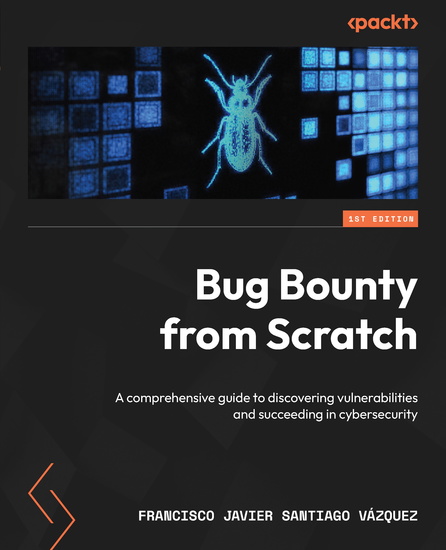
Bug Bounty from Scratch - A comprehensive guide to discovering vulnerabilities and succeeding in cybersecurity - cover

Bug Bounty from Scratch - A comprehensive guide to discovering vulnerabilities and succeeding in cybersecurity

Francisco Javier Santiago Vázquez

Publisher: Packt Publishing

  • 0
  • 0
  • 0

Summary

Bug bounty programs help to enhance cybersecurity by incentivizing ethical hackers to discover vulnerabilities. This book is a comprehensive guide, equipping you with practical skills to excel in bug bounty programs and contribute to a safer digital ecosystem.You’ll start with an introduction to the bug bounty world, followed by preparation techniques for participation, including vulnerability discovery methods, tools, and resources. Specific sections will provide you with tips and best practices to help you optimize rewards. The book also aims to cover fundamental aspects, such as program structure, key tools, methodologies, and common vulnerabilities, drawing insights from community hackers’ public reports. As you progress, you’ll discover that ethical hacking can be legally learned through bug bounty programs, gaining practical knowledge of offensive security and bug bounty platform operations.By the end of this bug bounty book, you’ll have the confidence you need to navigate bug bounty programs, find security vulnerabilities, craft reports, and reap rewards.
Available since: 06/28/2024.
Print length: 238 pages.

Other books that might interest you

  • Cornerstone at the Confluence - Navigating the Colorado River Compact's Next Century - cover

    Cornerstone at the Confluence -...

    Jason A. Robison

    • 0
    • 0
    • 0
    Signed on November 24, 1922, the Colorado River Compact is body of laws colloquially called the "Law of the River" that governs how human beings use water from the river system dubbed the "American Nile." No fewer than forty million people have come to rely on the Colorado River system in modern times—a system immersed in an unprecedented, unrelenting megadrought for more than two decades. Attempting to navigate this "new normal," policymakers are negotiating new management rules for the river system, a process coinciding with the compact's centennial that must be completed by 2026. 


    Animated by this remarkable confluence of events, Cornerstone at the Confluence leverages the centennial year to reflect on the compact and broader "Law of the River" to envision the future. It is a volume inviting dialogue about how the river system's flows should be apportioned given climate change, what should be done about environmental issues such as ecosystem restoration and biodiversity protection, and how long-standing issues of water justice facing Native American communities should be addressed. 


    These topics touch on the concept of "equity" embedded within the compact—a concept that tees up what is perhaps the foundational question confronted by Cornerstone at the Confluence: Who should have a seat at the table of Colorado River governance?
    Show book
  • The Inventions of Ancient Egypt - Pioneering Technologies and Ideas - cover

    The Inventions of Ancient Egypt...

    Omar Khalil

    • 0
    • 0
    • 0
    Ancient Egypt's writing systems stand as a testament to human ingenuity and cultural expression. The development of writing marked a pivotal point in Egyptian civilization, allowing for the documentation of history, religion, and daily life. Among the most significant inventions were hieroglyphs, which evolved into more simplified forms such as hieratic and demotic scripts. These writing systems not only served practical purposes but also played a crucial role in shaping Egypt’s legacy. 
    The invention of hieroglyphs can be traced back to around 3100 BCE. These symbols, composed of pictorial and phonetic elements, were carved into stone monuments and written on papyrus scrolls. Hieroglyphs were primarily used for religious texts, inscriptions on temples, and royal decrees. The complexity and beauty of this script were not just artistic but symbolic, as each symbol held both sound and meaning. Hieroglyphic writing required skilled scribes, who underwent rigorous training to master the hundreds of characters used in various contexts. 
    Over time, the need for quicker, more practical writing gave rise to hieratic script, a simplified and cursive form of hieroglyphs. Hieratic was used mainly for administrative and literary texts, allowing scribes to write more efficiently on papyrus. This new form retained the symbolic power of hieroglyphs but adapted to the demands of record-keeping and correspondence. As hieratic became more widespread, it bridged the gap between the formal, ceremonial writing of hieroglyphs and the everyday needs of administration and commerce.
    Show book
  • Dark Space Enigmas - Dark Matter and the Evolution of Galaxies - cover

    Dark Space Enigmas - Dark Matter...

    Dirk Fallon

    • 0
    • 0
    • 0
    The cosmic frontier has long captivated human imagination as it holds the mysteries of the universe in its vast expanses. From the earliest observations of the night sky, humanity has been drawn to the unknown depths beyond our planet, seeking to unravel the secrets of dark matter and the intricate evolution of galaxies. In this chapter, we explore the beginnings of our cosmic journey and the fundamental forces that shape the universe, setting the stage for a deeper understanding of the interplay between dark matter and galactic evolution. 
    The universe, in its infancy, was a turbulent and dynamic environment where matter and energy coalesced into the structures we observe today. In the early moments following the Big Bang, subtle fluctuations in density laid the groundwork for the formation of dark matter haloes, which in turn influenced the emergence of galaxies. These initial irregularities acted as seeds that grew over time through gravitational attraction, gradually giving rise to the complex web of cosmic structures that now stretches across the observable universe. 
    As we peer into the cosmic frontier, the concept of dark matter becomes central to our understanding of the universe’s architecture. Dark matter, an invisible substance that does not interact with light in the conventional manner, exerts gravitational forces that shape the evolution of galaxies. Although its exact composition remains elusive, its effects are evident in the rotational speeds of galaxies and the clustering of matter on cosmic scales. The study of these phenomena provides critical clues about the underlying nature of dark matter and the processes that govern the birth and evolution of galactic systems.
    Show book
  • How to Hack Your Vagus Nerve - Exercises to Dramatically Reduce Inflammation Anxiety and Trauma With Vagal Stimulation - cover

    How to Hack Your Vagus Nerve -...

    Angelina Power

    • 0
    • 0
    • 0
    The vagus nerve is the most important nerve you probably didn’t know you had. 
    The vagus nerve is a long meandering bundle of motor and sensory fibers that links the brain stem to the heart, lungs, and gut. It also branches out to touch and interact with the liver, spleen, gallbladder, ureter, female fertility organs, neck, ears, tongue, and kidneys. 
    Dr Justin Hoffman, a Santa Rosa, California, licensed naturopathic medical physician, says: 
    “Without the vagus nerve, key functions that keep us alive would not be maintained.” 
    Nationally recognized sports nutritionist, strength, and conditioning coach Brandon Mentore elaborates: 
    “The vagus nerve is extremely critical to your overall health and is intimately tied in with multiple organs and systems of the body.” 
    Vagus nerve dysfunction can result in a whole host of problems including obesity, bradycardia (abnormally slow heartbeat), difficulty swallowing, gastrointestinal diseases, fainting, mood disorders, B12 deficiency, chronic inflammation, impaired cough, and seizures. 
    Meanwhile, the vagus nerve stimulation has been shown to improve conditions such as: 
    - Anxiety disorder 
    - Heart disease 
    - Tinnitus 
    - Obesity 
    - Alcohol addiction 
    - Migraines 
    - Alzheimer’s 
    - Leaky gut 
    - Bad blood circulation 
    - Mood disorder 
    - CancerWhether you are feeling anxiety or depression, you can use tools to engage your social nervous system to re-establish higher order nervous system functions.
    Show book
  • The Smartphone Solution - cover

    The Smartphone Solution

    Dr Martha Deiros Collado

    • 0
    • 0
    • 0
    The Essential Self-Help Guide to Your Children Thriving in a Digital Age from Clinical Psychologist and Bestselling Author Dr Martha Deiros Collado 
    ‘The book us parents urgently need’ Dr Julie Smith 
    The smartphone dilemma: it’s on every parent’s mind. When should I let my child have a phone? What are the risks and how can I protect them? How can I encourage and nurture healthy digital habits? In The Smartphone Solution, highly respected child-and-family clinical psychologist Dr Martha Deiros Collado provides the answers so you can:determine the right age to give your child a phoneanswer the questions they may have and turn these conversations into moments that build connectiondistinguish the real risks and benefits of smartphones from the misinformationteach yourself and older siblings to model healthy phone habitsnavigate online safety, digital footprints, consent and family tech boundariessign the Family Phone Pledge and build a supportive community with like-minded parents. 
    Written with Dr Martha’s characteristic warmth and empathy, The Smartphone Solution will provide the information and tools you need to support your child and allow them to thrive in the modern digital world. 
    In The Smartphone Solution, Dr Martha Deiros Collado, an expert in parenting and education, provides a comprehensive guide to navigating the stages of introducing your child to the world of internet and devices. This non-fiction book is a top pick for parents seeking to balance privacy and the digital life of their children. 
    For fans of Sarah Ockwell-Smith (Between), Philippa Perry (The Book You Want Everyone You Love* To Read *(and maybe a few you don’t)), and Emma Svanberg (Why Birth Trauma Matters). 
    HarperCollins 2025
    Show book
  • Owning the Sun - A People's History of Monopoly Medicine from Aspirin to COVID-19 Vaccines - cover

    Owning the Sun - A People's...

    Alexander Zaitchik

    • 0
    • 0
    • 0
    Owning the Sun tells the story of one of the most contentious fights in human history: the legal right to control the production of lifesaving medicines. Medical science began as a discipline geared toward the betterment of all human life, but the merging of research with intellectual property and the rise of the pharmaceutical industry warped and eventually undermined its ethical foundations. Why does the US government fund the development of medical science in the name of the public, only to relinquish exclusive rights to drug companies, and how does such a system impoverish us, weaken our responses to global crises, and, as in the case of AIDS and COVID-19, put the world at risk? 


    Outlining how generations of public health and science advocates have attempted to hold the line against Big Pharma and their allies in government, Alexander Zaitchik's first-in-kind history documents the rise of medical monopoly in the United States and its subsequent globalization. From the controversial arrival of patent-wielding German drug firms in the late nineteenth century, to present-day coordination between industry and philanthropic organizations—including the influential Gates Foundation—that stymie international efforts to vaccinate the world against COVID-19, Owning the Sun tells one of the most important and least understood histories of our time.
    Show book