Junte-se a nós em uma viagem ao mundo dos livros!
Adicionar este livro à prateleira
Grey
Deixe um novo comentário Default profile 50px
Grey
Assine para ler o livro completo ou leia as primeiras páginas de graça!
All characters reduced
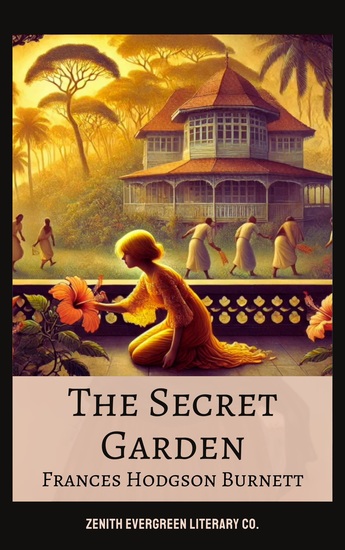
The Secret Garden - Frances Hodgson Burnett's Enchanting Tale of Hope and Renewal - cover
LER

The Secret Garden - Frances Hodgson Burnett's Enchanting Tale of Hope and Renewal

Frances Hodgson Burnett, Zenith Evergreen Literary Co.

Editora: Zenith Evergreen Literary Co.

  • 0
  • 0
  • 0

Sinopse

🌸 Unlock the magic of The Secret Garden, Frances Hodgson Burnett's timeless classic that has charmed readers for generations. This heartwarming story of transformation and friendship will take you on a journey of discovery and healing. 🌿

📖 Follow Mary Lennox, a lonely and spoiled orphan, as she uncovers the mysteries of a hidden garden in her uncle's vast Yorkshire estate. With the help of new friends, Mary breathes life back into the garden—and in doing so, finds joy, love, and a sense of belonging. 🌼

🏆 A cornerstone of children's literature, The Secret Garden continues to inspire readers of all ages with its themes of resilience, growth, and the beauty of nature. 🌏

👉 Click "Buy Now" to step into a world of wonder and rediscover the magic of hope and renewal.
Disponível desde: 11/04/2025.
Comprimento de impressão: 281 páginas.
Outros livros que poderiam interessá-lo

  • Typee - cover

    Typee

    Herman Melville

    • 0
    • 0
    • 0
    "Typee" is a novel written by Herman Melville and published in 1846. It is partly based on Melville's own experiences as a sailor and his brief stay in the Marquesas Islands in the South Pacific. The novel follows the adventures of Tommo, the narrator, who jumps ship with his companion Toby and finds themselves living among the Typee people, a Polynesian tribe known for their reputed cannibalism. 
     
    "Typee" offers a fictionalized account of the time Melville spent living with the Typee tribe, providing vivid descriptions of the landscape, customs, and rituals of the people he encountered. The novel presents a contrast between the seemingly idyllic and harmonious life of the Typee and the harsh realities of Western civilization. Melville explores themes of cultural encounter, colonialism, and the clash between primitive and civilized societies. 
     
    Throughout the novel, Melville reflects on the inherent biases and misunderstandings that arise when encountering different cultures. He challenges prevailing stereotypes and offers a more nuanced portrayal of the Typee people, depicting them as complex and fully realized characters rather than exoticized caricatures. The novel raises questions about the nature of civilization, the impact of colonialism on indigenous peoples, and the tensions between individual freedom and societal norms. 
     
    "Typee" garnered significant attention upon its publication, captivating readers with its adventurous narrative and its exploration of the exotic and unfamiliar. The novel contributed to the growing interest in the South Pacific and its cultures during the 19th century, influencing subsequent literary works and travel writing. While "Typee" is often overshadowed by Melville's later and more renowned works, such as "Moby-Dick," it remains an important early work in his career and a fascinating exploration of cultural encounters and human nature.
    Ver livro
  • SOE Agent Code Name LILLY - cover

    SOE Agent Code Name LILLY

    Steve Urry

    • 0
    • 0
    • 0
    Mary Dumont is a third officer in the Women’s Royal Naval Service working at the Admiralty Communications Centre in London in 1942 where she is recruited by the Special Operations Executive (SOE) to become a wireless operator-saboteur. Parachuted into France, Mary joins a small band of resistance fighters where she leads a double life, a schoolteacher by day, a wireless operator by night; all goes horribly wrong, Mary is captured and tortured by an SS major who is determined to obtain both her codes and the names of her companions. Mary makes a daring escape during an air raid, unknown to her, German Intelligence has infiltrated SOE, a double agent known to Mary has also been parachuted into France to capture a Dutch scientist who is escaping to England with plans for the German V1 flying bomb. Evading capture, 
    Mary’s resistance cell must get the scientist to England before he can be handed over to the Gestapo, but first Mary must eliminate the German double agent. Just when she thinks it is safe on returning to England, Mary and her companions discover the identity of the traitor within SOE, they must try to eliminate him before he can return the scientist to the Germans.
    Ver livro
  • A Complete Recovery - From their pens to your ears genius in every story - cover

    A Complete Recovery - From their...

    Barry Pain

    • 0
    • 0
    • 0
    Barry Eric Odell Pain was born at 3 Sydney Street in Cambridge on 28th September 1864. He was one of 4 children. 
    He was educated at Sedbergh School and then Corpus Christi College, Cambridge. 
    In 1889, Cornhill Magazine published his short story ‘The Hundred Gates’.  This opened the way for Pain to advance his literary career on several fronts. He became a contributor to Punch and The Speaker, as well as joining the staff of both the Daily Chronicle and Black and White.  
    Pain was also a noted and prominent contributor to The Granta and from 1896 to 1928 a regular contributor to the Windsor Magazine. 
    It is often said that Pain was discovered by Robert Louis Stevenson, who compared his work to that of Guy de Maupassant.  It’s an apt comparison. Pain was a master of disturbing prose but was also able to inject parody and light comedy into many of his works.  A simple premise could in his hands suddenly expand into a world very real but somehow emotionally fraught and on the very edge of darkness. 
    Barry Pain died on 5th May 1928 in Bushey, Hertfordshire.
    Ver livro
  • Stories To Make You Cry - Sometimes you need a good cry - cover

    Stories To Make You Cry -...

    Anton Chekhov, Stephen Crane,...

    • 0
    • 0
    • 0
    When we read or listen, words can have a transforming effect.  Our mood can alter in the space of a few sentences from joy to sadness.  And not just our mood.  These words can affect us physically, they can engage our emotions and even in their sadness bring a lump to our throat and tears to our eyes.  Sometimes the relief can be palpable. 
     
    Our authors, from Anton Chekhov, Stephen Crane, Willa Cather, Katherine Mansfield and a wealth of others are well aware of what their talents will evoke.   Genius has many names.   
     
    1 - Short Stories To Make You Cry  - An Introduction 
    2 - Vanka by Anton Chekhov 
    3 - A Dark Brown Dog by Stephen Crane 
    4 - Suicides by Guy de Maupassant 
    5 - The Life of Ma Parker by Katherine Mansfield 
    6 - The District Doctor by Ivan Turgenev 
    7 - Paul's Case by Willa Cather 
    8 - Hands by Sherwood Anderson 
    9 - Silence by Leonid Andreyev 
    10 - The Stones of the Village by Alice Dunbar Nelson 
    11 - Hide And Seek or Pliatki by Fyodor Sologub
    Ver livro
  • A Dark Brown Dog - cover

    A Dark Brown Dog

    Stephen Crane

    • 0
    • 0
    • 0
    A dog. A child. A rope that drags, and a bond that tightens.
    In this brief, haunting tale, Stephen Crane casts a quiet, unflinching gaze at innocence, cruelty, and the strange bargains we make in the name of love.
    Told in spare, evocative prose, A Dark Brown Dog is more than it appears — a fable with no moral, a friendship with no promise, a home with no safety.
    You may not be sure where the pain ends and the loyalty begins.
    But you will know you've seen something true.
    Ver livro
  • Winnie-the-Pooh - cover

    Winnie-the-Pooh

    Alan Alexander Milne

    • 0
    • 0
    • 0
    Winnie-the-Pooh is a children's book by English author A.A. Milne and English illustrator E.H. Shepard. Published in 1926, it is a collection of short stories about an anthropomorphic teddy bear, Winnie-the-Pooh, and his friends Christopher Robin, Piglet, Eeyore, Owl, Rabbit, Kanga, and Roo. It is the first of two story collections by Milne about Winnie-the-Pooh, the second being The House at Pooh Corner (1928).
    Milne and Shepard collaborated previously for English humour magazine Punch, and in 1924 created When We Were Very Young, a poetry collection. Among the characters in the poetry book was a teddy bear Shepard modeled after his son's toy. Following this, Shepard encouraged Milne to write about his son Christopher Robin Milne's toys, and so they became the inspiration for the characters in Winnie-the-Pooh.
    The book was well-received at release, and was a commercial success, selling 150,000 copies before the end of the year. Winnie-the-Pooh has been translated into over fifty languages; a 1958 Latin translation, Winnie ille Pu, was the first foreign-language book to be featured on the New York Times Best Seller List, and the only book in Latin ever to have been featured. The stories and characters in the book have been adapted in other media, most notably by Disney beginning with Winnie the Pooh and the Honey Tree (1966).
    Ver livro