Junte-se a nós em uma viagem ao mundo dos livros!
Adicionar este livro à prateleira
Grey
Deixe um novo comentário Default profile 50px
Grey
Assine para ler o livro completo ou leia as primeiras páginas de graça!
All characters reduced
Third Worldism - Global Perspectives on Development and Decolonization - cover
LER

Third Worldism - Global Perspectives on Development and Decolonization

Fouad Sabry

Editora: One Billion Knowledgeable

  • 0
  • 0
  • 0

Sinopse

Unlock the World of Third Worldism in Political Science!
 
Explore the profound impact of Third Worldism on global politics and development. This guide delves into ideologies shaping the Global South, from colonial legacies to modern strategies for sovereignty. Whether you're a professional, student, or enthusiast, gain insights that transcend basic knowledge.
 
1-Third-Worldism-Origins, evolution, and its role in shaping international relations.
 
2-Foreign Relations of Algeria-Algeria’s diplomatic strategies and its role in anti-colonial movements.
 
3-Frantz Fanon-The life and theories of Fanon, a key figure in anti-colonial discourse.
 
4-The Wretched of the Earth-Analyzing Fanon’s seminal work and its influence on liberation movements.
 
5-List of Political Ideologies-Overview of ideologies and how Third Worldism interacts with them.
 
6-Peaceful Coexistence-The role of peaceful coexistence in Third World diplomatic relations.
 
7-Nasserism-The impact of Nasserism on Arab nationalism and Third World solidarity.
 
8-Bandung Conference-The historic Bandung Conference and its significance in uniting newly independent nations.
 
9-Che Guevara-Guevara’s contributions to Third Worldism and revolutionary movements.
 
10-India and the Non-Aligned Movement-India’s leadership in the Non-Aligned Movement and its Cold War stance.
 
11-Third World Socialism-Unique characteristics of Third World socialism across different countries.
 
12-Arab Cold War-The dynamics and impact of the Arab Cold War on Third World politics.
 
13-Guevarism-The ideology of Guevarism and its influence on Global South revolutions.
 
14-Maoism–Third Worldism-The fusion of Maoism with Third Worldism and its global impact.
 
15-Yugoslavia and the Non-Aligned Movement-Yugoslavia’s role in fostering Third World solidarity.
 
16-Tricontinental Conference (1966)-Uniting liberation movements from Africa, Asia, and Latin America.
 
17-Indonesia–Yugoslavia Relations-Diplomatic ties within the context of Third Worldism.
 
18-Egypt and the Non-Aligned Movement-Egypt’s strategies for promoting Third World unity.
 
19-1st Summit of the Non-Aligned Movement-The inaugural summit and its foundational principles.
 
20-Non-Aligned Movement-Understanding the movement’s goals and global impact.
 
21-1987 Mediterranean Non-Aligned Countries Ministerial Meeting-Key outcomes for Mediterranean Third World countries.
 
Embark on a journey through the political landscapes of the Global South and witness the transformative power of Third Worldism. This book is an invaluable resource, offering insights and knowledge beyond its price.
Disponível desde: 04/09/2024.
Comprimento de impressão: 441 páginas.


Outros livros que poderiam interessá-lo

  • The Cost of "Non-Maghreb" - Unpacking the Political and Economic Costs of Disunion and Divisions - cover

    The Cost of "Non-Maghreb" -...

    Aldo Liga

    • 0
    • 0
    • 0
    Over the last decades, rivalries, bilateral disagreements, and distrust between Maghreb states have taken a toll on common political and security challenges, like the Western Sahara issue, the Libyan conflict, the destabilisation in the Sahel region and transnational clandestine flows. Moreover, the Maghreb is one of the least economically integrated regions in the world, and this leads to the region's loss in growth, and the disheartening record of missed opportunities for stability and prosperity. This is the cost of the "non-Maghreb".
    This Report aims to unpack the political and economic costs of the "non-Maghreb", understand its historical genesis and geopolitical implications and, more broadly, what the future might hold for individual countries and the Maghreb as a divided, fractious but potentially coherent whole.
    Ver livro
  • A Rare Recording of Thomas Edison - cover

    A Rare Recording of Thomas Edison

    Thomas Eidson

    • 0
    • 0
    • 0
    Thomas Alva Edison, February 11, 1847 - October 18, 1931, was an American inventor and businessman. He developed many devices in fields such as electric power generation, mass communication, sound recording, and motion pictures. These inventions, which include the phonograph, the motion picture camera, and early versions of the electric light bulb, have had a widespread impact on the modern industrialized world. In this recording, Edison discusses some of his numerous inventions.
    Ver livro
  • Drunks: An American History - An American History - cover

    Drunks: An American History - An...

    Christopher M. Finan

    • 0
    • 0
    • 0
    A social history of alcoholism in the United States, from the seventeenth century to the present day 
    Today, millions of Americans are struggling with alcoholism, but millions are also in long-term recovery. Alcoholics Anonymous and a growing number of recovery organizations are providing support for alcoholics who will face the danger of relapse for the rest of their lives. We have finally come to understand alcoholism as a treatable illness, rather than a moral failure. Today’s advocates can draw inspiration from the victories of sober drunks throughout American history. 
    Christopher Finan recounts the nation’s history with alcohol and its search for sobriety, which began among Native Americans in the colonial period, when liquor was used to cheat them of their property. He introduces us to the first of a colorful cast of characters, a remarkable Iroquois leader named Handsome Lake, who dedicated his life to helping his people renounce hard liquor. And we meet Carrie Nation, the wife of an alcoholic who destroyed bars with an ax in her anger over what alcohol had done to her family, as well as the idealistic and energetic Washingtonians, reformed drunks who led the first national movement to save men like themselves. 
    Finan also tells the dramatic story of Bill Wilson and Dr. Bob Smith, the two drunks who helped each other stay sober and then created AA, which survived its tumultuous early years and has made it possible for millions of men and women to quit drinking. This is narrative history at its best: entertaining and authoritative, an important portrait of one of America’s great liberation movements.
    Ver livro
  • Iron Catastrophes - A Global History of Train Disasters - cover

    Iron Catastrophes - A Global...

    P Agrawal

    • 0
    • 0
    • 0
    This audiobook is narrated by an AI Voice.  
    From the dawn of the railway age to the sleek high‑speed trains of the twenty‑first century, the story of the railroad has always carried a double edge—an instrument of triumph and transformation, and at the same time an arena of grief and devastation. Iron Catastrophes: A Global History of Train Disasters is a sweeping chronicle of how progress raced forward on steel tracks while continually stumbling into tragedy. 
    This book journeys across continents and centuries to chart the history of railway disasters in all their complex dimensions. Beginning with the earliest accidents of the nineteenth century, when untested locomotives burst their boilers or derailed on fragile tracks, it shows how railway travel was stamped by peril from its very birth. The death of British politician William Huskisson in 1830, struck down on the Liverpool and Manchester line’s opening day, symbolized how quickly innovation could turn lethal. Soon after came infernos, collisions in the fog, bridge collapses, and explosions that shocked a society intoxicated by speed yet horrified by risk. 
    The narrative then widens to explore disasters across Europe, America, Asia, Africa, and the colonial world. Chapters recount Europe’s notorious horrors—from Britain’s Harrow collision to France’s Versailles fire and Spain’s Torre del Bierzo tragedy—where crashes shattered faith in modernity. In America, endless expansion created reckless improvisations: wooden bridges that collapsed, locomotives that burned, collisions that littered small towns with wreckage. In Asia, the disasters grew on an almost unimaginable scale. India’s catastrophic wrecks, Japan’s cultural trauma at Amagasaki, Sri Lanka’s tsunami train engulfed by waves, and China’s modern tragedy at Wenzhou illustrate that even regions most reliant on the rails suffered losses measured in the thousands.
    Ver livro
  • Neuroplasticity For Beginners: Conquer Trauma and PTSD Change Bad Habits Eliminate Depression (Discover the Secrets to Rewiring Your Brain for Optimal Performance and Mental Agility) - cover

    Neuroplasticity For Beginners:...

    Elena Russo

    • 0
    • 0
    • 0
    Unlock the Power of Your Brain to Heal, Grow, and Thrive 
    Are you stuck in patterns of anxiety, depression, trauma, or bad habits that seem impossible to break? Neuroplasticity For Beginners is your essential guide to understanding and harnessing the brain’s incredible ability to rewire itself. 
    Grounded in cutting-edge neuroscience but written in clear, accessible language, this book shows how you can transform your mind and life—starting today. Whether you’re struggling with PTSD, battling negative thinking, or simply seeking to sharpen your mental performance, you’ll discover practical tools and strategies to:Reprogram limiting beliefs and emotional responsesBreak the cycle of destructive habits and addictionOvercome anxiety, trauma, and depressive thought patternsCultivate resilience, focus, and emotional balanceUnlock your brain’s full potential through mindful rewiring 
    Through step-by-step exercises, real-life examples, and actionable insights, Neuroplasticity For Beginners empowers you to take control of your mental health and shape a brighter, healthier future—no matter your past. 
    It’s never too late to change your brain. It’s never too late to change your life.
    Ver livro
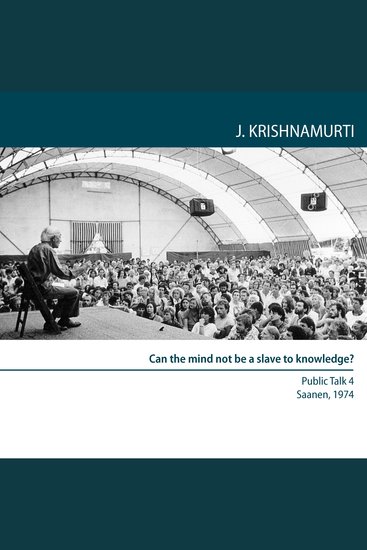
  • Can the Mind Not Be a Slave to Knowledge? - Saanen 1974 - Public Talk 4 - cover

    Can the Mind Not Be a Slave to...

    Jiddu Krishnamurti

    • 0
    • 0
    • 0
    Can the mind not be a slave to knowledge? - 21 July 1974 
    • When consciousness invents a super-consciousness is it a part of thought aware of the past? 
    • Is there a part of the brain which has not been touched by the known? 
    • Is it our education to escape from ‘what is’ through ideals? 
    • Has the mind been trained to operate and function in the field of the known? 
    • Observing the movement of thought and its source, can one come upon some 
    thing beyond thought? 
    • Is time required to see the reality and non-reality of knowledge? 
    Questions from the audience followed the talk.
    Ver livro