¡Acompáñanos a viajar por el mundo de los libros!
Añadir este libro a la estantería
Grey
Escribe un nuevo comentario Default profile 50px
Grey
Suscríbete para leer el libro completo o lee las primeras páginas gratis.
All characters reduced
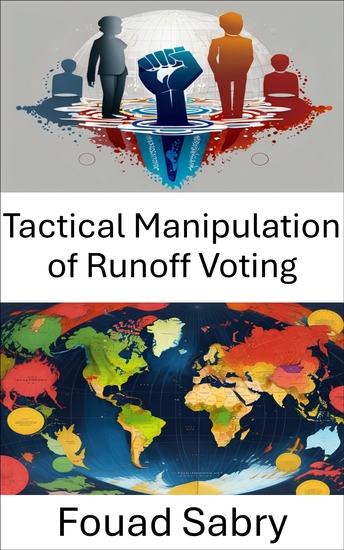
Tactical Manipulation of Runoff Voting - Strategic Dynamics in Electoral Systems - cover

Tactical Manipulation of Runoff Voting - Strategic Dynamics in Electoral Systems

Fouad Sabry

Editorial: One Billion Knowledgeable

  • 0
  • 0
  • 0

Sinopsis

Explore the complex world of runoff voting and its strategic implications in this insightful guide. Aimed at professionals, students, and enthusiasts, this book unveils the subtle tactics that can dramatically shape election outcomes.
 
1: Tactical Manipulation of Runoff Voting: Grasp how tactical manipulation can shift electoral results, shaping the outcome.
 
2: Strategic Voting: Understand how voters may cast votes not solely by preference but for favorable outcomes.
 
3: Independence of Irrelevant Alternatives: Explore how election results are affected by non-winning candidates.
 
4: Vote Pairing: Learn how voters agree to swap votes to achieve mutually beneficial results.
 
5: Vote Splitting: Analyze how multiple similar candidates can split votes, affecting results.
 
6: 2002 French Presidential Election: A case study illustrating tactical voting in the 2002 French presidential election.
 
7: Coombs' Method: Explore an elimination-based voting system that removes the least popular candidates.
 
8: Exhaustive Ballot: Understand how this system works by eliminating candidates one by one.
 
9: Contingent Vote: Explore a hybrid system combining elements of plurality and instant-runoff voting.
 
10: Instant-Runoff Voting: Learn the mechanics of ranking candidates and how votes transfer in rounds.
 
11: Approval Voting: Discover a system where voters can approve multiple candidates at once.
 
12: Plurality Voting: Examine the plurality system, where the most votes win, despite possible manipulation.
 
13: Two-Round System: Learn about this system, which calls for a second voting round if no majority is achieved.
 
14: Bullet Voting: Understand the practice of voting for only one candidate despite having more options.
 
15: 2002 French Legislative Election: Analyze another case study of tactical voting in French legislative elections.
 
16: Supplementary Vote: Learn about this variation of instant-runoff voting in elections.
 
17: Plural Left: Study the coalition within the Plural Left and its electoral influence.
 
18: Borda Count: Explore a ranking system where points are assigned based on candidates' positions.
 
19: Schulze STV: Learn about this method, which aims to minimize wasted votes.
 
20: 2016 The Republicans Presidential Primary: A case study on strategic voting in the 2016 French Republican primary.
 
21: STAR Voting: Understand the STAR voting system, combining scoring and runoff methods.
 
Through this exploration, you’ll unlock the hidden strategies used in elections and gain the tools to analyze or participate in political systems with greater expertise. With in-depth insights into voting systems from around the globe, you’ll be well-equipped to navigate and influence electoral outcomes more strategically. Whether you're involved in political campaigns or academic research, this guide offers a transformative understanding of runoff voting tactics.
Disponible desde: 16/10/2024.
Longitud de impresión: 302 páginas.

Otros libros que te pueden interesar

  • Why White Liberals Fail - Race and Southern Politics from FDR to Trump - cover

    Why White Liberals Fail - Race...

    Anthony J. Badger

    • 0
    • 0
    • 0
    From FDR to Clinton, Democratic leaders have promised a New South—a model of social equality and economic opportunity. So how did the region become the stronghold of conservative Republicans in thrall to Donald Trump? After a lifetime studying Southern politics, Anthony Badger has come to a provocative conclusion: white liberals failed because they put their faith in policy solutions as an engine for social change and were reluctant to confront directly the explosive racial politics dividing their constituents. 


    After World War II, many Americans believed that if the edifice of racial segregation, white supremacy, and voter disfranchisement could be dismantled across the South, the forces of liberalism would prevail. Hopeful that economic modernization and education would bring about gradual racial change, Southern moderates were rattled when civil rights protest and federal intervention forced their hand. Most were fatalistic in the face of massive resistance. When the end of segregation became inevitable, it was largely driven by activists and mediated by Republican businessmen. 


    Badger considers the dilemmas liberals faced across the South, arguing that their failure cannot be blamed simply on entrenched racism. Conservative triumph was not inevitable, he argues, before pointing to specific false steps and missed opportunities.
    Ver libro
  • Second Inaugural Address - cover

    Second Inaugural Address

    Ronald Reagan

    • 0
    • 0
    • 0
    Because of extreme cold weather, Chief Justice Warren Burger administered the official oath of office in the White House on January 20, 1985. A public administration of the oath of office and the inaugural address were delayed until January 21, 1985, in the Capitol Rotunda.  
    On the 50th inauguration since George Washington’s, Reagan marvels at America’s growth and inventions, including journeying to the moon and back. “There are no limits to growth and human progress when men and women are free to follow their dreams.” Our values of faith, family, work, and neighborhood were restored “when our economy was finally freed from government’s grip”.  
    America supports "individual liberty, self-government, and free enterprise throughout the world…” We deal best with great challenges when we come “together not as Democrats or Republicans, but as Americans united in a common cause.”  
    “We must never again abuse the trust of working men and women by sending their earnings on a futile chase after the spiraling demands of a bloated Federal Establishment.” “Freedom and incentives unleash the drive and entrepreneurial genius that are the core of human progress.” 
    “We must act now to protect future generations from government's desire to spend its citizens' money and tax them into servitude when the bills come due.” Though “our heritage is one of blood lines from every corner of the Earth, we are all Americans, pledged to carry on this last, best hope of man on Earth.” 
    Rather than relying on mutual assured destruction, we need “a security shield that will destroy nuclear missiles before they reach their target” and “render nuclear weapons obsolete.”  
    We are “one people under God, dedicated to the dream of freedom that He has placed in the human heart, called upon now to pass that dream on to a waiting and hopeful world.” 
    Audio recording courtesy of the Ronald Reagan Presidential Library. 
    AspenLeafMedia.com
    Ver libro
  • Reckoning The: Book Summary and Analysis - cover

    Reckoning The: Book Summary and...

    Briefly Summaries

    • 0
    • 0
    • 0
    This is a concise summary and analysis of The Reckoning, by Mary trump.
     
    It is not the original book and is not affiliated with or endorsed by Mary trump.
     
    Ideal those seeking a quick and insightful overview.


    In The Reckoning, Mary trump takes listeners on a profound journey through the hidden forces shaping society and personal success. This audiobook dives deep into the intersections of history, trauma, power, privilege, and societal structures, unraveling the complex web of factors that influence individual and collective productivity.
     
    Through a dynamic exploration of both personal and societal challenges, The Reckoning encourages listeners to confront the legacies of the past and understand how these forces continue to shape the present. By reflecting on historical injustices, economic disparities, and psychological burdens, the author inspires listeners to take control of their personal growth, redefine success, and unlock their true potential.
    Ver libro
  • Wake Up and Reclaim Your Humanity - Essays on the Tragedy of Israel-Palestine - cover

    Wake Up and Reclaim Your...

    Richard Forer

    • 0
    • 0
    • 0
    Wake Up and Reclaim Your Humanity: Essays on the Tragedy of Israel-Palestine 
    Written and Narrated by Richard Forer 
    Published by Audiobook Publishing Services 
    Explore the heart of the Israel-Palestine conflict through a powerful lens of transformation and truth. In Wake Up and Reclaim Your Humanity, author and narrator Richard Forer—once a passionate supporter of Israel—shares his remarkable spiritual awakening that redefined his identity and opened his eyes to the shared humanity between Israelis and Palestinians. 
    Through deeply personal essays, Forer challenges long-held narratives and confronts the existential fears and divisions that fuel the ongoing tragedy in the Middle East. This audiobook takes listeners on a journey from division to compassion, from confusion to clarity—revealing the deeper causes of suffering and offering a bold path toward justice, equality, and inner peace. 
    Whether you're searching for books on the Israel-Palestine conflict, interfaith understanding, or human rights advocacy, this groundbreaking commentary offers a unique perspective rooted in compassion, history, and truth. Perfect for listeners seeking clarity in a world of polarized narratives, Wake Up and Reclaim Your Humanity is a timely and transformative guide to healing one of the world’s most enduring struggles.
    Ver libro
  • American Amnesia - How We Lost Our National Memory―and How to Recover It - cover

    American Amnesia - How We Lost...

    Helen E. Krieble

    • 0
    • 0
    • 0
    People are who they are because of what they have been through, where they came from, who they learned from, and all the things that have happened to them. The same is true not just for individuals, but also for families, communities, and nations. America, too, has its own unique character, also formed by its memories, history, things it has been through, and what it has learned. 
    If people, communities, or even nations lose their memory, they lose their character. That is why cultures throughout the world work at maintaining their identity and passing traditions along to future generations. But what if a nation purposely decides it no longer wants to remember its history? What if a country imposes amnesia on itself? 
    Helen Krieble argues persuasively that this is precisely what has happened to America. It has lost the memory of its own founding principles, and the sacrifices made over the past 250 years to preserve them. The nation is losing its character. She writes that America cannot be preserved as “the last best hope of Earth” if its own people no longer understand why that is true and are no longer willing to do what it takes to preserve it. 
    “The duties of citizenship are vitally important,” Krieble writes, “but they are not complicated. It is our duty, as the owners, to defend our freedom against all threats, and to pass it along to future generations undiminished.” 
    Americans are failing in that duty, but Krieble says there is still time to cure our national amnesia. It begins with rebuilding our understanding of, and commitment to, those founding principles, regaining our national memory.
    Ver libro
  • Rust Belt Union Blues - Why Working-Class Voters Are Turning Away from the Democratic Party - cover

    Rust Belt Union Blues - Why...

    Theda Skocpol, Lainey Newman

    • 0
    • 0
    • 0
    In the heyday of American labor, the influence of local unions extended far beyond the workplace. Unions were embedded in tight-knit communities, touching nearly every aspect of the lives of members and their families and neighbors. They conveyed fundamental worldviews, making blue-collar unionists into loyal Democrats who saw the party as on the side of the working man. Today, unions play a much less significant role in American life. 


    Lainey Newman and Theda Skocpol provide timely insight into the relationship between the decline of unions and the shift of working-class voters away from Democrats. Using western Pennsylvania as a case study, Newman and Skocpol argue that union members' loyalty to Democratic candidates was as much a product of the group identity that unions fostered as it was a response to the Democratic Party's economic policies. As the social world around organized labor dissipated, conservative institutions like gun clubs, megachurches, and other Republican-leaning groups took its place. 


    Rust Belt Union Blues sheds new light on why so many union members have dramatically changed their party politics. It makes a compelling case that Democrats are unlikely to rebuild credibility in places like western Pennsylvania unless they find new ways to weave themselves into the daily lives of workers and their families.
    Ver libro