¡Acompáñanos a viajar por el mundo de los libros!
Añadir este libro a la estantería
Grey
Escribe un nuevo comentario Default profile 50px
Grey
Suscríbete para leer el libro completo o lee las primeras páginas gratis.
All characters reduced
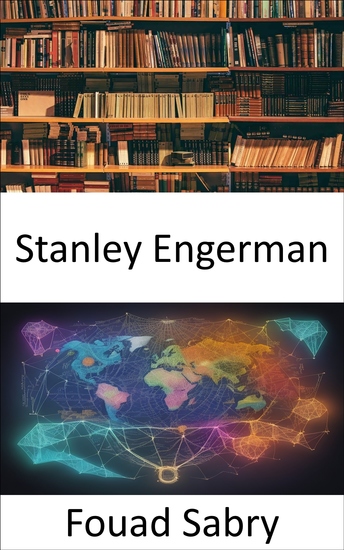
Stanley Engerman - Illuminating the Past Shaping the Future - cover

Stanley Engerman - Illuminating the Past Shaping the Future

Fouad Sabry

Editorial: One Billion Knowledgeable

  • 0
  • 0
  • 0

Sinopsis

Who is Stanley Engerman
 
American economist and economic historian Stanley Lewis Engerman was a prominent figure in the field. He was well-known for his quantitative historical work, which he did in collaboration with Robert Fogel, an economist who won the Nobel Prize. Time on the Cross: The Economics of American Negro Slavery was his first major work, it was published in 1974, and it was written in collaboration with Robert Fogel. Readers were challenged to engage in critical thinking about the economics of slavery through the reading of this seminal work, which was awarded the Bancroft Prize in American history. In addition, Engerman has produced, co-authored, or edited sixteen book-length studies, and he has published more than one hundred research articles.
 
How you will benefit
 
(I) Insights about the following:
 
Chapter 1: Stanley Engerman
 
Chapter 2: Economic history
 
Chapter 3: Slavery in the United States
 
Chapter 4: Cliometrics
 
Chapter 5: Robert Fogel
 
Chapter 6: Antebellum South
 
Chapter 7: Ulrich Bonnell Phillips
 
Chapter 8: Slave trade in the United States
 
Chapter 9: Time on the Cross: The Economics of American Negro Slavery
 
Chapter 10: Herbert Gutman
 
Chapter 11: J. Steven Wilkins
 
Chapter 12: Journal of Political Economy
 
Chapter 13: Timeline of abolition of slavery and serfdom
 
Chapter 14: Kenneth Sokoloff
 
Chapter 15: The Slave Community
 
Chapter 16: Alfred H. Conrad
 
Chapter 17: Slave breeding in the United States
 
Chapter 18: The Negress
 
Chapter 19: Robert L. Paquette
 
Chapter 20: Great Liberal Party of Venezuela
 
Chapter 21: Capitalism and Slavery
 
Who this book is for
 
Professionals, undergraduate and graduate students, enthusiasts, hobbyists, and those who want to go beyond basic knowledge or information about Stanley Engerman.
Disponible desde: 07/02/2024.
Longitud de impresión: 202 páginas.
Otros libros que te pueden interesar

  • INTUITIVE EATING WORKBOOK - The Most Complete Guide to Help You Developa Good Relationship With Food and Naturally Lose Weight - cover

    INTUITIVE EATING WORKBOOK - The...

    Jewel Reeves

    • 0
    • 0
    • 0
    Intuitive eating means listening to the signals your body sends you. It's all a matter of self-love. The intuitive eating model was developed in 1995 by two California dietitians, Evelyn Tribole and Elyse Resch. 
    All of us, at birth, ate following our intuition. Small children are the perfect example: they eat when they are hungry and stop when they are full. The amount of food they ingest changes virtually every day. Once they eat two whole courses, other times they stop after just a few bites. 
    As we grow up, we use intuition less when it comes to food. In childhood we were told that if we wanted dessert we had to finish what we had on our plate first. We have learned that there are good and other bad foods. The result of these lessons? As adults, when we eat "good" foods, we feel good about ourselves. But if we eat "bad" foods, we end up feeling guilty. The purpose of intuitive eating is to fundamentally change the way we think about food, and this can only be done through a new learning process. 
    Intuitive eating is not a diet; indeed, it is the opposite. You don't have to count calories or macronutrients, and there's no plan for your meals. All foods are allowed. If you eat while listening to your body, you will learn to be more aware of the signals you are receiving. Eat when you are hungry, stop when you reach satiety. You will then understand what you need. It can be a salad, but also a slice of chocolate cake. And that's fine.
    Ver libro
  • Shopaholic Burden - How to Stop Your Compulsive Buying And Heal Your Shopping Addiction - cover

    Shopaholic Burden - How to Stop...

    Brian Gibson

    • 0
    • 0
    • 0
    Shopping addiction, pathological buying, or compulsive buying disorder are all mental health conditions characterized by the persistent, excessive, impulsive, and uncontrollable purchase of products despite severe psychological, social, occupational, and financial consequences. Unlike ordinary non-addicted shoppers, who buy to improve their mood, cope with stress, gain social approval/recognition, and improve their self-image, compulsive buyers buy to improve their mood, cope with stress, gain social support/recognition, and improve their self-image. Although the consequences of long-term compulsive buying include feelings of regret/remorse for purchases, shame, guilt, legal and financial problems, and interpersonal difficulties, people with compulsive buying fail to stop buying.  
    In this book, you will learn:What is compulsive shoppingThe causes of compulsive shoppingThe marketing strategies companies use Treatments that can lead to a solution to the problemHow to regain mental and psychological health
    Ver libro
  • Summary - Home Fire - Based On The Book By Kamila Shamsie - cover

    Summary - Home Fire - Based On...

    Library Of Stories

    • 0
    • 0
    • 0
    SUMMARY 
      
    HOME FIRE 
    BASED ON THE BOOK BY KAMILA SHAMSIE 
      
    SUMMARY WRITTEN BY: LIBRARY OF STORIES 
      
    CONTENT 
    Departure and Arrival 
    Encounters and Revelations 
    Unveiling Secrets and Family Ties 
    Political Turmoil and Personal Struggles 
    Hope and Deception 
    A Longing for Home and the Weight of the Past 
    A Death in Istanbul 
    A Confrontation and a Mother's Fury 
    The Ice Coffin and the Quest for Justice 
    Analysis 
      
    ABOUT THE ORIGINAL BOOK 
    "Home Fire," by Kamila Shamsie, is a contemporary reimagining of Sophocles’ “Antigone,” exploring the themes of family, loyalty, and justice against the backdrop of the War on Terror. The story follows the Pasha family, whose lives are shattered when their brother, Parvaiz, becomes radicalized and joins ISIS. After Parvaiz is killed in Istanbul, his sister Aneeka embarks on a journey to reclaim his body, challenging societal norms and defying the British government's refusal to repatriate the remains of citizens who joined ISIS. Aneeka's quest for justice intersects with the life of Karamat Lone, the ambitious British Home Secretary of Pakistani origin, who finds his political aspirations clashing with his family’s history. As the narrative unfolds, the novel explores the complexities of identity, belonging, and the enduring power of familial bonds in a world marked by political turmoil and the corrosive effects of prejudice.
    Ver libro
  • The Corporate Whistleblower's Survival Guide - A Handbook for Committing the Truth - cover

    The Corporate Whistleblower's...

    Anónimo

    • 0
    • 0
    • 0
    With groundbreaking resources from the Government Accountability Project (GAP), this is the ultimate guide for would-be whistleblowers, as well as corporate gatekeepers in HR and Legal who are required by law to protect them.
    Ver libro
  • A Critical Analysis of Judicial Appointments in India - (with respect to Higher Judiciary) - cover

    A Critical Analysis of Judicial...

    Sanjit Kumar Naskar

    • 0
    • 0
    • 0
    The author, Sanjit Kumar Naskar, in this book titled A Critical Analysis of Judicial Appointments in India, has referred to a wide range of resources including books, online law journals, and articles from authoritative resources.Firstly, the author reviews Prof. Madhav Godbole’s book The Judiciary and Governance in India, which advocates for judicial accountability in the higher judiciary. While Prof. Godbole touches on lower judiciary transfers and politicization, he overlooks transparency in the appointment process for the lower judiciary.Secondly, the author examines Prof. V.R. Jayadevan’s PhD thesis Judicial Creativity in Constitutional Interpretation to explain the historical background of judicial appointments in the higher judiciary. The author, however, critiques Jayadevan’s acceptance of the seniority rule in appointing the CJI, countering it with Justice Katju’s arguments.Thirdly, the article The NJAC Act – Is it the Perfect Remedy? by Vikram Mishra and Ananth Balaji is analyzed, highlighting its critical view of the NJAC Act, 2014. While comprehensive, the article fails to fully recognize the Act’s salient features.Lastly, Prof. Tom S. Clark’s The Limits of Judicial Independence is discussed, where the author argues that while judicial behaviour is crucial, Clark does not adequately justify its role as an additional selection criterion for judges in the higher judiciary.
    Ver libro
  • ACS Chemistry Made Easy - "Elevate your ACS Chemistry prep with dynamic audio lessons tailored for stellar exam success!" - cover

    ACS Chemistry Made Easy -...

    Orson Fenwick

    • 0
    • 0
    • 0
    ACS Chemistry Made Easy 
    ⭐⭐ Simplified Guide & Explanations Included ⭐⭐ 
    Are you eager to advance your career and reinforce your understanding by successfully mastering the ACS Chemistry Exam? 
    In search of a complete resource that encompasses everything necessary to excel in ACS Chemistry concepts? 
    Your quest ends here! 
    This guide acts as your ultimate resource for enriching your knowledge, applying your skills, and participating in hands-on practice. With this at your side, you'll be equipped for triumph. 
    Updated for the current ACS Chemistry Exam format. 
    Key features of this enhanced guide: 
    - In-depth insights into ACS Chemistry concepts for exam success and confidence 
    - Clear explanations of essential chemistry principles 
    - Effective strategies for exam preparation and problem-solving 
    Our guide sets itself apart through its exhaustive coverage, which is vital for your success in the exam. Concepts are not just glossed over; we explore them in detail for clarity. 
    Crafted with a logical structure and straightforward language, our ACS Chemistry Made Easy guide ensures seamless transitions between topics. Bid farewell to confusing terminology and embrace content that is clear, precise, and technically sound. 
    So, why delay? Click the BUY NOW button, secure your guide, and embark on your journey toward mastering ACS Chemistry for exam success and confidence! 
    Don't miss out—grab your guide today and take the first step toward ACS Chemistry success!
    Ver libro