¡Acompáñanos a viajar por el mundo de los libros!
Añadir este libro a la estantería
Grey
Escribe un nuevo comentario Default profile 50px
Grey
Suscríbete para leer el libro completo o lee las primeras páginas gratis.
All characters reduced
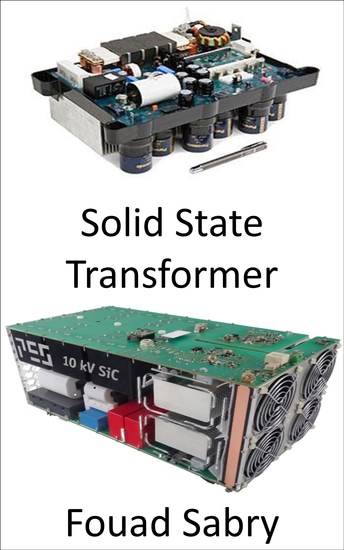
Solid State Transformer - Revolutionizing the power grid for power quality and energy efficiency - cover

Solid State Transformer - Revolutionizing the power grid for power quality and energy efficiency

Fouad Sabry

Editorial: One Billion Knowledgeable

  • 0
  • 0
  • 0

Sinopsis

What Is Solid State Transformer
 
In actuality, an AC-to-AC converter, also known as a solid-state transformer (SST), power electronic transformer (PET), or electronic power transformer, is a type of electric power converter that replaces a conventional transformer in AC electric power distribution. This type of electric power converter is known as an AC-to-AC converter. Because it works at a higher frequency, this kind of transformer is more complicated than a traditional transformer that uses the utility frequency, but it also has the potential to be more space-efficient and smaller than a traditional transformer. The two primary varieties are referred to as "real" AC-to-AC converters and AC-to-DC-to-DC-to-AC converters, respectively. The AC-to-AC converter or DC-to-DC converter that is often found inside of a solid-state transformer is really a transformer. This transformer is what provides the electrical isolation and carries the entire power. This transformer is more compact because the DC-DC inverting stages that occur between the transformer coils are on the smaller side. As a result, the transformer coils that are needed to step up or step down voltages are also on the smaller side. Active regulation of voltage and current may be performed via a solid-state transformer. There are several that are able to convert electricity from single-phase to three-phase and vice versa. The amount of conversions that need to take place may be decreased by having variations that can either input or output DC power. This results in increased end-to-end efficiency. A Modular Solid-state transformer is similar to a Multi-level converter in that it is made up of numerous high-frequency transformers and has the same function. Because it is an intricate electrical circuit, it has to be constructed such that it can survive surges of various kinds, such as lightning. The solid-state transformer is a relatively new kind of transformer.
 
How You Will Benefit
 
(I) Insights, and validations about the following topics:
 
Chapter 1: Solid-state transformer
 
Chapter 2: Power factor
 
Chapter 3: Rectifier
 
Chapter 4: Power supply
 
Chapter 5: Power inverter
 
Chapter 6: Switched-mode power supply
 
Chapter 7: DC-to-DC converter
 
Chapter 8: Voltage regulator
 
Chapter 9: Power electronics
 
Chapter 10: Motor?generator
 
Chapter 11: Rotary converter
 
Chapter 12: HVDC converter station
 
Chapter 13: Variable-frequency drive
 
Chapter 14: Index of electrical engineering articles
 
Chapter 15: H-bridge
 
Chapter 16: Phase converter
 
Chapter 17: Voltage converter
 
Chapter 18: Induction heater
 
Chapter 19: Transformer types
 
Chapter 20: Electric machine
 
Chapter 21: Glossary of electrical and electronics engineering
 
(II) Answering the public top questions about solid state transformer.
 
(III) Real world examples for the usage of solid state transformer in many fields.
 
(IV) 17 appendices to explain, briefly, 266 emerging technologies in each industry to have 360-degree full understanding of solid state transformer' technologies.
 
Who This Book Is For
 
Professionals, undergraduate and graduate students, enthusiasts, hobbyists, and those who want to go beyond basic knowledge or information for any kind of solid state transformer.
Disponible desde: 31/08/2022.
Longitud de impresión: 620 páginas.


Otros libros que te pueden interesar

  • Cracking Hitler's Atlantic Wall - The 1st Assault Brigade Royal Engineers on D-Day - cover

    Cracking Hitler's Atlantic Wall...

    Richard C Anderson

    • 0
    • 0
    • 0
    A military historian analyzes the ingenious WWII tanks known as Hobart’s Funnies, detailing their development and their role in the D-Day campaign. When the British and Canadians landed in Normandy on June 6, 1944, they were accompanied by specialized armored vehicles designed to remove German obstacles and mines. Developed by the Royal Engineers, these tanks known as Hobart's Funnies featured a range of ingenious innovations, from carpet-laying and bridge-laying devices to a giant 290-millimeter mortar.   Examining these vehicles from technical development to combat deployment, military historian Richard C. Anderson Jr. gives a minute-by-minute account of D-Day's early hours on Sword, Juno, and Gold Beaches—the critical moments when success hinged on the assault engineers’ ability to  clear a path or breach the seawall.   Anderson also describes the events on Omaha and Utah Beaches, where U.S. troops, despite being offered these vehicles, stormed ashore without them. Through careful comparison of conditions and outcomes, Anderson assesses the vehicles’ performance and impact on D-Day's successes and failures.
    Ver libro
  • The Universe Within - cover

    The Universe Within

    Raphael Terra

    • 0
    • 0
    • 0
    This audiobook has been recorded using Text to speech (TTS). 
     
    This is a divided and chaotic world. A world torn apart by greed and hatred. By desires that spread around the world like a disease. The stress of modern life pushes us further and further apart from each other and nature. 
     
    The simple fact is that we are destroying the planet upon which we rely for sustenance. Our chaotic minds form chaotic societies. Power and wealth are in the hands of the people who should not have them. We subconsciously know that we have screwed things up and yet we proceed to screw things up a little more with each passing generation. 
     
    We have forgotten the prime directive of the universe. We ignore its teachings. We fail to listen to its pleas. 
     
    The truth that will save you and all of mankind is very simple. It is the Universal Law of Attraction and it is time to listen and learn from it.
    Ver libro
  • Egyptian Science and Technology - Innovations of the Ancient World - cover

    Egyptian Science and Technology...

    Omar Khalil

    • 0
    • 0
    • 0
    Ancient Egypt, renowned for its monumental architecture and sophisticated culture, was also a hub of intellectual and scientific advancements. At the heart of Egyptian knowledge was a unique blend of practical experience, religious beliefs, and cultural traditions. Understanding the foundations of their knowledge requires examining the interplay between mythology, early scientific thought, and the ways this knowledge was transmitted through generations. 
    The role of religion and mythology in ancient Egypt cannot be overstated. Egyptian cosmology deeply influenced how people understood the world around them. Deities associated with creation, the afterlife, and natural phenomena shaped the Egyptians' perception of science and technology. For example, the god Thoth was believed to be the deity of wisdom, writing, and mathematics, and his influence permeated educational practices. Priests and scribes, who were often part of temple schools, acted as custodians of this sacred knowledge. Their training combined religious teachings with practical subjects like astronomy, mathematics, and medicine. 
    Early scientific thought in ancient Egypt was pragmatic rather than theoretical. Egyptians were skilled observers, and much of their knowledge arose from practical problem-solving. Whether it was calculating the Nile's flooding patterns or designing complex irrigation systems, their science emerged from the need to manage everyday challenges. For instance, their understanding of geometry developed out of the necessity to remeasure fields after the annual inundation of the Nile. Similarly, medical practices were rooted in practical observations of ailments and their treatments, blending empirical knowledge with spiritual beliefs.
    Ver libro
  • Your Brain Is Playing Tricks On You - How the Brain Shapes Opinions and Perceptions - cover

    Your Brain Is Playing Tricks On...

    Albert Moukheiber

    • 0
    • 0
    • 0
    Why are we often convinced that we’re right even when we’re wrong? Why are we jealous, or paranoid, even when we have absolutely no reason to be? Why is it so easy for fake news to spread around the globe and fool us? It’s because we don’t see the world as it is, rather we reconstruct it in our mind.
    Ver libro
  • Balancing Planet - How Climate Shapes Life and Life Shapes Climate - cover

    Balancing Planet - How Climate...

    Ylia Callan

    • 0
    • 0
    • 0
    This audiobook is narrated by an AI Voice.   
    Balancing Planet: How Climate Shapes Life and Life Shapes Climate is an immersive audiobook that brings the history and science of Earth’s climate to your ears. Explore the dramatic transformations of our planet, from its fiery origins to ice ages, human civilisation and the challenges of modern climate change. 
    This audiobook offers: A journey through deep time, showing how climate has influenced life and human development. Insight into the Industrial Revolution, fossil fuel use, and the Anthropocene. A clear explanation of current climate science, extreme weather, and global warming trends. Practical solutions for a regenerative future, including clean energy, carbon capture, reforestation, and sustainable agriculture. Reflections on ethics, mythology and human stewardship of the planet. 
    Whether you’re commuting, exercising, or relaxing, Balancing Planet turns complex science into a captivating story, leaving listeners informed, inspired and empowered to engage with the climate challenges of our time.
    Ver libro
  • Know about "giordano bruno" - a friar philosopher mathematician astronomer & occultist - cover

    Know about "giordano bruno" - a...

    Saurabh Singh Chauhan

    • 0
    • 0
    • 0
    This is small copy of introduction of the book: Giordano Bruno was a 16th-century Italian friar, philosopher, mathematician, astronomer, and occultist. He is best known for his cosmological theories, which anticipated the Copernican model of the universe and held that the stars are distant suns surrounded by their own planets. Bruno's ideas were considered heretical by the Catholic Church, and he was burned at the stake in Rome in 1600. 
    Bruno was born in Nola, Italy, in 1548. He joined the Dominican Order at the age of 15, but he soon became disillusioned with the Church's teachings. He left the Order in 1572 and began to travel throughout Europe, teaching his ideas about cosmology and philosophy. 
    In 1576, Bruno published his book On the Shadows of the Ideas, in which he outlined his cosmological theories. He argued that the universe is infinite and that it contains many inhabited worlds. He also rejected the Aristotelian view of the universe as a finite sphere centered on the Earth.  
    Bruno's ideas were controversial from the start. He was accused of heresy by the Catholic Church and forced to flee Geneva in 1583. He then spent several years in France, where he was protected by King Henry III. However, after Henry's death in 1589, Bruno was forced to flee again. 
    In 1591, Bruno returned to Italy. He was arrested in Venice in 1592 and extradited to Rome. He was put on trial for heresy and found guilty. On February 17, 1600, Bruno was burned at the stake in Campo de' Fiori. 
    Despite his execution, Bruno's ideas had a profound influence on later thinkers. His work helped to pave the way for the scientific revolution of the 17th century.
    Ver libro