¡Acompáñanos a viajar por el mundo de los libros!
Añadir este libro a la estantería
Grey
Escribe un nuevo comentario Default profile 50px
Grey
Suscríbete para leer el libro completo o lee las primeras páginas gratis.
All characters reduced
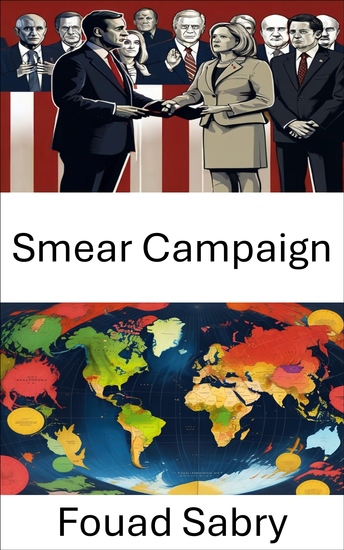
Smear Campaign - Manipulating Public Perception in Modern Politics - cover

Smear Campaign - Manipulating Public Perception in Modern Politics

Fouad Sabry

Editorial: One Billion Knowledgeable

  • 0
  • 0
  • 0

Sinopsis

Explore the intricate world of political maneuvering in "Smear Campaign," an essential examination of the tactics, impacts, and ethical implications of smear campaigns in modern politics. This book offers insights into how public perception and electoral outcomes can be manipulated through misinformation and character assassination.
 
1: Smear Campaign: Defines smear campaigns, tracing their evolution and prevalence in modern politics.
 
2: Tactic: Discusses diverse methods of smear campaigns, including fact distortion and selective quoting.
 
3: Character Assassination: Examines efforts to damage reputations through unfounded allegations and malicious narratives.
 
4: Negative Campaigning: Analyzes negativity in political messaging, contrasting legitimate critiques with manipulative tactics.
 
5: Propaganda Techniques: Highlights emotional appeals and misinformation used in smear campaigns to sway public opinion.
 
6: Informal Fallacy: Explores logical fallacies leveraged in smear campaigns to distort perceptions and mislead voters.
 
7: Whispering Campaign: Investigates the spread of damaging rumors that erode trust in political figures.
 
8: Swiftboating: Chronicles the Swift Boat Veterans for Truth campaign as a case study in electoral distortion.
 
9: Counterpropaganda: Examines strategies to respond to smear campaigns, emphasizing truth-telling to mitigate damage.
 
10: Whataboutism: Analyzes how whataboutism deflects legitimate criticism by creating false equivalences.
 
11: John Pilger: Profiles Pilger's work in exposing media manipulation and the role of independent journalism.
 
12: Pincer Movement: Explores coordinated smear tactics aimed at overwhelming political opponents.
 
13: Media Lens: Highlights the role of media watchdogs in exposing biased reporting and misinformation.
 
14: Chess Tactic: Draws parallels between chess strategy and political smear campaigns.
 
15: Push Poll: Investigates the deceptive use of polling to spread negative information.
 
16: False Flag: Analyzes historical false flag operations used to discredit adversaries.
 
17: Kompromat: Examines the use of compromising materials to blackmail political opponents.
 
18: Isolation: Explores isolation tactics that weaken opponents' support networks.
 
19: Internet Manipulation: Analyzes the rise of smear campaigns in digital spaces, including social media and bots.
 
20: Disinformation Attack: Investigates efforts to spread false information through digital channels.
 
21: Terruqueo: Explores the use of terror and intimidation in political smear campaigns.
 
This groundbreaking work is indispensable for professionals and enthusiasts, offering insights into the complex strategies of modern political discourse. Equip yourself with the knowledge to discern truth from manipulation and safeguard democracy in an era of information warfare.
Disponible desde: 09/10/2024.
Longitud de impresión: 261 páginas.

Otros libros que te pueden interesar

  • Perpetual Peace - Immanuel Kant - cover

    Perpetual Peace - Immanuel Kant

    Immanuel Kant

    • 0
    • 0
    • 0
    "Perpetual Peace" is a philosophical work written by the German philosopher Immanuel Kant in 1795. In this work, Kant argues that peace can only be achieved through a world order based on international law, democratic governance, and the promotion of free trade. 
    Kant believed that war was a result of a flawed system of international relations, where states pursued their own self-interests without regard for the interests of other nations. He argued that in order to establish a lasting peace, a system of international law must be established that would regulate the behavior of nations and prevent them from going to war. 
    Kant also believed that a world federation of nations would be necessary to ensure peace. This federation would be based on democratic governance, where each nation would have an equal say in decisions that affected the world as a whole. Kant believed that this would help to ensure that the interests of all nations were taken into account, and that no one nation could dominate the others. 
    Finally, Kant argued that free trade was essential for peace. He believed that by promoting economic interdependence between nations, free trade would create incentives for nations to work together and avoid war. 
    Overall, Kant's "Perpetual Peace" is a seminal work in the history of political philosophy, and continues to be influential today in debates about international relations and the pursuit of peace.
    Ver libro
  • The Petroleum Papers - Inside the Far-Right Conspiracy to Cover Up Climate Change - cover

    The Petroleum Papers - Inside...

    Geoff Dembicki

    • 0
    • 0
    • 0
    Burning fossil fuels will cause catastrophic global warming: this is what top American oil executives were told by scientists in 1959. But they ignored that warning. Instead, they developed one of the biggest, most polluting oil sources in the world—the oil sands in Alberta, Canada. As investigative journalist Geoff Dembicki reveals in this explosive book, the decades-long conspiracy to keep the oil sands flowing into the US would turn out to be one of the biggest reasons for the world's failure to stop the climate crisis. 


    In The Petroleum Papers, Dembicki draws from confidential oil industry documents to uncover for the first time how companies like Exxon, Koch Industries, and Shell built a global right-wing echo chamber to protect oil sands profits—a misinformation campaign that continues to this day. He also tells the high-stakes stories of people fighting back: a Seattle lawyer who brought down Big Tobacco and is now going after Big Oil, a Filipina activist whose family drowned in a climate disaster, and a former Exxon engineer pushed out for asking hard questions. 


    With experts now warning we have less than a decade to get global emissions under control, The Petroleum Papers provides a step-by-step account of how we got to this precipice—and the politicians and companies who deserve our blame.
    Ver libro
  • Albert Einstein’s "Why Socialism?" - The Enduring Relevance of His Classic Essay - cover

    Albert Einstein’s "Why...

    Albert Einstein

    • 0
    • 0
    • 0
    A contemporary look at Albert Einstein's classic call for socialism 


    First published more than seventy-five years ago in the inaugural issue of Monthly Review: An Independent Socialist Magazine, Albert Einstein's "Why Socialism?" is an unheralded classic. Written during the McCarthyite witch-hunt in the United States, it constituted an act of defiance, making a case for socialism unrivaled in its time or ours. Yet, its very existence has been an embarrassment to an establishment which has continually sought to downplay the significance of his iconoclastic essay, together with Einstein's socialism itself. 


    This volume includes Einstein's essay along with a detailed commentary on his essay by Monthly Review editor, John Bellamy Foster. Foster's introduction tells the story of Einstein's life-long commitment to socialism and the events leading to the publication of "Why Socialism?" and contextualizes the importance of his essay as we enter a time of planetary crisis and new threats of world war. Over the three-quarters of century since its publication, "Why Socialism?" is one of those rare statements whose power has only grown, reaching untold numbers of readers over the years. It is of crucial importance that―for the sake of the future of humanity―Einstein's message continues to proliferate.
    Ver libro
  • The Status and Recognition of Post-1992 Transnistria - An Investigation of the Case for de jure Independence - cover

    The Status and Recognition of...

    Richard Colbey

    • 0
    • 0
    • 0
    The only book in English on the subject. Of topical relevance in the context of the current conflict in Ukraine.
    Ver libro
  • Gang Politics - Revolution Repression and Crime - cover

    Gang Politics - Revolution...

    Kristian Williams

    • 0
    • 0
    • 0
    Demystifying forces of the state, gangs, and revolutionary violence. 


    In Gang Politics, Kristian Williams examines our society's understanding of social and political violence, what gets romanticized, misunderstood, or muddled. He explores the complex intersections between "gangs" of all sorts—cops and criminals, Proud Boys and Antifa, Panthers and skinheads—arguing that government and criminality are intimately related, often sharing critical features. As society becomes more polarized and conflict more common, Williams's analysis is a crucial corrective to our usual ideas about the role violence might or should play in our social struggles.
    Ver libro
  • 100 Weeks of Scotland - A Portrait of a Nation on the Verge - cover

    100 Weeks of Scotland - A...

    Alan McCredie

    • 0
    • 0
    • 0
    100 Weeks of Scotlandis a revealing journey into the heart and soul of Scotland in the 100 weeks that led up to the independence referendum in September 2014.
    
    From the signing of the Edinburgh Agreement through to the referendum and its immediate aftermath, this book charts a country in the grip of political debate. 100 Weeks of Scotlandis not simply a political book. It brings together stunning photography and stimulating commentary to capture a country in transition.
    
    It examines Scotland in all its forms from its stunning landscapes to its urban sprawl to, most notably of all, its people as they live their lives in the run up to the most significant democratic event in their country's history. It is a portrait of a nation on the verge of the unknown.
    
    What I discovered was a country made up of people from all over the world, who live and work here and who were given a chance to have their say in how the place they live should govern itself. Civil wars have broken out for less, but we, in this small part of a small island, could do it with the stroke of a pen. It has been an utterly remarkable period in the history of Scotland, one that I am so glad I could live through, and document.<
    
    A collection of pictures that capture a spirit of each area. Rather than focus on the heather and hills, he's turned his camera on the mundane, the Scotland we see every day.
    
    WRITER PICTURES on This is ScotlandThis is Scotland
    Ver libro