Junte-se a nós em uma viagem ao mundo dos livros!
Adicionar este livro à prateleira
Grey
Deixe um novo comentário Default profile 50px
Grey
Assine para ler o livro completo ou leia as primeiras páginas de graça!
All characters reduced
Positive Political Theory - Illuminating Pathways to Democratic Discourse - cover
LER

Positive Political Theory - Illuminating Pathways to Democratic Discourse

Fouad Sabry

Editora: One Billion Knowledgeable

  • 0
  • 0
  • 0

Sinopse

Explore "Positive Political Theory," a comprehensive guide to applying rational choice theory in political science. This book offers valuable insights into decision-making and governance, ideal for professionals, students, and enthusiasts.
 
Chapters Highlights:
 
- 1: Introduction to positive political theory and its significance.- 2: Overview of political science and its context.- 3: Principles of rational choice theory in political behavior.- 4: Public choice theory merging economics and politics.- 5: Importance of institutional frameworks in politics.- 6: Historical development of political institutions.- 7: Economic theories of democracy and voter behavior.- 8: Rational choice within institutional contexts.- 9: Altruism's role in voting behavior.- 10: Rational choice in international relations.- 11: Contributions of William H. Riker.- 12: Bounded rationality in political decision-making.- 13: Critical role of institutions in politics.- 14: New institutional economics in political analysis.- 15: Contributions of Peter Ordeshook.- 16: James Fearon's work on political theory.- 17: Margaret Levi's insights on political institutions.- 18: Rochester School's rational choice applications.- 19: James D. Morrow on international relations.- 20: Kenneth Shepsle's work on political institutions.- 21: Heresthetic and strategic political decision-making.
 
"Positive Political Theory" is a crucial resource for understanding the intersection of rational choice theory and political science, offering essential insights into the dynamics of political behavior and institutions.
Disponível desde: 07/08/2024.
Comprimento de impressão: 167 páginas.

Outros livros que poderiam interessá-lo

  • Black Panther Speeches - cover

    Black Panther Speeches

    Fred Hampton

    • 0
    • 0
    • 0
    Black Panther Speeches – Fred Hampton is a powerful and historic collection of speeches delivered by one of the most charismatic and revolutionary leaders of the Black Panther Party. Fred Hampton’s electrifying words, filled with passion, conviction, and an unwavering commitment to justice, echo the struggles and aspirations of a movement fighting against systemic oppression. In this audiobook, listeners will experience Hampton’s raw and unfiltered voice as he speaks on topics such as unity, revolution, and the power of the people. His ability to inspire, educate, and mobilize communities remains as relevant today as it was during his lifetime. Whether you are a student of history, an activist, or simply someone who values the power of spoken truth, The Black Panther Speeches offers a compelling and unforgettable listening experience.
    Ver livro
  • A Graver Danger - White Chalk Crime The Stunning First-Ever Explanation for School Shootings & How We End Them - cover

    A Graver Danger - White Chalk...

    Karen Horwitz M.Ed

    • 0
    • 0
    • 0
    You will be thrilled to find a book that answers what happened to America so you can help heal our beloved country. In 1995, Karen Horwitz, aka the CHANGE EVERYTHING TEACHER, discovered our schools suffered from the 'Harvey Weinstein syndrome'—the powerful get their way no matter how wicked until someone finds the courage to expose them. She wrote a memoir to do to those running our schools what that brave actress who testified against Weinstein did — expose and end wrongdoing of a different kind. Readers will learn why we have school shootings and how to end them and restore democracy.She names the corruption that transformed our schools from revered institutions to mere shells White Chalk Crime™ and reveals how it dismantled democracy. The sheer audacity and disbelief of this corruption prompted her to write a book so that citizens could comprehend its extent. She warns, "There are consequences for a society that allows evil an honored home. One is school shootings, which are the tip of the democracy-destroying iceberg, taking our country down Titanic-style. Abraham Lincoln warned, 'The philosophy of the schoolroom in one generation will be the philosophy of government in the next.'  When I taught, it was as if  Trump ran our schools."She reveals that those in power secretly thwart school reform and presents an 'idea invention' that will revolutionize education as Jeff Bezos did to marketing and Steve Jobs to computers. It includes a blueprint for top-notch schools that ensures a home for great teachers and tells about a grassroots movement for change.This book is a beacon of hope, showing that change is within reach. It inspires the reader to feel optimistic about the future of education and democracy. This engaging and insightful book on education takes those who cherish democracy and fear autocracy on a journey deep inside our schools, where the root of many of this nation's challenges lies. It will change a whole lot. PDFs at WhiteChalkCrime.com/audio
    Ver livro
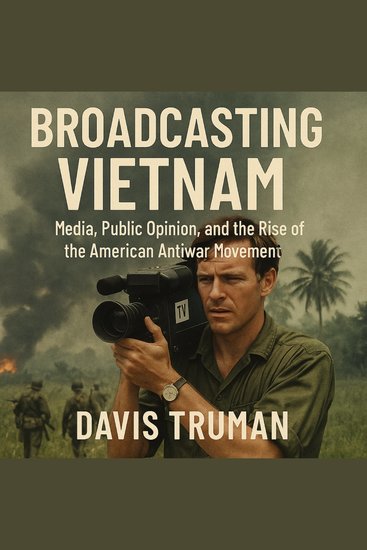
  • Broadcasting Vietnam - Media Public Opinion And The Rise Of The American Antiwar Movement - cover

    Broadcasting Vietnam - Media...

    Davis Truman

    • 0
    • 0
    • 0
    "Broadcasting Vietnam" offers a powerful and deeply human look at one of the most controversial wars in modern history and how it was brought into the living rooms of America. With an unflinching eye on the role of mass media, Davis Truman examines how televised images, frontline reporting, and photojournalism contributed to turning the tide of public opinion and fueling one of the most significant protest movements in U.S. history. 
    From the revolutionary leadership of Ho Chi Minh and the early days of conflict to the escalating American involvement and the devastating use of napalm and chemical weapons, this book chronicles the Vietnam War in vivid detail. Through chapters like "Napalm Girl" and "War and Mass Media," Truman highlights the undeniable impact of iconic moments that shocked a nation and galvanized a generation. 
    Combining historical analysis with cultural insight, Truman also explores the long-term consequences of the war, including its profound impact on American society, politics, and public trust. This is not just a book about war. It's a story about how information, images, and voices changed the course of history. 
    Bold, gripping, and unflinchingly honest, Broadcasting Vietnam is essential reading for anyone seeking to understand the power of media in shaping truth, perception, and resistance.
    Ver livro
  • Surveillance - A Very Short Introduction - cover

    Surveillance - A Very Short...

    David Lyon

    • 0
    • 0
    • 0
    Surveillance permeates every aspect of our lives today. Every click on the keyboard, every call, text or email, every purchase, every contact with a doctor or the police or a government department, each time you walk under a video camera or pass through a security check, and in many other ways, you are recorded, identified, traced, and tracked. Who processes this free-flowing data, how, and with what consequences, is a critical question affecting everyone. 


    Surveillance is not inherently good or bad but neither is it neutral. It urgently needs to be understood better because people's lives and life-chances depend on it. Today surveillance is central to doing business, meeting friends, organizing governance, maintaining security, and being entertained. Surveillance requires not just exploration and understanding but ethical guidance and political debate. How you get credit or welfare benefits or get on a no-fly list or are ranked as a consumer depends on surveillance. This Very Short Introduction investigates how surveillance makes people visible, how it grew to its present size and prevalence, how it came to rely on technologies of data-handling, and how it developed its own cultural features. Throughout, David Lyon also considers the ethics of surveillance, and explores its potential in prompting political struggles.
    Ver livro
  • Creating the KGB and CIA: The Establishment of the World’s Most Famous Intelligence Agencies - cover

    Creating the KGB and CIA: The...

    Editors Charles River

    • 0
    • 0
    • 0
    The KGB is one of the most famous abbreviations of the 20th century, and it has become synonymous with the shadowy and often violent actions of the Soviet Union’s secret police and internal security agencies. In fact, it is often used to refer to the Soviet state security agencies throughout its history, from the inception of the inception of the Cheka (Extraordinary Commission) in 1917 to the official elimination of the KGB in 1992. Whether it’s associated with the Russian Civil War’s excesses, Stalin’s purges, and even Vladimir Putin, the KGB has long been viewed as the West’s biggest bogeyman during the second half of the 20th century. However, the KGB did not appear out of thin air. Naturally, the earliest Soviet leaders utilized intelligence agencies that collected information both abroad and within the Soviet Union, targeting foreign opponents and domestic opponents alike. Lenin did not imagine the scale of the opposition he would have to face after the revolution, and he quickly came to the conclusion that "a special system of organized violence" must be created to implement the dictatorship of the proletariat. 
    Though it might be hard to believe, the Americans did not have a covert operations organization when they joined World War II, and like the British, it took them some time to realize it could be a powerful tool. As a result, the Office of Strategic Services (OSS) was not established until June 13, 1942, six months after the attack on Pearl Harbor. This would all chart a path for the early days of America’s most famous intelligence agency, the CIA. Although plagued by its own share of problems in its early existence during World War II and the early Cold War years, the agency’s early problems, smoothed over by a string of tenured presidents, paled in comparison to those it would face in the coming decades.
    Ver livro
  • Summary: Killing the Killers: Bill O'Reilly and Martin Dugard - The Secret War Against Terrorism - cover

    Summary: Killing the Killers:...

    Scott Campbell

    • 0
    • 0
    • 0
    This summary book is meant to complement the original. It is not intended to replace the fine book by Bill O'Reilly and Martin Dugard, #1 bestselling authors. 
    Readers soon find themselves injected into the worldwide war on terror, which started more than two decades ago on September 11, 2001. 
    America went into battle mode as the World Trade Center towers crumbled, the Pentagon burned, and a tiny number of passengers fought frantically to prevent a third jet from carrying out its murderous flight plan. Killing The Killers tells the story of America's long struggle against radicals who plotted and carried out not just the 9/11 atrocities but hundreds of others throughout the globe, finally destroying whole countries in their pursuit for power. 
    Killing The Killers follows the United States' fight against Al Qaeda, ISIS, and the Iranian Revolutionary Guard in Afghanistan, Iraq, Yemen, Syria, Libya, and elsewhere, as well as specific targets of these organizations' most renowned commanders. O'Reilly and Dugard provide an irresistible narrative of our era's most crucial battle with new detail and well-sourced material.
    Ver livro