Junte-se a nós em uma viagem ao mundo dos livros!
Adicionar este livro à prateleira
Grey
Deixe um novo comentário Default profile 50px
Grey
Assine para ler o livro completo ou leia as primeiras páginas de graça!
All characters reduced
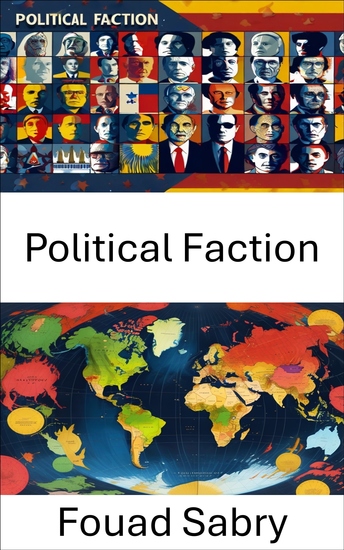
Political Faction - Influence and Dynamics of Modern Political Groups in Global Governance - cover
LER

Political Faction - Influence and Dynamics of Modern Political Groups in Global Governance

Fouad Sabry

Editora: One Billion Knowledgeable

  • 0
  • 0
  • 0

Sinopse

Explore the complex world of political factions in "Political Faction," a vital contribution to Political Science. This work delves into the critical roles factions play in governance across different global contexts, offering key insights for professionals, students, and enthusiasts.
 
1: Political Faction: Examine the formation, motives, and global impact of political factions.
 
2: Political Party: Study political parties' roles in shaping electoral systems and policies.
 
3: Tory: Trace the Tory faction's historical roots and contemporary relevance.
 
4: Two-party system: Analyze how two-party systems affect political stability and policies.
 
5: Factions in the Democratic Party (United States): Explore ideological divides within America's Democratic Party.
 
6: Labour Party: Discover the Labour Party's role in British political factionalism.
 
7: Labour Right: Examine right-wing Labour views and their policy positions.
 
8: Bloc party: Uncover bloc parties’ influence on coalition politics and policy.
 
9: Political colour: Explore how political colours define identities and strategies.
 
10: Pillarisation: Understand the Dutch system of pillarisation and its factional implications.
 
11: Social conservatism: Analyze social conservatism's role in shaping policies and elections.
 
12: Non-partisan democracy: Explore governance models minimizing factional influence through non-partisan principles.
 
13: Democratic Socialist Party (Japan): Discover the strategies and ideology behind Japan's Democratic Socialist Party.
 
14: Liberalism in the Netherlands: Study the impact of liberalism on Dutch politics and governance.
 
15: Australian Young Labor: Investigate youth factions’ influence on policy and party dynamics.
 
16: Democratic and Social Centre (Spain): Analyze Spain’s centrist faction’s role in moderating policies.
 
17: List of United States House of Representatives elections (1824–1854): Explore early U.S. electoral trends and factional alignments.
 
18: Popular Democratic Party (Puerto Rico): Examine the evolution of Puerto Rico’s Popular Democratic Party.
 
19: List of political parties in Ukraine: Survey Ukraine’s diverse political factions and their geopolitical roles.
 
20: International Socialist Organization: Discover the evolution of the International Socialist Organization’s factional influence.
 
21: Labour First: Explore Labour First’s grassroots organizing within the Labour Party.
 
Unlock the complexities of global political factions with "Political Faction." This research-packed book provides a deeper understanding of how partisan groups shape governance and policies worldwide, making it essential for anyone wanting to grasp political dynamics beyond the surface.
Disponível desde: 01/10/2024.
Comprimento de impressão: 269 páginas.

Outros livros que poderiam interessá-lo

  • Broken Supremacy - The Rise and Fall of the Wehrmacht in Russia - cover

    Broken Supremacy - The Rise and...

    Davis Truman

    • 0
    • 0
    • 0
    A searing chronicle of ambition, brutality, and collapse, Broken Supremacy: The Rise and Fall of the Wehrmacht in Russia reveals the untold dimensions of the most catastrophic military campaign in modern history. 
    At the height of its power, the Wehrmacht was celebrated as an unstoppable force, an army honed on lightning victories, driven by a doctrine of speed and annihilation. Yet on the vast, unforgiving battlefields of the Eastern Front, that supremacy was shattered. This groundbreaking work peels back the myths to expose the flawed strategies, fatal hubris, and relentless resistance that led to the Wehrmacht’s disintegration against the Soviet war machine. 
    Drawing on newly unearthed archives, soldiers’ testimonies, and penetrating analysis, the book traces the Wehrmacht’s trajectory from its initial triumphs in 1941 to its devastating reversals at Stalingrad, Kursk, and beyond. It examines the interplay between ideology and strategy, the limitations of military innovation, and the human toll of a conflict that claimed millions of lives. More than a military history, it is an unflinching portrait of a regime’s overreach and the resilience of those who resisted it. 
    Written with cinematic immediacy and scholarly authority, Broken Supremacy illuminates how the Wehrmacht’s rise carried the seeds of its downfall, and why its defeat in Russia sealed the fate of Nazi Germany itself.
    Ver livro
  • Edge of Armageddon - The Imminent Nuclear Consequence - cover

    Edge of Armageddon - The...

    Robert Enochs

    • 0
    • 0
    • 0
    Edge of Armageddon: The Imminent Nuclear Consequence is a gripping nonfiction political thriller exploring the intricate dance of dominance and diplomacy surrounding nuclear war on the global stage. Delve into the heart of US hegemony, tracing the history from World War II to the present, revealing the evolution of nuclear diplomacy and the challenges to American supremacy.  
    Through insightful analysis, it explores the decline of the US Dollar and the rise of multipolar currency dynamics. Timely and sobering, it challenges readers to ponder the consequences of America's decline and offers hope for humanity amidst the foreboding, urging action to steer away from a nuclear war precipice. 
    This book is a must-read (a call to action) for anyone who dares to understand the fragility of our current geopolitical landscape and the ray of light needed to steer us away from a nuclear war precipice. Step to the Edge of Armageddon, and arm yourself with knowledge to envision a future of cooperation over annihilation.
    Ver livro
  • Cyrus the Great: The Enthralling Life of the Father of the Persian Empire - cover

    Cyrus the Great: The Enthralling...

    Billy Wellman

    • 0
    • 0
    • 0
    Cyrus the Great was a humanitarian, a diplomat, a military strategist, and a ruler of the largest empire the world had ever seen up to that point. 
    Cyrus the Great was a remarkable man who became a legend in his own lifetime. The greatest testament to his good character and great achievements came to us via Persia’s enemies: the Greeks. It is said he served as an inspiration to Alexander the Great and Julius Caesar. Cyrus gained such hero status that his heritage was still claimed by the last shahs of Iran in the 20th century CE. 
    His policies included freedom of religion, equality of wages, and freedom of speech. His cultural and societal activities set in motion what we know today as human rights. The Declaration of Independence of the United States of America incorporates the major points Cyrus II of Persia focused on during his reign. 
    In this audiobook, we delve into facts and mythology regarding his birth, his ascension to the throne, and how he built the largest empire of his time. 
    How do events from over two and a half millennia ago influence the current world we live in? As you listen to the life and environment of Cyrus the Great, you may be tempted to compare modern rulers with this ruler who lived more than 2,500 years ago. 
    In this audiobook, you will discover more about the following:The life of Cyrus the Great: both as a monarch and as a man.A dip into the milieu of cultures, influences, and worldviews of Cyrus’s timeCyrus’s multi-faceted Achaemenid EmpireMythology and religions of the eraHow Cyrus achieved harmony between conquerors and conqueredThe fall of the splendid city of BabylonA unique artifact that ties in with modern-day human rightsCyrus the Great’s legacyAnd so much more! 
    Scroll up and click the “add to cart” button to learn more about Cyrus the Great!
    Ver livro
  • Plutocracy - The Rule of Wealth: How Economic Power Influences Political Decision-Making - cover

    Plutocracy - The Rule of Wealth:...

    Arlo Holders

    • 0
    • 0
    • 0
    Plutocracy, often described as the rule of wealth, refers to a political system in which economic elites hold significant influence over government decisions, shaping policies to favor their interests. This concentration of power is not limited to authoritarian regimes or monarchies but can also be observed in modern democracies, where wealth and power are deeply intertwined. In such systems, political decisions are often made in ways that protect and increase the wealth of the rich, while the needs and concerns of the broader population are sidelined. 
    The concept of plutocracy is not a recent phenomenon. Throughout history, societies have been dominated by a small group of wealthy individuals or families who controlled vast resources and used their wealth to influence political outcomes. Whether through the control of land, natural resources, or capital, the wealthy elite have been able to dictate the direction of national policies, often at the expense of the lower classes. From the Roman Empire to the monarchies of Europe, political power and economic power have often been inextricably linked. 
    In modern democracies, the influence of wealth on politics is more subtle but no less pervasive. Campaign financing, lobbying, and the revolving door between government and corporate sectors are just a few examples of how wealth can shape political agendas. Political campaigns are expensive, and politicians often rely on wealthy donors and interest groups to fund their campaigns. In return, these donors and groups expect favorable legislation or regulatory policies. As a result, the political system becomes more responsive to the needs of the wealthy, while the voices of ordinary citizens are drowned out.
    Ver livro
  • British Intelligence in the World Wars: The History and Legacy of Britain’s Covert Activities during Both Conflicts - cover

    British Intelligence in the...

    Editors Charles River

    • 0
    • 0
    • 0
    Many members of British society viewed war as a sport, a lethal one admittedly, but one played by gentlemen in the spirit of amateurism and fair play as it had been throughout the British Empire in the preceding decades. The bloody stalemate on the Western Front caught them unprepared for the dark arts of covert warfare which would be needed to avert defeat, gain the initiative, win the war and, ultimately, shape the peace. Those operations would witness the evolution of an ad hoc coalition of stakeholders from the military, the political elite, academics, technical experts, various kinds of industry, the media, and even the artistic community, all of which came together to wage a variety of forms of covert warfare. Many of the programs were technically successful, and in some cases, they undoubtedly saved lives and shortened the war.  
    	Given the nature of war, many operations and many technologies have to be covert in order to be successful, and that imposes limits on democratic oversight, but in the case of the First World War, the boundaries of what was acceptable under the bounds of morality and the laws of war were repeatedly challenged. 
    	World War II was also a conflict in which modern covert operations first hit their stride. From the jungles of Burma to the streets of Paris, spies, saboteurs, and commandos carried out missions built on secrecy and cunning. Precise, self-contained operations could be as important to the outcome of the war as acts of massive destruction, whether it involved targeted assassinations, sabotaging key logistics, or counterintelligence to break up the enemy’s own rings. At the time, most of these operations were hidden from the public since that was the only way they could be successfully carried out, but in the years since, stories about various missions have emerged. They paint a picture of incredible courage and ingenuity, whether in war zones, enemy territory, or far from the front lines.
    Ver livro
  • Summary: The Road Less Stupid - Advice from the Chairman of the Board by Keith J Cunningham: Key Takeaways Summary & Analysis - cover

    Summary: The Road Less Stupid -...

    Brooks Bryant

    • 0
    • 0
    • 0
    Disclaimer: This is not the official book, but a summary & it does not accompany the official. 
    Explore the nuances of 'thinking time' — Cunningham's signature strategy that has empowered countless entrepreneurs to make smarter decisions and dodge costly pitfalls. From understanding cash flow to mastering the mindset for success, our summary captures the essence of Cunningham's teachings, guiding readers down the path of less regret and greater profits. 
    Unlock the secrets to smart entrepreneurship and discover the road that's not just less traveled, but 'less stupid'. With our concise rendition of this transformative guide, embrace the tools and insights that can shift your business journey from turbulent to triumphant.
    Ver livro