Unisciti a noi in un viaggio nel mondo dei libri!
Aggiungi questo libro allo scaffale
Grey
Scrivi un nuovo commento Default profile 50px
Grey
Iscriviti per leggere l'intero libro o leggi le prime pagine gratuitamente!
All characters reduced
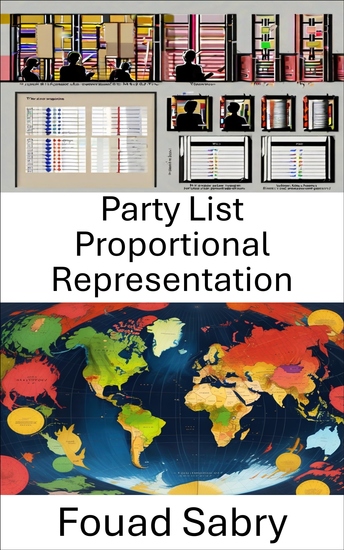
Party List Proportional Representation - Decoding Electoral Fairness and Representation - cover

Party List Proportional Representation - Decoding Electoral Fairness and Representation

Fouad Sabry

Casa editrice: One Billion Knowledgeable

  • 0
  • 0
  • 0

Sinossi

Explore the intricate world of electoral systems with "Party List Proportional Representation," a must-read guide that examines one of the key methods of democratic representation. This essential Political Science series entry explains how Party List Proportional Representation (PLPR) influences political landscapes and party dynamics worldwide. Whether you're a student, professional, or just curious, this book provides key insights into PLPR and its effects on democracy.
 
1-Party-List Proportional Representation-Learn the basics of PLPR and how it ensures fair seat distribution based on party votes.
 
2-Proportional Representation-Understand the broader idea of proportional representation and its importance in balanced governance.
 
3-D'Hondt Method-Discover the D'Hondt method's formula for seat allocation in PLPR and assess its pros and cons.
 
4-Sainte-Laguë Method-Compare the Sainte-Laguë method with the D'Hondt method in different electoral contexts.
 
5-Highest Averages Method-Learn about the Highest Averages method and its effects on seat distribution in PLPR.
 
6-Largest Remainder Method-Explore the Largest Remainder method for fairer vote representation and seat allocation.
 
7-Imperiali Quota-Investigate the Imperiali quota's role in ensuring proportional representation in elections.
 
8-Hare Quota-Examine the Hare quota and its significance in distributing seats and ensuring fairness.
 
9-Huntington–Hill Method-Analyze the Huntington–Hill method's role in ensuring equity in PLPR systems.
 
10-Electoral System-Get an overview of various electoral systems and their impact on political representation.
 
11-Single Transferable Vote-Discover the Single Transferable Vote system's role in boosting proportionality.
 
12-Single Non-Transferable Vote-Explore the Single Non-Transferable Vote system's effects on electoral fairness.
 
13-Apportionment (Politics)-Understand apportionment's role in distributing political power and its impact on representation.
 
14-21-Regional Elections Case Studies-Analyze regional elections, like the 2005 Lombard and Piedmontese, to understand PLPR in practice.
 
This book offers a deep dive into Party List Proportional Representation, shedding light on its complexities. Through thorough analysis and wide-ranging coverage, readers gain more than just a basic understanding, making this guide an invaluable resource.
Disponibile da: 05/09/2024.
Lunghezza di stampa: 236 pagine.

Altri libri che potrebbero interessarti

  • Clean air - cover

    Clean air

    Gianfranco Rosolia

    • 0
    • 0
    • 0
    Imagine living without clean air. For the people who lived on the doorstep of Monkton Coke Works, their daily reality was a horrendous nightmare of hazardous and acrid sulfur dioxide emissions, all-pervading soot, and clamorous tannoys. Over decades, the facility grew unflaggingly, converting ever-increasing quantities of coal into coke without concern for the residents' well-being. In forming the Hebburn Residents' Action Group, Jennie Shearan united and empowered the underrepresented residents of Monkton Lane Estate, and gave them a voice, igniting a national dialogue about the health risks from the pollution that her neighborhood had to endure. CLEAN AIR is an exhilarating memento of the lengths that Jennie Shearan went to in order to secure environmental equity for her community. It is a David and Goliath account of a fearless working class woman who put it all on the line and left no stone unturned in her uncompromising fight for the right to clean air.
    Mostra libro
  • Systematic Theology - cover

    Systematic Theology

    Paul Tillich

    • 0
    • 0
    • 0
    “A great voyage of discovery into a rich and deep, and inclusive...vision and understanding of human life in the presence of the mystery of God.” -- H. Richard Niebuhr, author of Christ and Culture   This is the first part of Paul Tillich's three-volume Systematic Theology, one of the most profound statements of the Christian message ever composed and the summation and definitive presentation of the theology of the most influential and creative American theologian of the twentieth century. In this path-breaking volume Tillich presents the basic method and statement of his system—his famous “correlation” of man's deepest questions with theological answers. Here the focus is on the concepts of being and reason. Tillich shows how the quest for revelation is integral to reason itself. In the same way a description of the inner tensions of being leads to the recognition that the quest for God is implied in finite being. Here also Tillich defines his thought in relation to philosophy and the Bible and sets forth his famous doctrine of God as the “Ground of Being.” Thus God is understood not as a being existing beside other beings, but as being-itself or the power of being in everything. God cannot be made into an object; religious knowledge is, therefore, necessarily symbolic.   “Beyond doubt the richest, most suggestive, and most challenging philosophical theology our day has produced.” --John Herman Randall Jr., author of The Making of the Modern Mind
    Mostra libro
  • Under the Dome - Politics Crisis and Architecture at the United States Capitol - cover

    Under the Dome - Politics Crisis...

    Alan M. Hantman, Sen. Harry M....

    • 0
    • 0
    • 0
    The domed US Capitol Building is recognized around the world as America's most iconic symbol, the forum for representative democracy, and the physical stage for the transfer of executive power. As the United States grew in size and complexity, the Capitol was built, rebuilt, enlarged, and extended many times under the direction of the few who have served as Architect of the Capitol. This official heads the agency dedicated to preserving and upgrading this magnificent structure, and all the buildings and grounds of Capitol Hill. 


    In Under the Dome, Alan Hantman, the Architect of the Capitol from 1997 to 2007, provides a personal account of how the Capitol works as a physical space; who runs it, how and why decisions are made about the security of the Capitol and the people who work there, and how politicians think about the Capitol Building. He also recounts security threats to the Capitol during his tenure—including the 1998 shooting murder of two police officers and the Capitol evacuation on 9/11 as a hijacked airplane approached—that underscore one of his greatest challenges as Architect. The tension between securing the Capitol and opening it to the public drove the design and construction under his direction of the Capitol Visitor Center, the largest expansion of the Capitol in its history, increasing its size by seventy percent.
    Mostra libro
  • Crime and Punishment in Ancient Egypt: The History and Legacy of the Egyptians’ Concepts of Justice - cover

    Crime and Punishment in Ancient...

    Editors Charles River

    • 0
    • 0
    • 0
    In ancient Egypt, the underpinning concept in law, in theory, was that rich and poor citizens should be treated equally, but this was an aspiration that was rarely fulfilled in practice. At the same time, the types of treatment delivered to those deemed guilty could also be harsh - common punishments included confiscation of property, slavery, beatings, and mutilation. During both the Old Kingdom (c. 2700 BCE – 2200 BCE) and Middle Kingdom (c. 2030 BCE – 1650 BCE), crime was dealt with by local officials using their own private police forces. However, during the New Kingdom (c. 1539 BCE – 1075 BCE) a centralized police force emerged, consisting of Nubian tribesmen under an Egyptian supervisor, who were armed with staffs and used specially trained dogs. 
    	In extreme cases, the death penalty was invoked, sometimes with the additional punishment of ensuring that the convicted were refused a burial or were buried but without full rituals. Based on the Egyptians’ religious beliefs, both situations resulted in the guilty being denied entry to the afterlife. 
    	Perhaps not surprisingly, not all laws related directly to criminal activity. Civil disputes were common, and suits by a plaintiff against a defendant provide another major source about the Egyptian legal system, as do the copies of the many legal transactions and contracts that date from the 7th century BCE onwards when the popular form of the written language (Demotic) started to become more widely used. Indeed, it is often difficult to distinguish between civil and criminal cases in the available records. Following the introduction of writing, however, written deeds or contracts quickly replaced traditional oral agreements, and many of these extant documents reveal considerable detail about the laws of ancient Egypt.
    Mostra libro
  • Monsters of Pennsylvania - Mysterious Creatures in the Keystone State - cover

    Monsters of Pennsylvania -...

    Patty A Wilson

    • 0
    • 0
    • 0
     Gritty isn’t the only monster who makes Pennsylvania his home. From Pittsburgh’s Ogua to the coal country’s Tommyknockers, mythical beasts stalk the state.   Pennsylvania is home to an assortment of odd creatures, and this volume features the best of the bunch. Bigfoot looms large here, trudging the wilds all throughout the state. Other cryptids featured are the gigantic Broad Top Snake, the bizarre Dogman of Westmoreland County, and Bessie, Lake Erie’s resident monster. Reports of big cats, giant attacking thunderbirds, bloodsucking wolfmen, and mischievous, mine-dwelling Tommyknockers are included.  
    Mostra libro
  • What Is Reality? - An Introduction to Metaphysics - cover

    What Is Reality? - An...

    Ross Inman

    • 0
    • 0
    • 0
    What is real? How do we determine what the fundamental structures of reality are?
    In this Questions in Christian Philosophy volume, philosopher Ross Inman offers an introduction to metaphysics. He introduces us to the tradition of metaphysics in Western philosophy, what it means to do metaphysics as a Christian, and considers timeless and universal inquiries into the central topics of metaphysics: identity, necessity and possibility, properties, universals, substances, and parts and wholes.
    With this academic but accessible primer, readers will be introduced to the key topics explored in contemporary metaphysics.
    The Questions in Christian Philosophy Series features introductory textbooks that offer students a Christian perspective on the various branches of philosophy, enabling them as they seek to understand all facets of life including existence, knowledge, ethics, art, and more.
    Mostra libro