¡Acompáñanos a viajar por el mundo de los libros!
Añadir este libro a la estantería
Grey
Escribe un nuevo comentario Default profile 50px
Grey
Suscríbete para leer el libro completo o lee las primeras páginas gratis.
All characters reduced
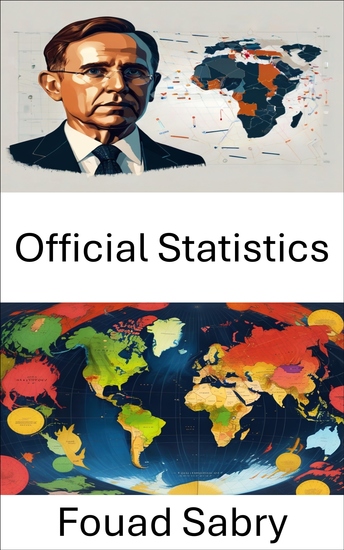
Official Statistics - Analyzing Data Trends for Informed Governance - cover

Official Statistics - Analyzing Data Trends for Informed Governance

Fouad Sabry

Editorial: One Billion Knowledgeable

  • 0
  • 0
  • 0

Sinopsis

"Official Statistics" is a must-read for anyone in political science and governance, offering a deep dive into how official statistical methods influence policy-making, governance, and public perception. Through exploring data collection and dissemination, the book highlights the pivotal role of statistics in shaping political dynamics and guiding critical decisions.
 
Chapters Overview:
 
1. Official Statistics: Introduction to key concepts and methodologies in official statistics and their importance in political science.
 
2. Census: Examines the role of national censuses in shaping policy decisions and public services.
 
3. United Nations Economic Commission for Europe: Discusses the UN's efforts in harmonizing statistical practices across Europe to improve data quality and comparability.
 
4. Statistics Canada: Explores how Canadian statistics support evidence-based policy.
 
5. Hellenic Statistical Authority: Highlights Greece’s contributions to national and European data systems.
 
6. Economic Data: Discusses how economic data informs fiscal and monetary policies.
 
7. Economic Statistics: Covers key economic indicators like GDP and inflation rates and their role in policy-making.
 
8. Statistics Belgium: Insight into Belgium’s statistical practices in a federal system.
 
9. Statistics New Zealand: Explores how New Zealand uses statistics to drive policy in a diverse context.
 
10. American Community Survey: Discusses its role in providing detailed demographic data for U.S. policy.
 
11. National Institute of Statistics and Census of Argentina: Highlights challenges in Argentina’s data collection and analysis.
 
12. Philippine Statistics Authority: Discusses innovations and challenges in the Philippines’ statistical system.
 
13. Statistics Denmark: Examines Denmark’s use of data in public policy.
 
14. Pollutant Release and Transfer Register: Focuses on environmental statistics and their role in policy.
 
15. Ministry of Statistics and Programme Implementation (India): Details how statistics support development in India.
 
16. Census and Statistics Department (Hong Kong): Explores Hong Kong’s unique statistical practices.
 
17. Statistics Botswana: Discusses Botswana’s use of data in national development.
 
18. Data Dissemination: Examines the importance of accessible data for transparency.
 
19. Statistical Disclosure Control: Covers techniques for balancing data confidentiality and utility.
 
20. Indian Statistical Service: Discusses the role of the Indian Statistical Service in government functions.
 
21. Five Safes: Introduces a framework for managing and sharing data securely.
 
This book offers essential insights and practical examples for understanding the impact of statistics on political science, making it a vital resource for professionals, students, and enthusiasts in the field.
Disponible desde: 08/08/2024.
Longitud de impresión: 218 páginas.

Otros libros que te pueden interesar

  • American Presidents - Andrew Jackson Richard Nixon Ronald Reagan and John F Kennedy - cover

    American Presidents - Andrew...

    Kelly Mass

    • 0
    • 0
    • 0
    This is a bundle book with biographies about the following USA presidents: 
    1 - Andrew Jackson was an American attorney, soldier, and statesman who acted as the seventh president of the U.S. from 1829 to 1837. Jackson rose to prominence as a basic in the US Army and served in both homes of Congress before being chosen to the presidency. Jackson, an expansionist president, defended the rights of the "commoner" and the Union against a "corrupt upper class." 
    2 - Richard Milhous Nixon was the United States' 37th president, serving from 1969 to 1974. Nixon, a Republican politician, formerly worked as the 36th Vice President from 1953 to 1961, after rising to country prominence as a California agent and senator. Following the Watergate occurrence, he ended up being the only president to leave from office after 5 years in the White Home that observed the end of the Vietnam War, détente with the Soviet Union and China, the first manned moon landings, and the starting of the Epa. 
    3 - Ronald Wilson Reagan was the 40th President of the U.S.A. of America, serving from 1981 to 1989. He was the Republican politician Party's 33rd ruler of California from 1967 to 1975, following a profession as a Hollywood star and labor organizer. Reagan was born in Tampico, Illinois, to a low-income family. In the year 1932, he finished from Eureka College and went to work in Iowa as a radio sports analyst. 
    4 - JFK, or John Fitzgerald Kennedy, was an American political leader who functioned as the 35th President of the US from 1961 till his assassination to the conclusion of his 3rd year in office. Kennedy was president throughout the height of the Cold War, and the majority of his time in office was spent handling the Soviet Union and Cuba. Prior to his presidency, Kennedy acted as a Democrat in both homes of Congress, representing Massachusetts.
    Ver libro
  • Conduct of Life volume 2 - cover

    Conduct of Life volume 2

    Moses Almosnino, Walter Hilliger

    • 0
    • 0
    • 0
    The major work of Rabbi Moses Almosnino (1515-1580), “Conduct of Life,” remains to this day an essential reference in classical Judeo-Spanish literature, now finally available in English in its first translation. First published in Ladino in 1564 as, Sefer Hanhagat ha-hayim and in 1729 as “Regimiento de la vida”, this three-volume edition is part of the prestigious collection Veritas è terra orietur. The work aims to disseminate the timeless teachings of ethics, in the words of the author: “In all that has been said, my intention is only to make you understand how the one who follows the path of virtue and customs of practising good and pure knowledge since childhood, lives a happy and fulfilled life (Volume 1, chapter 2)” This second volume addresses the confusion of indeterminism with free will (Volume 2, chapter 1) and how virtues arise from free will to surpass the force of destiny chapter 2), their conditions (chapter 3); the three types of strength or courage, which is the first virtue (chapter 4), its five properties and eleven conditions (chapter 5); as well as the ten ethical virtues, temperance (chapter 6), the sixteen properties of liberality chapters 7-8), magnificence (chapter 9), magnanimity and its fifty properties (chapter 10-12), modesty (chapter 13), meekness (chapters 14-16), affability (chapter 17), honesty or truth (chapters 18-19), and courtesy (chapter 20); following the order and numbering of Aristotle's Nicomachean Ethics.“Conduct of Life” draws heavily from the Nicomachean Ethics but transcends this source by situating itself at the universal intersection of several traditions: Greco-Arabic philosophy, Judeo-Christian scholasticism, classical Sephardic Judaism, and medieval Jewish thought. Thus, this work contributes to peace and intercultural understanding among peoples.
    Ver libro
  • FRUIT YOU’LL NEVER SEE THE - A memoir about overcoming shame - cover

    FRUIT YOU’LL NEVER SEE THE - A...

    Gail Brenner Nastasia

    • 0
    • 0
    • 0
    Growing up in Gloucester, Massachusetts, a quaint coastal town with a dark underbelly, Gail Brenner Nastasia learned early on that some people mattered and others didn’t. As the child of a heroin-addicted mother and an aunt who brokered deals with men who liked to have sex with young girls, Gail was sure she didn’t matter. As a result of keeping her secrets and those of her family, she developed a cunning and merciless pill addiction. 
    Despite moving away from Gloucester in her early twenties and becoming an attorney, Gail continued to use drugs while carrying the shame of her childhood. It wasn’t until she began to appreciate the value in her criminally-charged clients, those with whom she shared similar struggles, that she finally recognized her own worth. This new understanding gave her the courage to put down the drugs, fully embrace her history, and stop hiding. 
    A candid look at the things we inherit, THE FRUIT YOU’LL NEVER SEE reminds us of the value intrinsic in every human being and the responsibility we all have to each other and ourselves.
    Ver libro
  • Violette Szabo - The Life That I Have - cover

    Violette Szabo - The Life That I...

    Susan Ottaway

    • 0
    • 0
    • 0
    The story of Violette Szabo is one of the most extraordinary in the annals of World War II espionage and covert operations. 


    Totally fearless and a dead shot, Violette Szabo volunteered to become part of the Special Operations Executive, Britain's premier sabotage and subversion organization of the time. On June 7, 1944, Violette left behind a two-year-old daughter to parachute into France on a special mission. 


    Szabo and other British agents were assigned to organize French resistance fighters to hinder the advance of the SS Das Reich Division to the Normandy beaches. Unfortunately, Szabo's party was soon ambushed by the SS. 


    Unable to walk due to a twisted ankle, Szabo covered the retreat of her comrades with machine-gun fire. Captured, she went through a series of interrogations and changes of confinement before ending up at Ravensbruck, the German all-women's concentration camp. She was finally executed on January 26, 1945. She was twenty-three years old. 


    This exceptional work has been written with the assistance of Violette Szabo's daughter Tanya and unravels fact and fiction about one of the most fascinating characters of World War II.
    Ver libro
  • Old Gods New Enigmas - Marx's Lost Theory - cover

    Old Gods New Enigmas - Marx's...

    Mike Davis

    • 0
    • 0
    • 0
    Marx has returned, but which Marx? Recent biographies have proclaimed him to be an emphatically nineteenth-century figure, but in this book, Mike Davis's first directly about Marx and Marxism, a thinker comes to light who speaks to the present as much as the past. In a series of searching, propulsive essays, Davis, the bestselling author of City of Quartz and recipient of a MacArthur Fellowship, explores Marx's inquiries into two key questions of our time: Who can lead a revolutionary transformation of society? And what is the cause—and solution—of the planetary environmental crisis? 
     
    Davis consults a vast archive of labor history to illuminate new aspects of Marx's theoretical texts and political journalism. He offers a "lost Marx," whose analyzes of historical agency, nationalism, and the "middle landscape" of class struggle are crucial to the renewal of revolutionary thought in our darkening age. Davis presents a critique of the current fetishism of the "anthropocene," which suppresses the links between the global employment crisis and capitalism's failure to ensure human survival in a more extreme climate. In a finale, Old Gods, New Enigmas looks backward to the great forgotten debates on alternative socialist urbanism (1880–1934) to find the conceptual keys to a universal high quality of life in a sustainable environment.
    Ver libro
  • We Are Not the Enemy: The Practice of Advocacy in Singapore - cover

    We Are Not the Enemy: The...

    Cherian George, Kok Hoe Ng,...

    • 0
    • 0
    • 0
    Advocates and activists in Singapore contribute to policy discussions and positive change through a combination of deft manoeuvres and patient politics. Yet civil society is often unacknowledged, their skill and labour instead frequently misunderstood, even earning them the label of “troublemakers” or “enemies of the state”. 
     
    This collection of essays and interviews is a candid reflection on the intentions, beliefs and strategies behind the practice of advocacy across a spectrum of causes. The contributors come from varying backgrounds and include academics, artists, lawyers, journalists, non-profit and advocacy organisations, student and community organisers. They share practical insights into their aims and community-building work, and the tactics they employ to overcome obstacles, shedding light on how to navigate a city-state with shifting socio-political fault lines and out-of-bound markers. 
     
    With an introduction, “It is Time to Trim the Banyan Tree”, by Constance Singam, and a conclusion, “Their Struggle is Ours to Continue”, by Suraendher Kumarr.
    Ver libro