¡Acompáñanos a viajar por el mundo de los libros!
Añadir este libro a la estantería
Grey
Escribe un nuevo comentario Default profile 50px
Grey
Suscríbete para leer el libro completo o lee las primeras páginas gratis.
All characters reduced
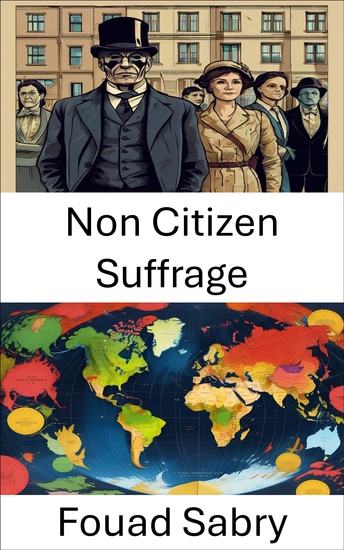
Non Citizen Suffrage - Empowering Voices in Global Democracies - cover

Non Citizen Suffrage - Empowering Voices in Global Democracies

Fouad Sabry

Editorial: One Billion Knowledgeable

  • 0
  • 0
  • 0

Sinopsis

Non-Citizen Suffrage: Understanding Global Voting Rights
 
Explore the complexities of non-citizen voting rights in "Non-Citizen Suffrage," part of the "Political Science" series. This book delves into how enfranchising non-citizens affects global democracy. As citizenship and residency boundaries blur, understanding these rights is key to shaping political equity.
 
Chapters Overviews
 
1: Non-citizen Suffrage – A deep dive into the relevance of non-citizen voting.
 
2: Suffrage – The historical roots and its impact on modern voting.
 
3: Disfranchisement – Exclusion from voting and its political consequences.
 
4: British Subject – Perspectives on non-citizen suffrage in the UK.
 
5: Elections in France – France's stance on non-citizen voting.
 
6: Voter Registration – How systems affect non-citizen participation.
 
7: Permanent Residency – The role of residency in voting rights.
 
8: Elections in Luxembourg – Luxembourg's approach to non-citizen suffrage.
 
9: Elections in Lithuania – Eastern European challenges in voting rights.
 
10: Right of Abode – How residency status impacts suffrage.
 
11: Irish Nationality Law – Nationality laws shaping Irish voting rights.
 
12: Commonwealth Citizen – Commonwealth's influence on voting rights.
 
13: Finnish Nationality Law – Finnish law and its impact on suffrage.
 
14: Maltese Nationality Law – Malta’s approach to non-citizen voting.
 
15: History of Icelandic Nationality – Iceland’s evolving voting practices.
 
16: Non-citizen Suffrage in the U.S. – The debate surrounding U.S. non-citizen voting.
 
17: Black Suffrage – The intersection of race and voting rights.
 
18: Multiple Citizenship – How dual/multiple citizenship affects voting.
 
19: Right of Foreigners to Vote in Switzerland – A Swiss case study on non-citizen voting.
 
20: Right of Expatriates to Vote – Expatriates' role in home-country elections.
 
21: Voting Rights in Belgium – Non-citizen voting in Belgium’s democracy.
 
Conclusion
 
With real-world examples and theoretical analysis, "Non-Citizen Suffrage" is essential for anyone studying voting rights. It offers new insights into global democratic practices and non-citizen participation, making it a must-read for scholars, professionals, and enthusiasts of political science.
Disponible desde: 12/09/2024.
Longitud de impresión: 353 páginas.

Otros libros que te pueden interesar

  • How to Think Like a Lawyer--and Why - A Common-Sense Guide to Everyday Dilemmas - cover

    How to Think Like a Lawyer--and...

    Kim Wehle

    • 0
    • 0
    • 0
    A law professor and author teaches non-attorneys how to think like a lawyer to gain advantage in their lives—whether buying a house, negotiating a salary, or choosing the right healthcare.   
    Lawyers aren’t like other people. They often argue points that are best left alone or look for mistakes in menus “just because.” While their scrupulous attention to detail may be annoying, it can also be a valuable skill.  
    Do you need to make health care decisions for an aging parent but are unsure where to start? Are you at crossroads in your career and don’t know how to move forward? Have you ever been on a jury trying to understand confusing legal instructions? How to Think Like a Lawyer has the answers to help you cut through the confusion and gain an advantage in your everyday life. Kim Wehle identifies the details you need to pay attention to, the questions you should ask, the responses you should anticipate, and the pitfalls you can avoid. Topics include: Selling and buying a homeUnderstanding employment termsCreating a will and health care proxyNavigating health concernsApplying for financial aidNegotiating a divorce 
     
    Wehle shows you how to break complex issues down into digestible, easier-to-understand pieces that will enable you to make better decisions in all areas of your life. 
    Supplemental enhancement PDF accompanies the audiobook.
    Ver libro
  • The War Ledger - cover

    The War Ledger

    A.F.K. Organski, Jacek Kugler

    • 0
    • 0
    • 0
    The War Ledger provides fresh, sophisticated answers to fundamental questions about major modern wars: Why do major wars begin? What accounts for victory or defeat in war? How do victory and defeat influence the recovery of the combatants? Are the rules governing conflict behavior between nations the same since the advent of the nuclear era? The authors find such well-known theories as the balance of power and collective security systems inadequate to explain how conflict erupts in the international system. Their rigorous empirical analysis proves that the power-transition theory, hinging on economic, social, and political growth, is more accurate; it is the differential rate of growth of the two most powerful nations in the system—the dominant nation and the challenger—that destabilizes all members and precipitates world wars. Predictions of who will win or lose a war, the authors find, depend not only on the power potential of a nation but on the capability of its political systems to mobilize its resources—the "political capacity indicator." After examining the aftermath of major conflicts, the authors identify national growth as the determining factor in a nation's recovery. With victory, national capabilities may increase or decrease; with defeat, losses can be enormous. Unexpectedly, however, in less than two decades, losers make up for their losses and all combatants find themselves where they would have been had no war occurred. Finally, the authors address the question of nuclear arsenals. They find that these arsenals do not make the difference that is usually assumed. Nuclear weapons have not changed the structure of power on which international politics rests. Nor does the behavior of participants in nuclear confrontation meet the expectations set out in deterrence theory.
    Ver libro
  • The Fall of Communism - Understanding the Collapse of the Soviet Union and Its Impact - cover

    The Fall of Communism -...

    Arlo Holders

    • 0
    • 0
    • 0
    The origins of communism can be traced back to the mid-19th century, largely shaped by the theories of Karl Marx and Friedrich Engels. Marx's writings, particularly The Communist Manifesto (1848), presented a vision for a classless society where the working class, or proletariat, would overthrow the capitalist bourgeoisie and establish a dictatorship of the proletariat. Marx believed this revolution would lead to the eventual abolition of private property, creating a system where resources and wealth were shared equally among all people. Engels, Marx’s collaborator, helped to spread these ideas, laying the theoretical foundation for communism as a political ideology. 
    In the early 20th century, the ideas of Marxism found fertile ground in Russia, where economic disparity and social unrest were widespread. The Russian Empire, under Tsar Nicholas II, faced increasing pressure from industrialization, a growing working class, and a largely disenfranchised peasantry. The Russian Revolution of 1917, led by the Bolshevik Party under Vladimir Lenin, marked the beginning of communism’s practical implementation. The Bolsheviks sought to establish a socialist state where the working class would control the means of production and dismantle the old Tsarist monarchy. 
    Following the revolution, the Soviet Union was formed in 1922, uniting the Russian Federation and several other Soviet republics under a single communist government. The new government, however, faced significant challenges, including civil war, foreign intervention, and the task of restructuring a country that had been predominantly agrarian into a socialist industrialized state. Lenin’s death in 1924 led to the rise of Joseph Stalin, who consolidated power through brutal purges and policies such as forced collectivization and rapid industrialization.
    Ver libro
  • A Very Short History of the Israel–Palestine Conflict - cover

    A Very Short History of the...

    Ilan Pappé

    • 0
    • 0
    • 0
    An indispensable guide to understanding the Israel–Palestine conflict, and how we might yet still find a way out of it. 


    "Ilan Pappe is the most original, radical and hard-hitting of Israel's 'new historians.'" —Avi Shlaim, author of Three Worlds 


    The devastation of 7 October 2023 and the horrors that followed astounded the world. But the Israel–Palestine conflict didn't start on 7 October. It didn't start in 1967 either, when Israel occupied the West Bank, or in 1948 when the state of Israel was declared. It started in 1882, when the first Zionist settlers arrived in what was then Ottoman Palestine. Ilan Pappe untangles the history of two peoples, now sharing one land. Going back to the founding fathers of Zionism, Pappe expertly takes us through the twists and turns of international policy towards Israel–Palestine, Palestinian resistance to occupation, and the changes taking place in Israel itself.
    Ver libro
  • NATO After Russia's Invasion of Ukraine - Threat Perceptions and Their Consequences - cover

    NATO After Russia's Invasion of...

    Jason W. Davidson

    • 0
    • 0
    • 0
    A revealing look at differing threat perceptions in six key NATO countries 
     
    When Russia began its full-scale invasion of Ukraine in February 2022, analysts and policymakers highlighted the unifying shock that NATO members experienced. However even before the return of US president Donald Trump, beneath this seeming cohesion lay deep-seated differences in how member states perceive and prioritize security threats. 
     
    NATO after Russia's Invasion of Ukraine analyzes the six most influential members of the alliance: the United States, the United Kingdom, France, Germany, Poland, and Italy. Through extensive interviews with current and former policymakers and a detailed examination of public statements and policies, Jason W. Davidson delivers a unique assessment of how divergent threat perceptions influence the NATO allies' major defense decisions, such as defense spending, and whether the alliance addresses each ally's most important threat and its view of NATO's most important challenges. With the rise in tumultuous geopolitical challenges posed by Russia, China, terrorism, mass refugee flows, and nationalism, this book provides the crucial context needed to navigate NATO's evolving role in international security.
    Ver libro
  • Campaigns Elections and the Threat to Democracy - What Everyone Needs to Know® 2nd Edition - cover

    Campaigns Elections and the...

    Dennis W. Johnson

    • 0
    • 0
    • 0
    The United States, through its local, state, and national contests, holds more elections, more often, than any democracy in the world. But in recent years, there have been troubling signs that our system of campaigns and elections has become much more fragile and vulnerable. More specifically, in the past twenty years, campaigns have changed profoundly: social media and viral messaging compete with traditional media, races once considered local in nature have become nationalized, Supreme Court decisions on campaign finance law now encourage mega-donors, voters are more polarized, party affiliation has waned, and the middle ideological ground has given way to extremist language and voter rage. 


    This new edition of Campaigns, Elections, and the Threat to Democracy: What Everyone Needs to Know® offers the most up-to-date examination of campaigns, elections, and future threats to voting and democracy. It will also include new data on voter participation, voter fraud, reapportionment post-2020 census, party polarization, campaign finance, and more. 


    Given the fragility of our election process, what are the threats to a healthy American democracy? This is not simply a book on how campaigns are run, but why campaigns and elections are integral components of American democracy and how those fundamental elements may be vulnerable to misuse.
    Ver libro