¡Acompáñanos a viajar por el mundo de los libros!
Añadir este libro a la estantería
Grey
Escribe un nuevo comentario Default profile 50px
Grey
Suscríbete para leer el libro completo o lee las primeras páginas gratis.
All characters reduced
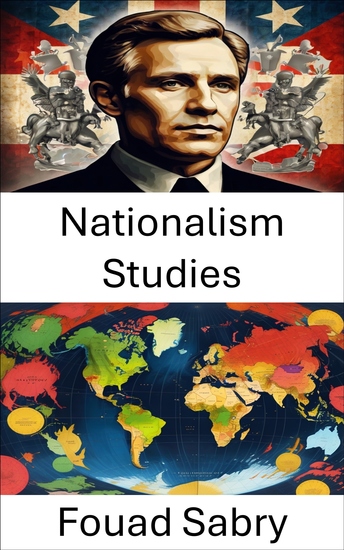
Nationalism Studies - Understanding Identity and Power in Modern States - cover

Nationalism Studies - Understanding Identity and Power in Modern States

Fouad Sabry

Editorial: One Billion Knowledgeable

  • 0
  • 0
  • 0

Sinopsis

Explore the complexities of nationalism with Nationalism Studies, a key volume in the Political Science series. This essential read delves into the intricate relationship between nationalism, identity, and global politics, offering valuable insights for professionals, students, and enthusiasts alike.
 
Chapter Highlights:
 
1. Nationalism Studies: Introduction to the core concepts and importance of nationalism in modern political science.
 
2. Nationalism: Foundational theories and evolution of nationalism.
 
3. Nation: The role of nations as political and cultural entities.
 
4. Women's Studies: Intersection of nationalism and gender, highlighting women's roles in nationalist movements.
 
5. Cultural Identity: The link between nationalism and cultural heritage.
 
6. National Identity: Formation and implications of national identity.
 
7. Primordialism: Theory of ancient ties between individuals and their nations.
 
8. Anthony D. Smith: Contributions to nationalism theory and ethnic identity.
 
9. Civic Nationalism: Focus on shared citizenship and political values.
 
10. Constitutional Patriotism: Loyalty to democratic principles over ethnic bonds.
 
11. Madheshi People: Nationalist challenges and recognition in Nepal.
 
12. Azar Gat: Views on nationalism's role in political structures and conflicts.
 
13. Ghassan Hage: Research on multiculturalism and nationalism.
 
14. Walker Connor: Theories on ethnic and national identity.
 
15. Thomas Spira: Perspectives on nationalism's global impact.
 
16. Multiculturalism in Canada: Interaction of multiculturalism and nationalism in Canada.
 
17. John Hutchinson: Scholarly contributions to nationalism studies.
 
18. Umut Özkirimli: Theoretical and practical aspects of nationalism.
 
19. Korean Ethnic Nationalism: Features and political influence of Korean ethnic nationalism.
 
20. Ethnosymbolism: Role in forming and maintaining national identities.
 
21. Ethnicities (Journal): Recent research and discussions on nationalism and ethnic studies.
 
Nationalism Studies provides a comprehensive understanding of nationalism's impact on global politics and personal identities, making it an invaluable resource for exploring this multifaceted topic.
Disponible desde: 05/08/2024.
Longitud de impresión: 179 páginas.

Otros libros que te pueden interesar

  • My Pet Peeve - cover

    My Pet Peeve

    Renée Rodgers Barstack

    • 0
    • 0
    • 0
    Molly is a lonely little girl who is looking for a friend. She lives on a farm with her mom and dad. Molly has always loved cats and wants to get a cat, but her father sneezes when he gets around cats, so he tells her she cannot have one. Molly asks and asks and asks again, but the answer is always “No.” Then one day, Molly finds a little kitten hiding in the barn and wants to keep her, of course. What will she do? Should she hide the kitten from her dad? Will dad see the kitten and think it is so adorable he will change his mind about letting Molly keep the cat? What would you do if you found the cutest kitten ever? How will Molly solve this problem?
    Ver libro
  • Acropolis and the Agora The: The History of Ancient Athens’ Most Important Sites - cover

    Acropolis and the Agora The: The...

    Editors Charles River

    • 0
    • 0
    • 0
    The Acropolis, which literally means “a city on the heights,” is a citadel whose currently surviving structures were mostly built during the 5th century B.C. in honor of Athena, the patron goddess of Athens. It functioned as a sacred precinct that contained the city’s most important religious and municipal structures, many of which have remained relatively intact for over 2,000 years. The Propylaea (the gateway to the Acropolis), the Parthenon (the principal shrine to the goddess), the Erechtheion (a shrine that supposedly houses the burial grounds of mythical Athenian kings), and the Temple of Athena Nike all survive to this day, and for these reasons, the Acropolis is perhaps the definitive and most eloquent expression of classical architecture, if not of the classical form itself. The Acropolis, which literally means “a city on the heights,” is a citadel whose currently surviving structures were mostly built during the 5th century B.C. in honor of Athena, the patron goddess of Athens.  
    	The center of political and commercial interaction in the Ancient Greek polis was the agora. The word essentially means a gathering place or an open space, and in all Greek city states, the agora was central to all aspects of daily life and commerce. As the agora developed as a civic space, particularly from the 6th century B.C. onward in Athens, the architectural splendor of the buildings associated with it became an ever more obvious demonstration of the power and glory of Athenian democracy. 	In its earliest forms, an agora in maritime cities was invariably situated near the sea, while in inland urban centers, it was usually located at the foot of the hill that normally provided the city’s ultimate defense. The agora was always the oldest part of any city and, as such, and as well as being the commercial hub of the area, also became the center of the religious and political life of the polis.
    Ver libro
  • Interview with the Sphinx - Audio Play by Jack Matthews - cover

    Interview with the Sphinx -...

    Jack Matthews

    • 0
    • 0
    • 0
    In this provocative & immensely irritating comic play, the Sphinx from ancient Greece is interviewed in modern times as though she were a celebrity pop star. The problem is she never answers any questions — never directly anyway. Instead she prefers just dishing the dirt on everybody. ON HOMER: “I never was exactly sure which one Homer was. I’m positive he wasn’t the blind one, though; that was just a silly story they started telling a few centuries later”. ON OEDIPUS: “Eddie was terribly conceited, you know … of course he was smart and handsome and, oh, just had a way of carrying himself that impressed everybody. In spite of his foot.” Bit by bit the Interviewer learns that what happens in Greek legend didn’t happen exactly the way Sophocles described it. Fortunately, the Sphinx offers the Interviewer another riddle … if only he could figure out what exactly it is! This witty 67 minute audio play stars Jill Brumer as the Sphinx and Neal Gage as the Interviewer. Part Tom Stoppard, part Monty Python, part Oscar Wilde, this play by Jack Matthews combines philosophical paradoxes with fast-paced verbal pyrotechnics. It offers the perfect antidote to people who remembered ancient literature as nothing but stuffy and melodramatic characters with hard-to-pronounce names.  
    Neal Gage  is a Houston actor and teacher who has appeared in several features and comic sketch videos on  Funny or Die. Jill Brumer has an MFA in Media & Performing Arts and teaches theater at Houston colleges. Jack Matthews (1925-2013) was an American novelist, short story writer, essayist, playwright and former professor in Ohio. 
    The play was first published & performed in 1992; later it was revised & expanded for the 2013 audio production.
    Ver libro
  • Chesapeake Oysters - The Bay's Foundation and Future - cover

    Chesapeake Oysters - The Bay's...

    Kate Livie

    • 0
    • 0
    • 0
    Chesapeake oysters are part of the legacy of the area, history on the half-shell. Hear of their beginning (foot-long bivalves!) through cultivation today. 


    The eastern oyster, the humble bivalve and delicious treat, are the living bones of the Chesapeake, as well as the ecological and historical lifeblood of the region. When colonists first sailed these impossibly abundant shores, they described massive shoals of foot-long oysters but the bottomless appetite of the Gilded Age and great fleets of skipjacks took their toll. Disease, environmental pressures and overconsumption decimated the population by the end of the twentieth century. While Virginia turned to bottom-leasing, passionate debate continues in Maryland among scientists and oystermen whether aquaculture or wild harvesting is the better way forward. Today, boutique oyster farming in the Bay is sustainably meeting the culinary demand of a new generation of connoisseurs. With careful research and interviews with experts, author Kate Livie presents this dynamic story and a glimpse of what the future may hold.
    Ver libro
  • I Am the Law - How Judge Dredd Predicted Our Future - cover

    I Am the Law - How Judge Dredd...

    Michael Molcher

    • 0
    • 0
    • 0
    He is the law—and you better believe it! 


    Judge, jury, and executioner, Judge Dredd is the brutal comic book cop policing the chaotic future urban jungle of Mega-City One, created by John Wagner and Carlos Ezquerra and launching in the pages of 2000 AD in 1977. 


    But what began as a sci-fi action comic quickly evolved into a searing satire on hardline, militarized policing and "law and order" politics, its endless inventiveness and ironic humor acting as a prophetic warning about our world today—and with important lessons for our future. 


    Blending comic book history with contemporary radical theories on policing, I Am The Law takes key Dredd stories from the last forty-five years and demonstrates how they provide a unique wake up call about our gradual, and not so gradual, slide towards authoritarian policing. 


    From the politicization of policing to "zero tolerance," from violent suppression of protest to the rise of the surveillance state, I Am The Law examines how a comic book warned us about the chilling endgame of today's "law and order" politics.
    Ver libro
  • Plato - Theaetetus - cover

    Plato - Theaetetus

    Plato

    • 0
    • 0
    • 0
    The Theaetetus is one of Plato's dialogues concerning the nature of knowledge, written circa 369 BC. In this dialogue, Socrates and Theaetetus discuss three definitions of knowledge: knowledge as nothing but perception, knowledge as true judgment, and, finally, knowledge as a true judgment with an account. Each of these definitions is shown to be unsatisfactory.
    Ver libro