Junte-se a nós em uma viagem ao mundo dos livros!
Adicionar este livro à prateleira
Grey
Deixe um novo comentário Default profile 50px
Grey
Assine para ler o livro completo ou leia as primeiras páginas de graça!
All characters reduced
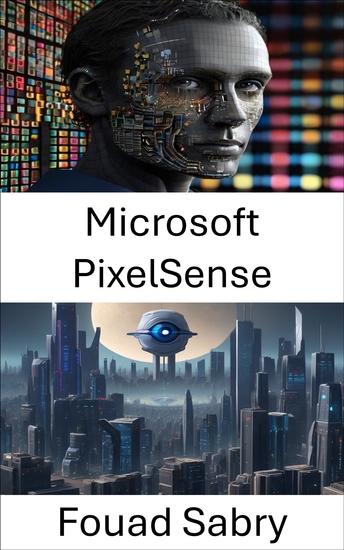
Microsoft PixelSense - Revolutionizing Human-Computer Interaction Through Visual Sensing - cover
LER

Microsoft PixelSense - Revolutionizing Human-Computer Interaction Through Visual Sensing

Fouad Sabry

Editora: One Billion Knowledgeable

  • 0
  • 0
  • 0

Sinopse

What is Microsoft PixelSense
 
Microsoft PixelSense was an interactive surface computing platform that allowed one or more people to use and touch real-world objects, and share digital content at the same time. The PixelSense platform consists of software and hardware products that combine vision based multitouch PC hardware, 360-degree multiuser application design, and Windows software to create a natural user interface (NUI).
 
How you will benefit
 
(I) Insights, and validations about the following topics:
 
Chapter 1: Microsoft PixelSense
 
Chapter 2: Computer mouse
 
Chapter 3: Graphical user interface
 
Chapter 4: Touchscreen
 
Chapter 5: Gesture recognition
 
Chapter 6: Tangible user interface
 
Chapter 7: Multi-touch
 
Chapter 8: Pen computing
 
Chapter 9: 3D user interaction
 
Chapter 10: Natural user interface
 
(II) Answering the public top questions about microsoft pixelsense.
 
(III) Real world examples for the usage of microsoft pixelsense in many fields.
 
Who this book is for
 
Professionals, undergraduate and graduate students, enthusiasts, hobbyists, and those who want to go beyond basic knowledge or information for any kind of Microsoft PixelSense.
Disponível desde: 14/05/2024.
Comprimento de impressão: 124 páginas.

Outros livros que poderiam interessá-lo

  • Quantum Computing and Artificial Intelligence - AI Quantum Computing and Post-Human Thought - cover

    Quantum Computing and Artificial...

    Martin K. Ettington

    • 0
    • 0
    • 0
    Intelligence is the most powerful force ever to emerge in the universe. 
    Today, intelligence is undergoing its most radical transformation since the emergence of the human mind. 
    Artificial intelligence has moved from theory into daily life. Algorithms now diagnose disease, generate art, predict markets, and converse with humans in natural language. Yet beneath these achievements lies a deeper truth: most contemporary AI remains constrained by the limits of classical computation. It excels at pattern recognition but struggles with genuine understanding, intuition, and creativity. It scales, but it does not truly think. 
    At the same time, a second revolution is quietly unfolding—one that challenges our deepest assumptions about computation itself. Quantum computing does not merely make calculations faster; it operates on principles fundamentally different from classical logic. Superposition, entanglement, and probabilistic collapse allow quantum systems to explore vast landscapes of possibilities simultaneously. These machines do not step through solutions one at a time—they sample reality in a way that resembles intuition more than calculation. 
    When artificial intelligence and quantum computing converge, intelligence itself changes form. 
    This book explores that convergence—and the consequences that follow.
    Ver livro
  • Majestic 12: The History and Conspiracy Theories Surrounding the Federal Government’s Investigation of UFOs - cover

    Majestic 12: The History and...

    Editors Charles River

    • 0
    • 0
    • 0
    When people think about unidentified flying objects (UFOs), they tend to think of flying discs piloted by gray beings with large heads and enormous eyes. They tend to think that these sightings only started relatively recently and that belief in UFOs is some sort of modern religion brought on, perhaps, by the very justifiable fears of a nuclear age. But a study of the phenomenon quickly reveals that people have been seeing UFOs since the beginning of recorded history and perhaps a lot longer than that. 
    	Naturally, as technological advances and the creation of flying aircraft became realities, the sighting of UFOs increased, as did the interest in potential contact with aliens.  Some of the American investigations of UFOs from the 1940s and 1950s were documented, but nothing exemplifies the debate between those who believe that extraterrestrials visit the Earth and skeptics than the top secret papers that emerged in the 1980s and seemed to prove the existence of a shadowy secret organization known as MJ-12 or Majestic 12. To believers, these papers proved beyond a doubt not only that UFOs were real and of extraterrestrial origin, but also that the federal government had been aware of this since the 1940s and had even managed to recover one or more crashed alien spacecrafts. To skeptics, this notion simply proved how gullible UFO believers were. There was no middle ground - people either believed in the MJ-12 papers completely or laughed at them. 
    	Decades later, it’s finally possible to take a more balanced view of the history of the MJ-12 papers, including where these documents originated from and who created them. It now seems virtually certain that there never was an organization called Majestic 12 and that the papers describing it were faked, but what makes the story truly fascinating is that it now also appears likely that these papers were faked by people actually working within the Air Force or another government agency.
    Ver livro
  • AI in Finance - Revolutionizing Financial Services with AI: Insights Innovations and Opportunities - cover

    AI in Finance - Revolutionizing...

    Chuck Sherman

    • 0
    • 0
    • 0
    In an era where technology drives unprecedented change, "AI in Finance" explores how artificial intelligence is transforming the financial landscape. From enhancing investment strategies and risk management to streamlining operations and improving customer experiences, AI is reshaping the way financial institutions operate and compete. 
    This comprehensive guide delves into the cutting-edge applications of AI across banking, trading, insurance, and wealth management. Learn how predictive analytics, machine learning, and natural language processing are revolutionizing decision-making and uncovering new opportunities. 
    This book offers practical insights into the challenges and ethical considerations of implementing AI in finance. With real-world case studies, expert perspectives, and a forward-looking approach, "AI in Finance" provides a roadmap to navigate the future of financial innovation.
    Ver livro
  • Six Steps to Managing Alzheimer's Disease and Dementia - A Guide for Families - cover

    Six Steps to Managing...

    MD Andrew E. Budson, PsyD...

    • 0
    • 0
    • 0
    Caregiving for a loved one with Alzheimer's disease or dementia is hard. It's hard whether you're caring for your spouse, parent, grandparent, sibling, other family member, or friend. And caring for a loved one with dementia can sometimes feel like a long, lonely journey. 


    Six Steps to Managing Alzheimer's Disease and Dementia can help, addressing concerns such as: 


    ● Is the problem Alzheimer's, dementia, or something else? 


    ● How do you approach problems in dementia? How do you manage problems with memory, language, and vision? How do you cope with emotional and behavioral problems? 


    ● What are the best ways to manage troubles with sleep and incontinence? Which medications can help? Which medications can actually make things worse? 


    ● How do you build your care team? Why is it important to care for yourself? How do you sustain your relationship with your loved one? 


    ● How do you plan for the progression of dementia? How do you plan for the end and beyond?
    Ver livro
  • Mastodon For Dummies - cover

    Mastodon For Dummies

    Chris Minnick, Michael McCallister

    • 0
    • 0
    • 0
    Ready to escape the drama of existing social media platforms and try something new and awesome in the world of social media? In Mastodon For Dummies, experienced tech trainers Chris Minnick and Mike McCallister show you exactly how to use Mastodon, the hot decentralized social media offering on the web and destination for thousands of social media migrants. Learn how to sign up for the service on your choice of server and get familiar with the rules of what's sure to become your new favorite app. You'll discover how to connect with other people, attract your own followers, and make yourself right at home in the Mastodon community. 


    In the book, you'll find: easy-to-follow instructions on how to choose the Mastodon server that suits you best; instructions for establishing new connections on a new social platform and learning the rules of the road; tips for conducting business on Mastodon and making a home for your home-based business or brand on the social media service; and step-by-step guides on launching your very own server. 


    Mastodon For Dummies is a must-listen if you're ready to leave old social platforms in the rearview and try something new.
    Ver livro
  • The Coming Singularity - cover

    The Coming Singularity

    Gary A. Freitas

    • 0
    • 0
    • 0
    As we approach 2050, it is projected that human consciousness will encounter a superior intelligence for the very first time: artificial machine intelligence. It is important for us to understand the evolutionary impact of this event, but also that we are being altered from the inside out for the singularity to arise. 
    Are we ready? 
    Will we be adaptive? 
    How will we change? 
    The Coming Singularity explores the psychological impact of the changes coming our way and the many adaptations we will have to make. 
    We are transitioning to a world of one degree of separation, with only the illusion of privacy, autonomy and anonymity. All of us are undergoing a transition to an electronic identity, one that can reach back and change the real you. The question going forward will be, who is the real you? 
    A cluster of psychological symptoms are evolving from our technology interface––Identity Diffusion. Its key feature is the de-realization of life. 
    Direct brain-to-technology interfaces will soon render our brains an open-source forum. We need to discuss who is in there and why! 
    The impact of e-technology on human identity will be profound, but it is also a prerequisite for machine intelligence to arise. We need to discuss this. 
    We humans reside in complex, dynamical networks. The goal of artificial intelligence will be to evolve and stabilize these networks. And we may not be the priority.
    Ver livro