Join us on a literary world trip!
Add this book to bookshelf
Grey
Write a new comment Default profile 50px
Grey
Subscribe to read the full book or read the first pages for free!
All characters reduced
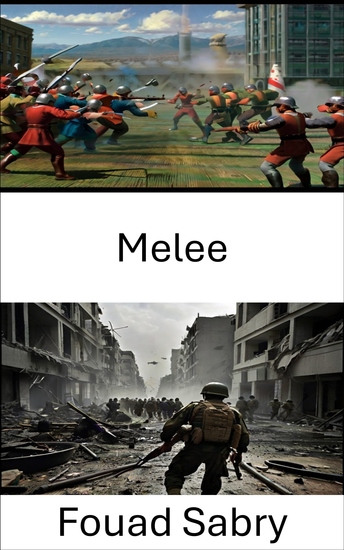
Melee - Strategic Combat Operations in Modern Warfare - cover

Melee - Strategic Combat Operations in Modern Warfare

Fouad Sabry

Publisher: One Billion Knowledgeable

  • 0
  • 0
  • 0

Summary

What is Melee
 
A melee or pell-mell is disorganized hand-to-hand combat in battles fought at abnormally close range with little central control once it starts. In military aviation, a melee has been defined as "an air battle in which several aircraft, both friend and foe, are confusingly intermingled".
 
How you will benefit
 
(I) Insights, and validations about the following topics:
 
Chapter 1: Melee
 
Chapter 2: Infantry
 
Chapter 3: Navy
 
Chapter 4: Battle of Trafalgar
 
Chapter 5: Combined arms
 
Chapter 6: Pike (weapon)
 
Chapter 7: Naval Battle of Guadalcanal
 
Chapter 8: Tournament (medieval)
 
Chapter 9: Charge (warfare)
 
Chapter 10: Skirmisher
 
(II) Answering the public top questions about melee.
 
Who this book is for
 
Professionals, undergraduate and graduate students, enthusiasts, hobbyists, and those who want to go beyond basic knowledge or information for any kind of Melee.
Available since: 06/19/2024.
Print length: 132 pages.

Other books that might interest you

  • Landing at the Top - How Embracing Adventure Leads to Extraordinary Success - cover

    Landing at the Top - How...

    David Jackson

    • 0
    • 0
    • 0
    David Jackson is proof positive that hard work, persistence, and belief in yourself can help you fulfill your most desired goals and dreams no matter what obstacles are thrown in your way. If ever there was a testament to perseverance and hard work, Landing at the Top is it.
    Show book
  • Renaissance - The Historical Time Period of Renewed Art and Trade - cover

    Renaissance - The Historical...

    Kelly Mass

    • 0
    • 0
    • 0
    This book contains the following titles: 
    Renaissance - When we think of the Renaissance, we often think of paintings. And indeed, many painters and sculptors were part of the artistic transformation the Renaissance caused. But there was more. The Renaissance basically formed a period of collective enlightenment and freedoms that put an end to certain tyrannies and false notions from the Middle Ages. 
    Dutch East India Trading Company - Did you know that the Dutch were some of the first who came up with stocks? They were also known for their gigantic fleet, their ships, their colonies, and so much more. The 17th century was a golden age, a golden century for the Dutch, who discovered how to go to the new world in Asia, America, and other continents to transport spices, minerals, and other materials. 
    Michelangelo - There is no doubt that Michelangelo is one of the most influential artists of all time, together with some other Renaissance geniuses such as Leonardo and Rafael. Michelangelo had a vision, a dream, and the talent to carry out those imaginations. His life, in our perspective, is a compilation of great works of art, architecture, sculptures, paintings, and intricate movements, contrast, colors, and anatomy of the human body. Religious and thematic symbolism are intertwined in his frescos and structures. Each year, millions of tourists admire his works. 
    Claude Monet - Claude Monet has been the icon for the impressionist movement. Painting vague strokes of color and contrast, water, and flowers were typical. Other aspects of the art weren’t as clear but were just as important, nonetheless. 
    Claude Monet certainly faced many struggles as he tried to build his passion for painting into a career. His family life wasn’t perfect either, but despite of all these obstacles, the French genius painter has left us a legacy and a new perspective on realism and technique in their purest forms.
    Show book
  • The Sangamon Story - Selected Readings from Francis Grierson's The Valley of Shadows - cover

    The Sangamon Story - Selected...

    Francis Grierson

    • 0
    • 0
    • 0
    Francis Grierson's, The Valley of Shadows, is truly a lost American classic. Written at the dawn of the twentieth century, the author has remarkably captured his adventures and observations as a child growing up on the prairies of Illinois in the years leading up the Civil War, in a region that was neither North nor South; neither for slavery nor against it; and how their small family farm became an unscheduled stop on the Underground Railroad.Written in an authentic vernacular of the time, and populated by larger than life characters, Grierson has woven a tale of excitement and mystery, set in a second Garden of Eden of wildlife and nature. The prose and dialogue is like Shakespeare of the prairie. It reads like a cross between Tom Sawyer and Uncle Tom's Cabin, and stands out among all of the other books written about that era.What people are saying:“It has a quality not to be found in any other writing about the Civil War;""Its prose is alive, strong, subtle, of warm color, almost overpowering;""No one can read it, without finding new enlightenment about our past.”
    Show book
  • As It Turns Out - No One's Got Their Shit Together - Learnings from inside the Collective Intelligence Journey - cover

    As It Turns Out - No One's Got...

    Ian 'Harv' Harvey

    • 0
    • 0
    • 0
    Have you ever observed someone you admire, and thought, "Wouldn't it be nice to be like them and have my shit together too"? 
    That's something Harv often reflected on in his early years, navigating a plethora of challenges coming from many different angles. 
    Here’s the thing – they’re highly likely to be still working on ‘getting their shit’ together’. However, a few have chosen a unique method of personal and professional development using the Collective Intelligence methodology. They do this with like-hearted others to guide them on their pathway to becoming their true selves and unlocking their potential. And they’re still on their journey. 
    In a world where we are increasingly disconnected and fed information that reinforces our existing views, Collective Itelligence provides that level of connection, challenge, safety and care that nurtures curiosity and can help you on your journey.  
    Our author, Ian (Harv) Harvey, a former sheep, beef and deer farmer, chose a different path in his late 40’s to satisfy an itch that just wouldn’t go away. He established Collective Intelligence, a diverse, human ecosystem that takes inspiration from mother nature to grow more emotionally intelligent leaders. As Harv says, “The gift of not being an expert is that it leaves you so much room to be curious about what the fuck is actually going on, and how we best respond to that”. 
    You’ll be inspired to start your own journey with Harv through his earthy, sometimes humorous, sometimes sad, but always true and engaging stories, of his own journey of ‘getting his shit together’. And he’s still not there!
    Show book
  • The Storm of Steel - cover

    The Storm of Steel

    Ernst Jünger

    • 0
    • 0
    • 0
    The Storm of Steel is a first-hand account of World War I trench combat lifted from the diaries of Ernst Jünger, a German infantryman who would become one of Europe's most renowned writers.
    
    The book was first translated into English in 1929 by Basil Creighton, the acclaimed translator of many other classic works of German literature, and was widely hailed as a masterpiece. To many, The Storm of Steel remains the definitive account of World War I, following Jünger through several major battles as he develops from an eager young soldier into a battle-hardened officer.
    Show book
  • Abraham Lincoln - His Life Death Morals Civil War and Assassination - cover

    Abraham Lincoln - His Life Death...

    Kelly Mass

    • 0
    • 0
    • 0
    From 1861 till his assassination in 1865, Abraham Lincoln was an American legal representative and statesman who functioned as the 16th president of the United States. Lincoln led the nation through the American Civil War, preserving the Union, eliminating slavery, enhancing the federal government, and helping the economy of the United States. 
    Lincoln grew up on the frontier, mainly in Indiana, and was born into poverty in a log cabin. He was self-taught and went on to end up being a legal representative, Whig Party leader, Illinois state lawmaker, and member of the U.S.A. Congress for Illinois. 
    In 1849, he resumed his law business, but was bothered by the Kansas-- Nebraska Act, which permitted farther terrain to be opened to slavery. In 1854, he went back to politics as a leader of the freshly formed Republican politician Party, and in 1858, he disputed Stephen Douglas in front of a nationwide audience. 
    Let’s learn more about this distinct, important, prominent figure in the United States’ history.
    Show book