¡Acompáñanos a viajar por el mundo de los libros!
Añadir este libro a la estantería
Grey
Escribe un nuevo comentario Default profile 50px
Grey
Suscríbete para leer el libro completo o lee las primeras páginas gratis.
All characters reduced
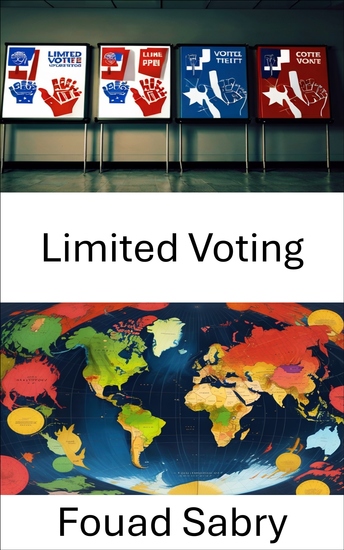
Limited Voting - Analyzing the Constraints and Opportunities in Electoral Representation - cover

Limited Voting - Analyzing the Constraints and Opportunities in Electoral Representation

Fouad Sabry

Editorial: One Billion Knowledgeable

  • 0
  • 0
  • 0

Sinopsis

Limited Voting: A Key to Understanding Electoral Dynamics
 
"Limited Voting" is essential for those studying electoral systems-This book explores how having fewer votes than seats influences representation, party dynamics, and fairness.
 
Chapters Overviews:
 
1-Limited Voting-Fundamentals and impact on electoral outcomes.
 
2-Plurality Voting-Comparison with limited voting and effects on voter influence.
 
3-Proportional Representation-Contrast with limited voting in fairness and representation.
 
4-Electoral Threshold-Role in shaping party systems within limited voting.
 
5-Duverger's Law-Predictions about party systems under various voting methods.
 
6-Single Non-Transferable Vote-Similarities and differences with limited voting.
 
7-Block Voting-Comparison in voter power and election outcomes.
 
8-First-Past-The-Post Voting-Implications for representation vs-limited voting.
 
9-Multiple Non-Transferable Vote-Impact on election dynamics.
 
10-Multi-Member Constituencies in the UK-Interaction with limited voting principles.
 
11-Elections in Sweden-Application of limited voting concepts.
 
12-Electoral System of Australia-Integration of limited voting principles.
 
13-List of Alberta General Elections-Role and impact of limited voting.
 
14-Canadian Electoral System-Effects on political outcomes.
 
15-Prussian Three-Class Franchise-Historical relevance to modern limited voting.
 
16-Elections in Canada-Impact on political representation.
 
17-1926 Alberta General Election-Case study of limited voting in practice.
 
18-Calgary Electoral District-Experiences with limited voting.
 
19-Edmonton Electoral District-Practical implications of limited voting.
 
20-Vancouver City Electoral District-Influence of limited voting.
 
21-Elections in the UK-Application and outcomes of limited voting.
 
Who is this book for?
 
Ideal for professionals and students of political science, this book offers deep insights into electoral systems and enhances understanding of democratic processes and fairness.
Disponible desde: 05/09/2024.
Longitud de impresión: 336 páginas.

Otros libros que te pueden interesar

  • Psychological Warfare - Using Psychological Tactics to Undermine or Control - cover

    Psychological Warfare - Using...

    Cito Harder

    • 0
    • 0
    • 0
    Psychological warfare is the deliberate use of tactics designed to influence, manipulate, and control the thoughts, emotions, and behaviors of individuals or groups. It involves the strategic deployment of psychological tactics to achieve specific objectives, often with the goal of weakening the will, confidence, and decision-making abilities of an opponent. Unlike physical warfare, which relies on the use of force and violence, psychological warfare focuses on undermining an adversary’s mental state, creating doubt, confusion, fear, or anxiety. The concept of psychological warfare spans across military, political, social, and personal domains, and its methods are utilized to achieve both large-scale and individual objectives. 
    At its core, psychological warfare operates by exploiting the weaknesses of human perception, beliefs, and emotions. It seeks to manipulate how people think, feel, and act, often in ways that are subtle and hard to detect. Through the strategic use of information, misinformation, fear, and emotional appeals, psychological warfare can alter the course of events and influence outcomes in a way that physical force alone cannot achieve. This manipulation can be direct, as in the use of propaganda, or more covert, as in the use of gaslighting to distort reality and create confusion. 
    Psychological warfare can be seen in many contexts, from international conflict and military operations to corporate competition, political campaigns, and even personal relationships. For example, in warfare, psychological tactics are employed to break the enemy’s morale, instill fear, and create division within their ranks. In the political arena, psychological warfare is often used to manipulate public opinion, spread propaganda, and discredit opponents.
    Ver libro
  • Still No Word from You - Notes in the Margin - cover

    Still No Word from You - Notes...

    Peter Orner

    • 0
    • 0
    • 0
    A new collection of pieces on literature and life by the author of Am I Alone Here?, a finalist for the NBCC Award for Criticism 


    From the acclaimed fiction writer about whom Dwight Garner of the New York Times wrote, "You know from the second you pick him up that he's the real deal," comes Still No Word from You, a unique chain of essays and intimate stories that meld the lived life and the reading life. For Orner, there is no separation. Covering such well-known writers as Lorraine Hansberry, Primo Levi, and Marilynne Robinson, as well as other greats like Maeve Brennan and James Alan McPherson, Orner's highly personal take on literature alternates with his own true stories of loss and love, hope and despair. In his mother's copy of A Coney Island of the Mind, he's stopped short by a single word in the margin, "YES!"—which leads him to conjure his mother at twenty-three. He stops reading Penelope Fitzgerald's The Beginning of Spring three quarters of the way through because he knows that finishing the novel will leave him bereft. Orner's solution is to start again from the beginning to slow the inevitable heartache. 


    Still No Word from You is a book for anyone for whom reading is as essential as breathing.
    Ver libro
  • The One-Idea Rule - An Efficient Way to Improve Your Writing at School and Work - cover

    The One-Idea Rule - An Efficient...

    PhD Mark Rennella

    • 0
    • 0
    • 0
    After a thirty-year career as a writer, instructor, and editor, Mark Rennella has crafted a battle-tested method to help students and young professionals who want to improve their writing: the One-Idea Rule, anchored on the assertion that every component of a successful piece of writing should express only one idea. 


    With The One-Idea Rule, writers embarking on their adult lives and professional journeys will have a reliable methodology they can easily remember and count on for all of their writing tasks, as well as increased confidence about the cogency of their writing and its potential for impact in the public sphere. 


    Most advice about writing looks like a long laundry list of dos and don'ts. For those already accomplished as writers, these lists can be a helpful addition to an already-developed communication style. But for teens starting college and young professionals entering the workforce, it can be challenging to wield such complex advice to tackle increasingly demanding writing assignments. 


    The One-Idea Rule is a writing primer aligned and empathetic with any young writer's needs.
    Ver libro
  • Help in a Hurry - Simple Tips for Finding Peace When You're Overwhelmed Anxious or Stressed - cover

    Help in a Hurry - Simple Tips...

    Dr. Caroline Leaf

    • 0
    • 0
    • 0
    Learn how to manage your anxiety and find peace with: 
     
    · Evidence-based strategies to fight feelings of overwhelm and cope in the moment 
    · Actionable ways to experience a better, more fulfilled life 
    · Tips from expert and bestselling author Dr. Caroline Leaf 
     
     
    Even though it's uncomfortable and sometimes even distressing to us, it's perfectly normal to feel lost, anxious, or overwhelmed at times. It's okay to be a bit of a mess! But none of us wants to stay that way for long. 
     
    With actionable, evidence-based strategies to handle our most common challenges in life, this practical guide from bestselling author and clinical neuroscientist Dr. Caroline Leaf offers the tools you need to prevent a descent into chaos and instead find peace and strength amid the turmoil of daily life.  
     
    If you have felt stuck in crisis mode, the strategies found in this book will help you cope in the moment, manage a chaotic mind, and start living each day with intention and inner peace. 
     
     
    "Help in a Hurry is jam-packed with evidence-based strategies to address a variety of common difficulties, including the experience of stressful, anxious, intrusive, or other overwhelming thoughts. Readers will come to understand what's going on in their mind and body and will learn practical steps to break these dysfunctional habits."--Nicole LePera, author of the #1 New York Times bestsellers How to Do the Work and How to Be the Love You Seek  
     
    "This book is a game-changer. If you're looking to transform your mindset and heal from past challenges, Caroline's approach will guide you every step of the way. Don't wait--this book will help you unlock your true potential."--Lewis Howes, New York Times bestselling author of The School of Greatness  
     
    "Life is full of inevitable challenges, but your mind is your greatest ally in overcoming them. If you're ready to unlock your mental power and embrace each challenge as an opportunity, this is the book for you."--Jim Kwik, top brain coach and New York Times bestselling author of Limitless  
     
    "In a world that demands constant mental recalibration, these strategies are not only helpful--they're our lifelines. Dr. Caroline expertly teaches us how to prepare ourselves with tools, repair negative thinking and behavioral cycles, and return to a place of personal agency where we can choose how we want to respond."--Alyson Stoner, actor, author, and mental health founder 
     
     
    Designed so you can quickly access the simple strategies you need in the moment, this book helps you regain control when: 
    · you don't understand your intense emotions 
    · you're under tremendous pressure 
    · you feel tired, angry, or full of regret 
    · you're dealing with intrusive thoughts 
    · your past is haunting you 
    · your inner critic won't let up 
    · you feel like sometimes you abandon yourself to please others 
    · your perfectionism is keeping you stuck or overwhelmed 
    · you feel setting and maintaining boundaries is difficult or guilt-inducing 
    · you're trapped in a cycle you don't know how to break 
    · you feel lost or directionless 
    · your regret over past mistakes is weighing you down 
    · and much more
    Ver libro
  • The Uncollected Essays of Elizabeth Hardwick - cover

    The Uncollected Essays of...

    Elizabeth Hardwick, Alex Andriesse

    • 0
    • 0
    • 0
    Essays on music, art, pop culture, literature, and politics by the renowned essayist and observer of contemporary life, now collected together for the first time. 


    The Uncollected Essays of Elizabeth Hardwick is a companion collection to The Collected Essays, a book that proved a revelation of what, for many, had been an open secret: that Elizabeth Hardwick was one of the great American literary critics, and an extraordinary stylist in her own right. The thirty-five pieces that Alex Andriesse has gathered here—none previously featured in volumes of Hardwick's work—make it clear that her powers extended far beyond literary criticism, encompassing a vast range of subjects, from New York City to Faye Dunaway, from Wagner's Parsifal to Leonardo da Vinci's inventions, and from the pleasures of summertime to grits soufflé. In these often surprising, always well-wrought essays, we see Hardwick's passion for people and places, her politics, her thoughts on feminism, and her ability, especially from the 1970s on, to write well about seemingly anything.
    Ver libro
  • Franklin Delano Roosevelt: His Finest Hour - The Winning of World War II - cover

    Franklin Delano Roosevelt: His...

    Liam Dale

    • 0
    • 0
    • 0
    The early years of World War II saw Nazi Germany dominate Europe, but by the end of 1941, as Adolf Hitler continued to build his Empire, events in the Pacific took on their own momentum as Imperial Japan and America became locked in battle after the bombing of the US Naval Fleet at Pearl Harbor. 
     
    As the smoke and flames rose from Pearl, America and its President, Franklin D Roosevelt, could no longer remain on the sidelines of the war that had been waging in Europe for over two years, and on December 7th, 1941, the hostilities were transformed into a global conflict. This would mark the beginning of a new chapter in the Second World War where the Americans joined the fight for what Roosevelt had laid out as the Four Freedoms. 
     
    The first was Freedom of Speech, the second, Freedom of Religion and Expression, the third Freedom from Want, and last but by no means least, the fourth was Freedom from Fear. The story of how the nation, which so treasured its neutrality and had gone to such great lengths to avoid fighting on foreign soil, joined the war, will follow in the footsteps of Roosevelt, the man responsible for the American Dream.
    Ver libro