¡Acompáñanos a viajar por el mundo de los libros!
Añadir este libro a la estantería
Grey
Escribe un nuevo comentario Default profile 50px
Grey
Suscríbete para leer el libro completo o lee las primeras páginas gratis.
All characters reduced
First Order Logic - Fundamentals and Applications - cover

First Order Logic - Fundamentals and Applications

Fouad Sabry

Editorial: One Billion Knowledgeable

  • 0
  • 1
  • 0

Sinopsis

What Is First Order Logic
 
First-order logic is a collection of formal systems that are utilized in the fields of mathematics, philosophy, linguistics, and computer science. Other names for first-order logic include predicate logic, quantificational logic, and first-order predicate calculus. In first-order logic, quantified variables take precedence over non-logical objects, and the use of sentences that contain variables is permitted. As a result, rather than making assertions like "Socrates is a man," one can make statements of the form "there exists x such that x is Socrates and x is a man," where "there exists" is a quantifier and "x" is a variable. This is in contrast to propositional logic, which does not make use of quantifiers or relations; propositional logic serves as the basis for first-order logic in this sense.
 
How You Will Benefit
 
(I) Insights, and validations about the following topics:
 
Chapter 1: First-order logic
 
Chapter 2: Axiom
 
Chapter 3: Propositional calculus
 
Chapter 4: Peano axioms
 
Chapter 5: Universal quantification
 
Chapter 6: Conjunctive normal form
 
Chapter 7: Consistency
 
Chapter 8: Zermelo–Fraenkel set theory
 
Chapter 9: Interpretation (logic)
 
Chapter 10: Quantifier rank
 
(II) Answering the public top questions about first order logic.
 
(III) Real world examples for the usage of first order logic in many fields.
 
Who This Book Is For
 
Professionals, undergraduate and graduate students, enthusiasts, hobbyists, and those who want to go beyond basic knowledge or information for any kind of first order logic.
Disponible desde: 25/06/2023.
Longitud de impresión: 191 páginas.


Otros libros que te pueden interesar

  • Epidemics - cover

    Epidemics

    Hippocrates

    • 0
    • 0
    • 0
    The term "epidemic" is used to describe the spread of a disease or condition to a large number of people. The word "epidemic" is derived from the Greek word "epi", meaning "upon", and "demos", meaning "people". Hippocrates, a Greek physician who lived in the fourth century BC, was one of the first to use the term "epidemic". He used it to describe the spread of disease through a population. Read in English, unabridged.
    Ver libro
  • Twentieth Century Inventions: A Forecast - cover

    Twentieth Century Inventions: A...

    George Sutherland

    • 0
    • 0
    • 0
    This work from 1901 predicts what technological developments will manifest in the twentieth century. The author, a technical journalist, presents ideas for inventions and new developments in the areas of power, transportation, agriculture, mining, domestic applications, electronic devices, warfare, music, art, and news. Many have come to pass. All of them provide an interesting look into how the next century was imagined and what challenges were anticipated for the progress of society. -(Summary by A. Gramour)
    Ver libro
  • Strange Random Facts That Will Put You to Sleep Fast - cover

    Strange Random Facts That Will...

    Trivia For Sleep

    • 0
    • 0
    • 0
    "Strange Random Facts That Will Put You to Sleep Fast" is the ideal audiobook for anyone looking to relax and drift into a peaceful slumber. Narrated by a calm male voice and set against a backdrop of soothing music, this collection features curious and unusual facts that entertain just enough to distract the mind from daily worries. Each strange tidbit is delivered in a gentle, steady manner, creating a tranquil environment perfect for bedtime. Allow these odd and fascinating facts to carry you into a restful, stress-free night, making it easier than ever to let go and fall asleep with ease.
    Ver libro
  • My Quest for Health Equity - Notes on Learning While Leading - cover

    My Quest for Health Equity -...

    MD David Satcher

    • 0
    • 0
    • 0
    Dr. David Satcher is one of the most widely known and well-regarded physicians of our time. A former four-star admiral in the US Public Health Service Commissioned Corps, he served as the assistant secretary for health, the surgeon general of the United States, and the director of the Centers for Disease Control and Prevention before founding the eponymous Satcher Health Leadership Institute at Morehouse School of Medicine. At the core of his impact on public health, he is also a lifelong leader for civil rights and health equity. 


    In My Quest for Health Equity, Dr. Satcher takes an inspiring and instructive look inside his fifty-year career to shed light on the challenge and burden of leadership. Explaining that he has thought of each leadership role—whether in academia, community, or government—as an opportunity to move the needle toward health equity, he shares the hard-won lessons he has learned over a lifetime in the medical field. 


    Drawing on his early memories, medical school days, and experience in the civil rights movement, Dr. Satcher touches on a number of topics, including the essential qualities of leadership; leading from science to policy to practice; the importance of clear communication and continual learning; the need for workplace discipline; confronting failure; team approaches to leadership; and much more.
    Ver libro
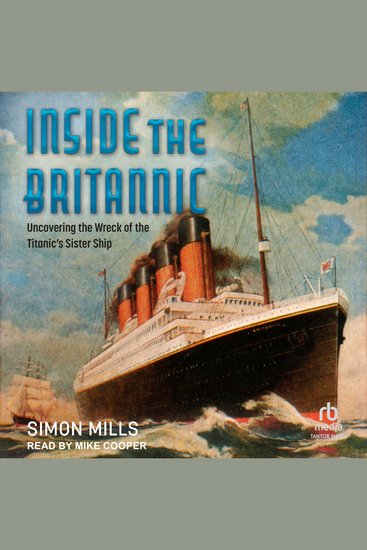
  • Inside the Britannic - Uncovering the Wreck of the Titanic's Sister Ship - cover

    Inside the Britannic -...

    Simon Mills

    • 0
    • 0
    • 0
    The Olympic Class ships were intended to be the greatest liners to ever sail the oceans, but the Britannic sank only four years after her sister ship the Titanic. While the wreck of the Titanic is two miles below the surface and rapidly deteriorating, the Britannic is much more accessible (only 400 ft down) and remains largely intact. One of the largest passenger ships ever to have sunk, her wreck presents a unique opportunity to explore the interior of the Olympic Class liners, and examine areas which on the Titanic simply no longer exist. 


    Simon Mills bought the wreck of the Britannic in 1996 and has spent more time exploring it than anyone else. Inside the Britannic is the sum of decades of work covering every inch of the shipwreck as he searches for answers to century-old questions, and discovers new mysteries to solve. Simon takes a forensic approach but this book is more than just the autopsy report of a ship. 


    The Britannic may have been lost over a century ago, but Simon Mills's fascinating new book gives everyone unparalleled access to rediscover her.
    Ver libro
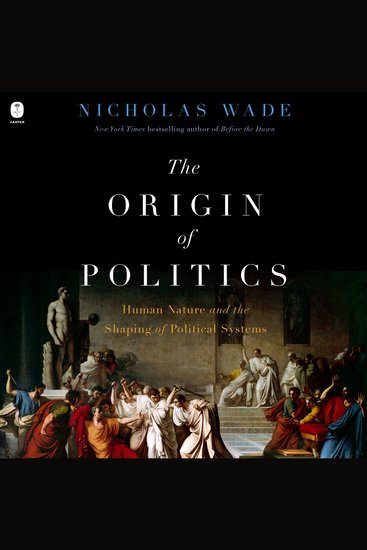
  • The Origin of Politics - How Evolution and Ideology Shape the Fate of Nations - cover

    The Origin of Politics - How...

    Nicholas Wade

    • 0
    • 0
    • 0
    Societies that ignore social disintegration and collapsing birth rates are putting their future in peril. So why are we ignoring the signs? 
    ?In The Origin Of Politics, Nicholas Wade explains how our political systems compete with a more ancient set of rules for organizing society—those developed by evolution. Modern ideologies are in constant tension with structures inherent in human social behavior, such as the family, the tribe, and male-dominated institutions.  
    This tension plays out in various ways. Sometimes nature prevails over politics, as in the proposal by Marx and Engels to eliminate the family, the basic unit of society. The founders of the kibbutz movement put this radical idea into practice, only to find that the conflict with human nature was unsustainable. In other cases, culture has successfully modified evolutionary behaviors, replacing polygamy with monogamy and dissolving the bonds of tribalism to make way for modern states.  
    But the evolutionary framework of human societies is not infinitely flexible. The nation-state, especially in the case of the United States, is prone to disintegration if disruptive ideologies are allowed to undermine the cohesive affinities that hold its disparate cultures together.  
    The worldwide decline in fertility in most countries except those in Africa signals a severe derangement in the behaviors evolution has devised for ensuring that a population will maintain itself. If the causes of this disruption cannot be understood and reversed, human societies will embark on an unsought path to extinction.  
    Other fraught issues in which human biology and politics conflict include the innate specializations of the sexes, the stratification of society by ability, and the mismatch between the inequalities of wealth-creating societies and the egalitarian ethic inherited from our hunter-gatherer ancestors. 
    We live in an iridescent bubble, the intoxicating richness of modern culture. Shielded from the natural world, we have lost our awareness of the evolutionary forces that still guide our motivations and shape the foundations of our societies. The Origin of Politics explores the risks of underestimating evolution’s fundamental role in human affairs. 
      
     
    Ver libro