¡Acompáñanos a viajar por el mundo de los libros!
Añadir este libro a la estantería
Grey
Escribe un nuevo comentario Default profile 50px
Grey
Suscríbete para leer el libro completo o lee las primeras páginas gratis.
All characters reduced
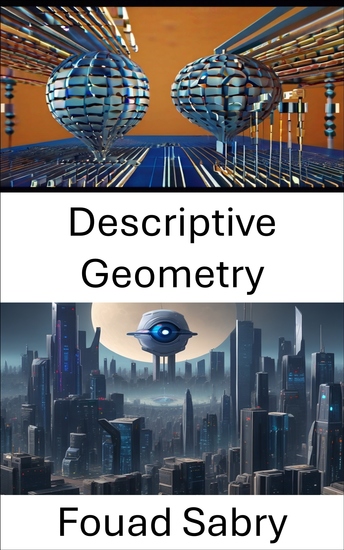
Descriptive Geometry - Unlocking the Visual Realm: Exploring Descriptive Geometry in Computer Vision - cover

Descriptive Geometry - Unlocking the Visual Realm: Exploring Descriptive Geometry in Computer Vision

Fouad Sabry

Editorial: One Billion Knowledgeable

  • 0
  • 0
  • 0

Sinopsis

What is Descriptive Geometry
 
Descriptive geometry is the branch of geometry which allows the representation of three-dimensional objects in two dimensions by using a specific set of procedures. The resulting techniques are important for engineering, architecture, design and in art. The theoretical basis for descriptive geometry is provided by planar geometric projections. The earliest known publication on the technique was "Underweysung der Messung mit dem Zirckel und Richtscheyt", published in Linien, Nuremberg: 1525, by Albrecht Dürer. Italian architect Guarino Guarini was also a pioneer of projective and descriptive geometry, as is clear from his Placita Philosophica (1665), Euclides Adauctus (1671) and Architettura Civile, anticipating the work of Gaspard Monge (1746-1818), who is usually credited with the invention of descriptive geometry. Gaspard Monge is usually considered the "father of descriptive geometry" due to his developments in geometric problem solving. His first discoveries were in 1765 while he was working as a draftsman for military fortifications, although his findings were published later on.
 
How you will benefit
 
(I) Insights, and validations about the following topics:
 
Chapter 1: Descriptive geometry
 
Chapter 2: Analytic geometry
 
Chapter 3: Affine transformation
 
Chapter 4: Orthographic projection
 
Chapter 5: 3D projection
 
Chapter 6: Oblique projection
 
Chapter 7: Vanishing point
 
Chapter 8: Picture plane
 
Chapter 9: Line (geometry)
 
Chapter 10: Parallel projection
 
(II) Answering the public top questions about descriptive geometry.
 
(III) Real world examples for the usage of descriptive geometry in many fields.
 
Who this book is for
 
Professionals, undergraduate and graduate students, enthusiasts, hobbyists, and those who want to go beyond basic knowledge or information for any kind of Descriptive Geometry.
Disponible desde: 05/05/2024.
Longitud de impresión: 104 páginas.
Otros libros que te pueden interesar

  • Lost Lake Erie - cover

    Lost Lake Erie

    Jennifer Boresz Engelking

    • 0
    • 0
    • 0
    Serene one moment and destructive the next, Lake Erie's moods mirror its tumultuous role in history . 
     
    As the site of Cleveland's Great Lakes Exposition, the lake offered visitors a respite from the Great Depression, and Hotel Victory, once considered the world's largest summer resort, drew thousands to Put-In-Bay. Daring postal workers dangerously crossed the ice-covered surface on hybrid "boats" and by foot. Canal Street, at the Buffalo Wharf, was once called "the Wickedest Street in America." The Erie is one of thousands of ships that lie in a solemn graveyard below the surface. And rum runners turned the lake into a watery highway for illegal booze during Prohibition. 
     
    Author Jennifer Boresz Engelking reveals entertaining, heartbreaking, and nostalgic stories of the lost sites, businesses, and industries of Lake Erie.
    Ver libro
  • Good Grief - On Loving Pets Here and Hereafter - cover

    Good Grief - On Loving Pets Here...

    E.B. Bartels

    • 0
    • 0
    • 0
    An unexpected, poignant, and personal account of loving and losing pets, exploring the singular bonds we have with our companion animals, and how to grieve them once they’ve passed. 
    E.B. Bartels has had a lot of pets—dogs, birds, fish, tortoises. As varied a bunch as they are, they’ve taught her one universal truth: to own a pet is to love a pet, and to own a pet is also—with rare exception—to lose that pet in time. 
    But while we have codified traditions to mark the passing of our fellow humans, most cultures don’t have the same for pets. Bartels takes us from Massachusetts to Japan, from ancient Egypt to the modern era, in search of the good pet death. We meet veterinarians, archaeologists, ministers, and more, offering an idiosyncratic, inspiring array of rituals—from the traditional (scattering ashes, commissioning a portrait), to the grand (funereal processions, mausoleums), to the unexpected (taxidermy, cloning). The central lesson: there is no best practice when it comes to mourning your pet, except to care for them in death as you did in life, and find the space to participate in their end as fully as you can. 
    Punctuated by wry, bighearted accounts of Bartels’s own pets and their deaths, Good Grief is a cathartic companion through loving and losing our animal family. 
    Supplemental enhancement PDF accompanies the audiobook.
    Ver libro
  • Social Media in the Classroom - Tools and Techniques that any teacher can use effectively 30-Minute Interview with Rick Sheridan - cover

    Social Media in the Classroom -...

    Dr. Rick Sheridan

    • 0
    • 0
    • 0
    In this 30-minute interview, Dr. Rick Sheridan - a longtime university professor and author of the book - Social Media in the Classroom, helps teachers understand why using social media in the classroom is so important, and the effective ways to use it. 
    Topics include: 
    Why is social media use in the classroom so valuable for both teachers and students?Ways to promote cultural understanding.Developing an online portfolio.What can students and teachers do to protect their privacy online?Learn about some of Google's many features besides the search engine.Getting shy students to participate.How to evaluate students on their social media experiences, and much more. 
    Dr. Rick Sheridan is a professor of Mass Media Communications at Wilberforce University in Ohio. Dr. Sheridan has also taught at California State University - Sacramento and Butte College. He has a master's degree in Media Arts, and has received awards for both his teaching and his web design. 
    ©2014 Dr. Rick Sheridan (P)2014 Dr. Rick Sheridan
    Ver libro
  • (L)earn Bitcoin - Become Financially Sovereign - cover

    (L)earn Bitcoin - Become...

    Anita Posch

    • 0
    • 0
    • 0
    Learn Bitcoin is the best Bitcoin book to decide why and how you should begin to use Bitcoin. It presents all its facets from technical, economical, political and social implications. It provides a step-by-step roadmap to navigate this new financial world and sets you up with concrete recommendations on bitcoin investing, earning and storing bitcoin. Ascending the staircase of financial sovereignty will grant you personal freedom and control over your bitcoin money. 
    In this book you will find answers to the questions of what money is, where it comes from, its history, blockchain technology and Bitcoin specifically. It gives answers to the why and how to use Bitcoin while debunking popular myths and misunderstandings surrounding cryptocurrencies. You'll find a deep dive into Bitcoin's development since its inception in 2008 and an outlook on the future of cryptocurrency based on Bitcoin. 
    While mainstream media and economic pundits in the Western world think that it's just a tool for speculation, my goal is to spread the word about Bitcoin as an enabler of financial fairness and social change. What goes unmentioned in most other publications are the positive real world implications that a truly permissionless, uncensorable, neutral digital asset with a fixed supply offers. 
    Later the cryptocurrency book focuses on the more practical applications of Bitcoin (BTC) and how you can safely acquire, use and store it. 
    This is not financial advice, it's for people who want to (l)earn and understand the fundamentals of Bitcoin. 
    Ver libro
  • Relational Databases - Mastering the Fundamentals of SQL Design and Optimization for Efficient Data Handling - cover

    Relational Databases - Mastering...

    SAM CAMPBELL

    • 0
    • 0
    • 0
    “Relational Databases" is an indispensable resource for students, database professionals, and software developers who are keen on mastering the art and science of managing structured data with relational databases. As the foundation of data storage and retrieval systems used in everything from small applications to global information systems, understanding relational databases is crucial for anyone looking to thrive in the technology field. 
    This comprehensive guide takes you on a journey from the basic principles of relational databases to advanced strategies for data design, optimization, and SQL programming. 
    "“Relational Databases" is designed to equip you with a solid foundation in relational databases, enabling you to design, build, and manage database solutions that are robust, scalable, and efficient. By demystifying the complexities of relational databases, this book empowers you to leverage the full potential of structured data management in your professional projects and endeavors.
    Ver libro
  • The Seven Follies of Science - cover

    The Seven Follies of Science

    John Phin

    • 0
    • 0
    • 0
    The seven follies of science; a popular account of the most famous scientific impossibilities and the attempts which have been made to solve them to which is added a small budget of interesting paradoxes, illusions, and marvels.(Summary by John Phin)
    Ver libro