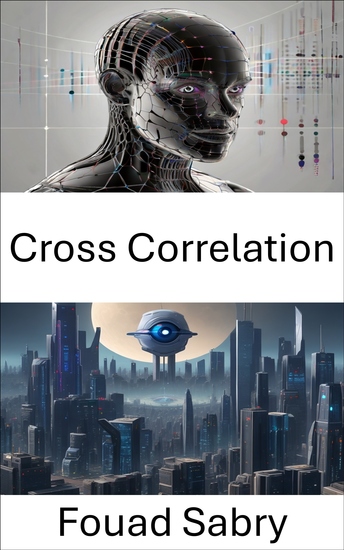
Cross Correlation - Unlocking Patterns in Computer Vision
Fouad Sabry
Editora: One Billion Knowledgeable
Sinopse
What is Cross Correlation

In signal processing, cross-correlation is a measure of similarity of two series as a function of the displacement of one relative to the other. This is also known as a sliding dot product or sliding inner-product. It is commonly used for searching a long signal for a shorter, known feature. It has applications in pattern recognition, single particle analysis, electron tomography, averaging, cryptanalysis, and neurophysiology. The cross-correlation is similar in nature to the convolution of two functions. In an autocorrelation, which is the cross-correlation of a signal with itself, there will always be a peak at a lag of zero, and its size will be the signal energy.

How you will benefit

(I) Insights, and validations about the following topics:

Chapter 1: Cross-correlation

Chapter 2: Autocorrelation

Chapter 3: Covariance matrix

Chapter 4: Estimation of covariance matrices

Chapter 5: Cross-covariance

Chapter 6: Autocovariance

Chapter 7: Variational Bayesian methods

Chapter 8: Normal-gamma distribution

Chapter 9: Expectation-maximization algorithm

Chapter 10: Griffiths inequality

(II) Answering the public top questions about cross correlation.

(III) Real world examples for the usage of cross correlation in many fields.

Who this book is for

Professionals, undergraduate and graduate students, enthusiasts, hobbyists, and those who want to go beyond basic knowledge or information for any kind of Cross Correlation.
Disponível desde: 10/05/2024.
Comprimento de impressão: 143 páginas.