¡Acompáñanos a viajar por el mundo de los libros!
Añadir este libro a la estantería
Grey
Escribe un nuevo comentario Default profile 50px
Grey
Suscríbete para leer el libro completo o lee las primeras páginas gratis.
All characters reduced
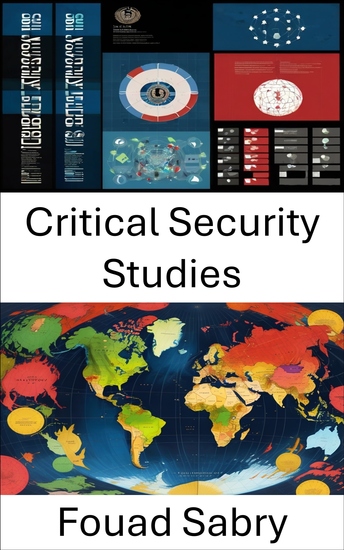
Critical Security Studies - Power Threat and Rethinking Security in the 21st Century - cover

Critical Security Studies - Power Threat and Rethinking Security in the 21st Century

Fouad Sabry

Editorial: One Billion Knowledgeable

  • 0
  • 0
  • 0

Sinopsis

Security in the 21st century goes beyond military threats. "Critical Security Studies" dives deep into this emerging field, empowering you to see security issues through a fresh lens.
 
Why is it important? Traditional security studies focus on states and military might. Critical Security Studies expands this view, examining the human aspect, environmental threats, and how societies construct ideas of security. Understanding these nuances is crucial for navigating today's complex world.
 
What will you learn?
 
Chapter 1: Critical Security Studies: This chapter lays the foundation, introducing you to the core concepts and theoretical frameworks of the field.
 
Chapters 2-5: Explore the foundational disciplines that inform Critical Security Studies, including Political Science, Social Science, International Relations, and International Relations Theory.
 
Chapters 6 & 7: Delve into Comparative Politics and International Security, gaining a broader understanding of global political dynamics and traditional security concerns.
 
Chapters 8-11: This section introduces Critical International Relations Theory, the Copenhagen School, Feminism in International Relations, and Television Studies, showcasing how critical perspectives challenge traditional narratives.
 
Chapters 12 & 13: Social Psychology (sociology) and Systems Theory offer valuable tools to analyze how societies function and threats emerge.
 
Chapters 14-17: Explore Sociology, the work of Anthony D. Burke, Feminist Ethics, and International Political Sociology, gaining insights into social structures, power dynamics, and the role of ethics in security.
 
Chapters 18 & 19: Focus on Feminist Security Studies and the work of R. B. J. Walker, highlighting the gendered aspects of security and how women are disproportionately affected by conflict.
 
Chapters 20 & 21: Critical Realism (philosophy of social sciences) and the work of Anna Leander equip you with the tools to critically analyze knowledge production and power structures in security studies.
 
"Critical Security Studies" goes beyond textbooks, answering the public's most pressing questions on the subject. Packed with valuable insights, this book is your gateway to a deeper understanding of security in today's world.
Disponible desde: 05/08/2024.
Longitud de impresión: 228 páginas.


Otros libros que te pueden interesar

  • The Ethiopian Great Famine of 2000 - A Modern Humanitarian Crisis - cover

    The Ethiopian Great Famine of...

    Sarah Willards

    • 0
    • 0
    • 0
    The Ethiopian Great Famine of 2000 was not an isolated event, but rather the culmination of a complex and interconnected set of factors rooted in the country's historical, environmental, and political landscape. To understand the origins of this crisis, it is essential to look back at Ethiopia’s long history of food insecurity and vulnerability to famine. While droughts have long been a natural part of Ethiopia’s climate cycles, the frequency and impact of famine have often been magnified by human elements, particularly governance and socio-economic structures. 
    In the years leading up to 2000, Ethiopia experienced several severe droughts, but the early signs of the looming crisis were evident by the late 1990s. Climatic shifts, including the failure of critical rainy seasons, devastated crop yields and dried up grazing lands, particularly in the country's eastern and southern regions. For a population heavily dependent on subsistence agriculture, these environmental changes meant immediate food shortages and a rapid decline in household resilience. What might have remained a regional hardship quickly evolved into a nationwide emergency due to the lack of sufficient preventative action. 
    Government response in the early stages was slow and limited by bureaucratic challenges and political distractions, including the aftermath of the Ethiopia-Eritrea war that ended in 2000. Resources were stretched thin, and infrastructure remained underdeveloped, particularly in rural areas where the famine was most severe. Early warning systems existed but were either underutilized or their signals ignored, contributing to the delayed mobilization of aid. The country’s centralization of power also complicated coordination with local authorities, which further hindered rapid intervention efforts.
    Ver libro
  • Operation Sea Lion Succeeds - Britain Falls to Nazi Germany (Alternate History) - cover

    Operation Sea Lion Succeeds -...

    Marcus Draysun

    • 0
    • 0
    • 0
    The real Operation Sea Lion was fraught with logistical challenges, poor planning, and the formidable defenses of the British military. However, in this alternate history, key factors aligned to turn Hitler’s gamble into a shocking success. The fall of Britain was not inevitable, but a series of strategic shifts, political missteps, and military breakthroughs paved the way for an event that would alter the course of history forever. 
    One of the most significant changes was a decisive shift in Germany’s air strategy. Instead of squandering resources on bombing civilian targets, the Luftwaffe focused relentlessly on eliminating the Royal Air Force. A more coordinated assault on British radar stations, airfields, and aircraft production facilities crippled Britain’s ability to defend its skies. With the RAF severely weakened, the Germans gained air superiority far earlier than in reality, making an amphibious invasion far more feasible. 
    German naval strategy also played a critical role. In this timeline, the Kriegsmarine, instead of being vastly outmatched by the Royal Navy, benefited from increased coordination with the Luftwaffe and U-boat support. The Channel crossing was still risky, but a well-timed offensive, bolstered by deception tactics and a more aggressive submarine campaign, created an opening for German forces to land successfully on British shores.
    Ver libro
  • Containing Big Tech - How to Protect Our Civil Rights Economy and Democracy - cover

    Containing Big Tech - How to...

    Tom Kemp

    • 0
    • 0
    • 0
    The path forward to rein in online surveillance, AI, and tech monopoliesTechnology is a gift and a curse. The five Big Tech companies—Meta, Apple, Amazon, Microsoft, and Google—have built innovative products that improve many aspects of our lives. But their intrusiveness and our dependence on them have created pressing threats to our civil rights, economy, and democracy.Coming from an extensive background building Silicon Valley–based tech startups, Tom Kemp eloquently and precisely weaves together the threats posed by Big Tech:• the overcollection and weaponization of our most sensitive data• the problematic ways Big Tech uses AI to process and act upon our data• the stifling of competition and entrepreneurship due to Big Tech’s dominant market positionThis richly detailed book exposes the consequences of Big Tech’s digital surveillance, exploitative use of AI, and monopolistic and anticompetitive practices. It offers actionable solutions to these problems and a clear path forward for individuals and policymakers to advocate for change. By containing the excesses of Big Tech, we will ensure our civil rights are respected and preserved, our economy is competitive, and our democracy is protected.
    Ver libro
  • The Ugandan Tales - cover

    The Ugandan Tales

    Victor Rumanyika

    • 0
    • 0
    • 0
    "The Ugandan Tales" is set in Uganda and about the struggles of ordinary Africans against post independence African rulers that preach freedom and emancipation but have turned into oppressors.  This collection of poetry dives deep into topics of police brutality, social injustices, and oppression through the landscape of the tortured cities. Ordinary people seek to reassert their rights against an intransigent regime that is determined to keep them oppressed. The poems chronicle everyday struggles that are faced at the hands of fellow Africans masquerading as Pan Africanists. Through peaceful and non violent means, a new generation of people is now taking a stand against social, political and economic segregation.
    Ver libro
  • Cage Eleven - Prison Writings from Long Kesh - cover

    Cage Eleven - Prison Writings...

    Gerry Adams

    • 0
    • 1
    • 0
    Long before he became President of Sinn Féin, Gerry Adams was a civil rights activist who took part in sit-ins, marches and protests in Northern Ireland. Along with hundreds of other men, Adams was interned on the Maidstone prison ship and in Long Kesh prison – without charge or trial – during the 1970s for his political activities. Women were interned also, in Armagh Women's Prison. Cage Eleven is his own account – sometimes passionate, often humorous – of life in Long Kesh. Written while Adams was a prisoner, the pieces were smuggled out for publication.
    This updated edition includes a new introduction and sketches drawn in Cage Eleven by another prisoner at the time, Danny Devenny.
    'Offers a unique insight into … the experience of internment … an unrivalled representation of the resilience and humour that were as much a part of the life of the political prisoner as the adherence to a set of political ideals.' Irish Herald
    Ver libro
  • The Nazi Escape - How Catholic Clergy Intelligence Agencies and Perón's Regime Helped the Third Reich Survive - cover

    The Nazi Escape - How Catholic...

    Davis Truman

    • 0
    • 0
    • 0
    This audiobook is narrated by an AI Voice.   
    What if the fall of Hitler was only the beginning? 
    In The Nazi Escape, uncover the shocking, meticulously researched story of how a secretive global alliance, spanning Vatican corridors, Allied intelligence networks, and Argentina’s highest political ranks, engineered one of history’s most chilling cover-ups. With the Third Reich in ruins, elite Nazi war criminals vanished without a trace. But they didn’t disappear... they were helped. 
    This gripping exposé reveals how Catholic clergy operated covert escape routes known as “ratlines,” how Western intelligence agencies turned a blind eye, or lent a hand, and how Juan Perón’s Argentina became a haven for some of the most notorious figures of World War II. 
    From shadowy monasteries in Rome to the pampas of South America, The Nazi Escape reads like a thriller, but every word is true. Packed with declassified documents, firsthand accounts, and shocking revelations, this is the untold story the world wasn’t supposed to know.
    Ver libro