Junte-se a nós em uma viagem ao mundo dos livros!
Adicionar este livro à prateleira
Grey
Deixe um novo comentário Default profile 50px
Grey
Assine para ler o livro completo ou leia as primeiras páginas de graça!
All characters reduced
Constitutional Law - Foundations and Dynamics of Governance - cover
LER

Constitutional Law - Foundations and Dynamics of Governance

Fouad Sabry

Editora: One Billion Knowledgeable

  • 0
  • 0
  • 0

Sinopse

Unlock the secrets of constitutional governance with "Constitutional Law," an essential addition to the "Political Science" series. This book is a comprehensive guide to understanding how constitutions shape and define modern states. Whether you’re a professional, student, or curious enthusiast, it offers valuable insights that go beyond mere academic knowledge, providing a practical framework for analyzing and interpreting constitutional frameworks around the world.
 
Chapters Summary:
 
1. Constitutional Law: Core principles shaping legal systems and governance within established legal parameters.
 
2. Constitution: Origins, significance in structuring political power, and safeguarding individual rights.
 
3. Separation of Powers: Preventing power concentration through checks and balances.
 
4. Constitutional Court: Role in upholding norms and resolving constitutional disputes.
 
5. Constitution of Lithuania: Insights into Lithuania’s constitutional framework.
 
6. Constitutionality: Ensuring laws align with fundamental legal norms.
 
7. Judicial Review in the United States: Ensuring laws conform to the Constitution.
 
8. Supreme Court: Pivotal decisions shaping constitutional interpretation.
 
9. Constitution of the United Kingdom: Unwritten elements defining legal and political landscape.
 
10. Separation of Powers in the United Kingdom: Balancing authority within the UK’s unique framework.
 
11. Law of Canada: Historical development and current practices.
 
12. Australian Legal System: Federal structure and interplay between state and federal laws.
 
13. Constitution of Singapore: Distinctive features influencing governance and legal practices.
 
14. Entick v Carrington: Landmark case on executive power and individual rights.
 
15. Australian Administrative Law: Governing public authorities' actions.
 
16. Law of California: Unique constitutional elements and state governance.
 
17. Law: Broad exploration of legal principles within constitutional frameworks.
 
18. Judicial Review: Role in maintaining constitutional integrity across jurisdictions.
 
19. Law of the United States: Intricate federal and state constitutional dimensions.
 
20. Royal Prerogative: Historical and contemporary significance.
 
21. Rule of Law in the United Kingdom: Foundational role in maintaining legal order and governance.
 
"Constitutional Law" provides a robust framework for understanding and engaging with the principles underpinning modern constitutional systems. Enhance your understanding and stay ahead in the field of political science with this indispensable resource.
Disponível desde: 08/08/2024.
Comprimento de impressão: 354 páginas.
Outros livros que poderiam interessá-lo

  • A Measure Short of War - A Brief History of Great Power Subversion - cover

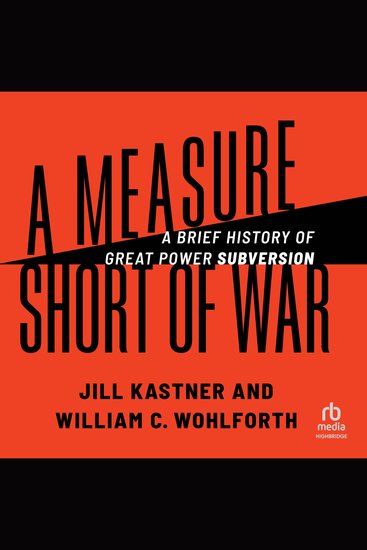
    A Measure Short of War - A Brief...

    William C. Wohlforth, Jill Kastner

    • 0
    • 0
    • 0
    In 2016, the United States was stunned by evidence of Russian meddling in the US presidential elections. But it shouldn't have been. Subversion—domestic interference to undermine or manipulate a rival—is as old as statecraft itself. The basic idea would have been familiar to Sun Tzu, Thucydides, Elizabeth I, or Bismarck. 


    It came as a surprise in 2016 because the sole superpower had fallen asleep at the wheel. But what's really new? Have we entered a new age of vulnerability? To answer these questions, and to protect ourselves against future subversion, we need a clear-eyed understanding of what it is and how it works. 


    In A Measure Short of War, Jill Kastner and William C. Wohlforth provide just that, taking the listener on a compelling ride through the history of subversion, exploring two thousand years of mischief and manipulation to illustrate subversion's allure, its operational possibilities, and the means for fighting back against it. With vivid examples from the ancient world, the great-power rivalries of the nineteenth century, epic Cold War struggles, and more, A Measure Short of War shows how prior technological revolutions opened up new avenues for subversion, and how some democracies have been fatally weakened by foreign subverters while others have artfully defended themselves—and their democratic principles.
    Ver livro
  • Democracy Unmoored - Populism and the Corruption of Popular Sovereignty - cover

    Democracy Unmoored - Populism...

    Samuel Issacharoff

    • 0
    • 0
    • 0
    The 2016 election of Donald Trump focused people's minds on populism, and most of the attention paid to the subject since has been on the threat it poses to wealthy democracies. In Democracy Unmoored, Samuel Issacharoff takes a far wider-angle view of the phenomenon, covering countries from across the globe: Brazil, Poland, Argentina, Turkey, India, Hungary, Venezuela, and more. Just as importantly, he focuses on populism's attack on the institutions of governance. Democracy requires two critical features: first, a commitment to repeat play such that political actors understand that what goes around comes around; and, second, institutional constraints so that the majority can prevail, albeit not by too much. Democracies must avoid the doomsday scenario in which the contending parties see the next election as the final choice between salvation and perdition. Issacharoff shows how populist governance undermines each of these two critical underpinnings of stable democracy, first by compressing the time horizon to the immediate, and second by eroding institutional constraints on strongman rule. At the same time, Issacharoff highlights the fact that ascendent populists were pushing in an open door as they found democracies in states of disrepair in the post-2008 world.
    Ver livro
  • Collected Works Of Marxism Anarchism Communism - The Communist Manifesto Reform or Revolution The Conquest of Bread Anarchism: What it Really Stands The State and Revolution Fascism: What It Is and How To Fight It - cover

    Collected Works Of Marxism...

    Karl Marx, Friedrich Engels,...

    • 0
    • 0
    • 0
    This book contains the fundamental works of Marxism, Anarchism and Bolshevism:
    The Communist Manifesto, originally the Manifesto of the Communist Party, by Karl Marx and Friedrich Engels;
    Reform or Revolution by Rosa Luxemburg;
    The Conquest of Bread by the Russian anarcho-communist Peter Kropotkin;
    Anarchism: What it Really Stands For by Emma Goldman;
    The State and Revolution by Vladimir Lenin;
    Fascism: What It Is and How To Fight It by Leon Trotsky.
     
    Translated by Mary Fox.
    Illustrated by Dmytro Rybalko.
    Ver livro
  • Democracy and Its Critics: Book Summary & Analysis - cover

    Democracy and Its Critics: Book...

    Briefly Summaries

    • 0
    • 0
    • 0
    This is a concise summary and analysis of Democracy and Its Critics, by Robert A. Dahl.
     
    It is not the original book and is not affiliated with or endorsed by Robert A. Dahl.
    Ideal those seeking a quick and insightful overview.
     
    This insightful book examines the strengths and challenges of democracy, offering a comprehensive analysis of democratic theory and practice. It explores the philosophical foundations of democracy, its historical development, and its practical implications in contemporary politics. The book critically evaluates competing views of democracy, addressing both its achievements and shortcomings, and provides a framework for understanding how democracy can be strengthened in the face of modern challenges such as inequality, populism, and globalization. A compelling read for anyone interested in political theory, governance, and the future of democratic institutions.
    Ver livro
  • The Communist Manifesto - cover

    The Communist Manifesto

    Karl Marx, Friedrich Engels

    • 0
    • 0
    • 0
    The Communist Manifesto, originally the Manifesto of the Communist Party (German: Manifest der Kommunistischen Partei), is an 1848 political document by German philosophers Karl Marx and Friedrich Engels. Commissioned by the Communist League and originally published in London just as the Revolutions of 1848 began to erupt, the Manifesto was later recognised as one of the world's most influential political documents. It presents an analytical approach to the class struggle (historical and then-present) and the conflicts of capitalism and the capitalist mode of production, rather than a prediction of communism's potential future forms.The Communist Manifesto summarises Marx and Engels' theories concerning the nature of society and politics, namely that in their own words "the history of all hitherto existing society is the history of class struggles". It also briefly features their ideas for how the capitalist society of the time would eventually be replaced by socialism. In the last paragraph of the Manifesto, the authors call for a "forcible overthrow of all existing social conditions", which served as a call for communist revolutions around the world. In 2013, The Communist Manifesto was registered to UNESCO's Memory of the World Programme along with Marx's Capital, Volume I.
    Ver livro
  • Logistics in Transition - Exploring Geopolitical Economic and Technological Trends - cover

    Logistics in Transition -...

    Carlo Secchi, Alessandro Gili

    • 0
    • 0
    • 0
    International cooperation is essential for fostering global connectivity and building resilient logistics systems. Geopolitical shifts and climate change present significant challenges that could disrupt the efficient operation of these systems. In the face of global instability, diversification and redundancy in transportation systems and modes are vital, with supply security forming the backbone of the global economy's smooth functioning.
    How can the resilience of value chains be bolstered amidst geopolitical pressures while navigating these dual transitions? How can logistics adapt to and capitalize on the new wave of potentially protectionist industrial policies? What strategies can be employed to mitigate risks, particularly for Europe, Italy, and the businesses involved?
    Ver livro