¡Acompáñanos a viajar por el mundo de los libros!
Añadir este libro a la estantería
Grey
Escribe un nuevo comentario Default profile 50px
Grey
Suscríbete para leer el libro completo o lee las primeras páginas gratis.
All characters reduced
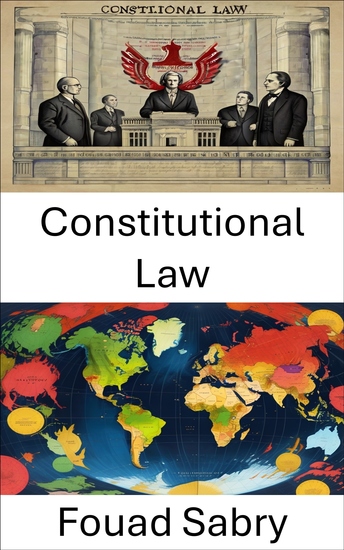
Constitutional Law - Foundations and Dynamics of Governance - cover

Constitutional Law - Foundations and Dynamics of Governance

Fouad Sabry

Editorial: One Billion Knowledgeable

  • 0
  • 0
  • 0

Sinopsis

Unlock the secrets of constitutional governance with "Constitutional Law," an essential addition to the "Political Science" series. This book is a comprehensive guide to understanding how constitutions shape and define modern states. Whether you’re a professional, student, or curious enthusiast, it offers valuable insights that go beyond mere academic knowledge, providing a practical framework for analyzing and interpreting constitutional frameworks around the world.
 
Chapters Summary:
 
1. Constitutional Law: Core principles shaping legal systems and governance within established legal parameters.
 
2. Constitution: Origins, significance in structuring political power, and safeguarding individual rights.
 
3. Separation of Powers: Preventing power concentration through checks and balances.
 
4. Constitutional Court: Role in upholding norms and resolving constitutional disputes.
 
5. Constitution of Lithuania: Insights into Lithuania’s constitutional framework.
 
6. Constitutionality: Ensuring laws align with fundamental legal norms.
 
7. Judicial Review in the United States: Ensuring laws conform to the Constitution.
 
8. Supreme Court: Pivotal decisions shaping constitutional interpretation.
 
9. Constitution of the United Kingdom: Unwritten elements defining legal and political landscape.
 
10. Separation of Powers in the United Kingdom: Balancing authority within the UK’s unique framework.
 
11. Law of Canada: Historical development and current practices.
 
12. Australian Legal System: Federal structure and interplay between state and federal laws.
 
13. Constitution of Singapore: Distinctive features influencing governance and legal practices.
 
14. Entick v Carrington: Landmark case on executive power and individual rights.
 
15. Australian Administrative Law: Governing public authorities' actions.
 
16. Law of California: Unique constitutional elements and state governance.
 
17. Law: Broad exploration of legal principles within constitutional frameworks.
 
18. Judicial Review: Role in maintaining constitutional integrity across jurisdictions.
 
19. Law of the United States: Intricate federal and state constitutional dimensions.
 
20. Royal Prerogative: Historical and contemporary significance.
 
21. Rule of Law in the United Kingdom: Foundational role in maintaining legal order and governance.
 
"Constitutional Law" provides a robust framework for understanding and engaging with the principles underpinning modern constitutional systems. Enhance your understanding and stay ahead in the field of political science with this indispensable resource.
Disponible desde: 08/08/2024.
Longitud de impresión: 354 páginas.
Otros libros que te pueden interesar

  • Free Exercise - Religion the First Amendment and the Making of America - cover

    Free Exercise - Religion the...

    Chris Beneke

    • 0
    • 0
    • 0
    CONGRESS SHALL MAKE NO LAW RESPECTING AN ESTABLISHMENT OF RELIGION, OR PROHIBITING THE FREE EXERCISE THEREOF. Those words, scratched on parchment in 1789, open the US Constitution's First Amendment. From them, countless interpretations have been drawn. As a consequence, an astonishing variety of activities in modern America—prayer after football games, Bible reading in classrooms, company healthcare policies, the baking of wedding cakes, and Ten Commandment displays around courthouses—have been alternately authorized, prohibited, or modified. 


    In this compelling historical account, Chris Beneke explains how the religion clauses came into existence and how they were woven into American culture. He brings prominent early national figures to life, including George Washington, James Madison, and Thomas Paine, while chronicling the First Amendment's relationship to defining social conditions like slavery, civility, family life, and the free market. 


    Going beyond traditional church-state scholarship, Beneke also demonstrates how white women, African Americans, Roman Catholics, Jews, and nonbelievers widened religious liberty's application and illuminated its boundaries. In doing so he makes a groundbreaking contribution to both constitutional history and the history of American pluralism.
    Ver libro
  • Democracy Unmoored - Populism and the Corruption of Popular Sovereignty - cover

    Democracy Unmoored - Populism...

    Samuel Issacharoff

    • 0
    • 0
    • 0
    The 2016 election of Donald Trump focused people's minds on populism, and most of the attention paid to the subject since has been on the threat it poses to wealthy democracies. In Democracy Unmoored, Samuel Issacharoff takes a far wider-angle view of the phenomenon, covering countries from across the globe: Brazil, Poland, Argentina, Turkey, India, Hungary, Venezuela, and more. Just as importantly, he focuses on populism's attack on the institutions of governance. Democracy requires two critical features: first, a commitment to repeat play such that political actors understand that what goes around comes around; and, second, institutional constraints so that the majority can prevail, albeit not by too much. Democracies must avoid the doomsday scenario in which the contending parties see the next election as the final choice between salvation and perdition. Issacharoff shows how populist governance undermines each of these two critical underpinnings of stable democracy, first by compressing the time horizon to the immediate, and second by eroding institutional constraints on strongman rule. At the same time, Issacharoff highlights the fact that ascendent populists were pushing in an open door as they found democracies in states of disrepair in the post-2008 world.
    Ver libro
  • Soviet Union Spy Operations - Learn About the Soviet Union's Most Notorious Spy Organization and Its Lasting Impact on World History (2022 Guide for Beginners) - cover

    Soviet Union Spy Operations -...

    Roger Holt

    • 0
    • 0
    • 0
    The KGB is one of the most well-known abbreviations of the twentieth century, and it has come to represent the shadowy and often violent activities of the Soviet Union's secret police and internal security agencies. 
      
     Indeed, it has frequently been used to refer to the Soviet state security agencies throughout its history, from the formation of the Cheka (Extraordinary Commission) in 1917 to the official demise of the KGB in 1992. The KGB has long been viewed as the West's biggest bogeyman during the second half of the twentieth century, whether it's associated with the excesses of the Russian Civil War, Stalin's purges, or even Vladimir Putin. 
      
    The KGB: The History and Legacy of the Soviet Union's Notorious Spy Agency delve into the history of one of history's most notorious agencies. You will learn about the KGB like never before, thanks to images depicting important people, places, and events. 
      
    ...And Much More! 
      
    What are you waiting for? 
      
    Don't let that chance pass you by... 
      
    Get Your Copy Today by Clicking the "BUY NOW" Button! 
     
    Ver libro
  • Sunbelt Capitalism and the Making of the Carceral State - cover

    Sunbelt Capitalism and the...

    Kirstine Taylor

    • 0
    • 0
    • 0
    The story of how the American South became the most incarcerated region in the world’s most incarcerated nation.
     
    Sunbelt Capitalism and the Making of the Carceral State examines the evolution of southern criminal punishment from Jim Crow to the dawn of mass incarceration, charting this definitive era of carceral transformation and expansion in the southern United States. The demise of the county chain gang, the professionalization of police, and the construction of large-scale prisons were among the sweeping changes that forever altered the southern landscape and bolstered the region’s capacity to punish. What prompted this southern revolution in criminal punishment?
     
    Kirstine Taylor argues that the crisis in the cotton fields and the arrival of Sunbelt capitalism in the south’s rising metropolises prompted lawmakers to build expansive, modern criminal punishment systems in response to Brown v. Board of Education and the Black freedom movements of the 1960s and ‘70s. Taking us inside industry-hunting expeditions, school desegregation battles, the sit-in movement, prisoners’ labor unions, and policy commissions, Taylor tells the story of how a modernizing south became the most incarcerated region in the globe’s most incarcerated nation.
    Ver libro
  • Constitution of Liberty The: Book Summary & Analysis - cover

    Constitution of Liberty The:...

    Briefly Summaries

    • 0
    • 0
    • 0
    This is a concise summary and analysis of The Constitution of Liberty, by Friedrich A. Hayek.
    It is not the original book and is not affiliated with or endorsed by Friedrich A. Hayek.
    Ideal those seeking a quick and insightful overview.
     
    The Constitution of Liberty is a timeless exploration of the principles of freedom, justice, and the rule of law in modern societies. This influential work provides a compelling argument for the preservation of individual liberty as the foundation of prosperity and social order. The book examines the relationship between government and the individual, emphasizing the importance of limited government and spontaneous order in fostering innovation and progress. Thought-provoking and meticulously reasoned, this work challenges readers to reflect on the philosophical and practical underpinnings of a free society.
    Ver libro
  • Political Uncertainty - A Comparative Exploration - cover

    Political Uncertainty - A...

    Gergana Dimova

    • 0
    • 0
    • 0
    Overall, this book furnishes important insights into uncertainty in political life and how the discipline of political science is coming to terms with it.
    Ver libro