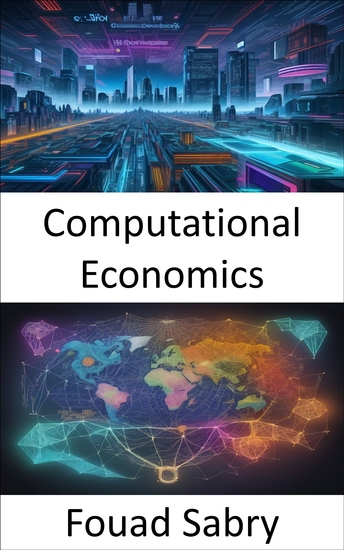
Computational Economics - Unlocking Economic Insights a Computational Approach
Fouad Sabry
Editora: One Billion Knowledgeable
Sinopse
What is Computational Economics

Computer science, economics, and management science are all branches of study that are included in the field of computational economics, which is an interdisciplinary research field. This topic includes the modeling of economic processes through the use of computer methods. There are some of these fields that are not found anywhere else, while others have established themselves as areas of economics by enabling robust data analytics and solutions to problems that would be difficult to investigate without the use of computers and the numerical methods that are connected with them.

How you will benefit

(I) Insights, and validations about the following topics:

Chapter 1: Computational economics

Chapter 2: Econometrics

Chapter 3: Experimental economics

Chapter 4: Representative agent

Chapter 5: Macroeconomic model

Chapter 6: Formal epistemology

Chapter 7: Evolutionary economics

Chapter 8: Economics education

Chapter 9: Agent-based computational economics

Chapter 10: Dynamic stochastic general equilibrium

Chapter 11: Microfoundations

Chapter 12: Adaptive Modeler

Chapter 13: Mathematical economics

Chapter 14: Methodology of econometrics

Chapter 15: ACEGES

Chapter 16: Anil K. Bera

Chapter 17: Heterogeneity in economics

Chapter 18: Criticisms of econometrics

Chapter 19: Causal inference

Chapter 20: Michael Keane (economist)

Chapter 21: John Rust

(II) Answering the public top questions about computational economics.

(III) Real world examples for the usage of computational economics in many fields.

(IV) Rich glossary featuring over 1200 terms to unlock a comprehensive understanding of computational economics. (eBook only).

Who will benefit

Professionals, undergraduate and graduate students, enthusiasts, hobbyists, and those who want to go beyond basic knowledge or information for any kind of computational economics.
Disponível desde: 23/12/2023.
Comprimento de impressão: 552 páginas.