Join us on a literary world trip!
Add this book to bookshelf
Grey
Write a new comment Default profile 50px
Grey
Subscribe to read the full book or read the first pages for free!
All characters reduced
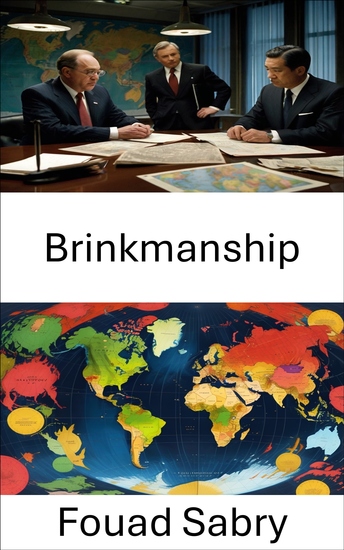
Brinkmanship - Mastering the Art of High-Stakes Negotiation and Strategy - cover

Brinkmanship - Mastering the Art of High-Stakes Negotiation and Strategy

Fouad Sabry

Publisher: One Billion Knowledgeable

  • 0
  • 0
  • 0

Summary

Are you interested in the high-stakes realm of international diplomacy? Brinkmanship is your essential guide to understanding the art of pushing confrontations to the brink of disaster to achieve political goals. This book offers an in-depth exploration of brinkmanship, detailing its historical significance, theoretical foundations, and the complex risks and rewards of this daring strategy.
 
1: Brinkmanship: Explore the core principles of brinkmanship, including its definition and strategic intent.
 
2: Cuban Missile Crisis: Analyze a pivotal moment in history where brinkmanship highlighted extreme risks and potential rewards.
 
3: Partial Nuclear Test Ban Treaty: Investigate the treaty's negotiations and implications, showcasing brinkmanship’s influence on arms control.
 
4: Mutual Assured Destruction: Delve into the concept of MAD and its role in shaping international relations through brinkmanship.
 
5: Nuclear Blackmail: Examine nuclear blackmail as a strategic tool used to leverage political advantages.
 
6: Nuclear Arms Race: Trace the nuclear arms race's development and its impact on global politics fueled by brinkmanship.
 
7: Cold War (1953–1962): Explore key events and policies demonstrating brinkmanship during this critical historical period.
 
8: First Taiwan Strait Crisis: Review this crisis to understand how brinkmanship plays a role in regional conflicts.
 
9: Massive Retaliation: Learn about the doctrine of Massive Retaliation and its implications for brinkmanship strategy.
 
10: Llewellyn Thompson: Highlight Thompson’s contributions to brinkmanship and his role in strategic development.
 
11: World War III: Explore hypothetical scenarios regarding the potential for World War III and brinkmanship's role.
 
12: New Look (Policy): Understand Eisenhower's New Look policy and its approach to brinkmanship.
 
13: Vienna Summit: Examine the Vienna Summit’s influence on Cold War diplomacy and brinkmanship.
 
14: Strategic Nuclear Weapon: Discover the significance of strategic nuclear weapons within the context of brinkmanship.
 
15: Presidency of John F. Kennedy: Analyze Kennedy’s approach to brinkmanship and its impact on foreign policy.
 
16: Berlin Crisis of 1961: Review how brinkmanship was pivotal in the Berlin Crisis during the Cold War.
 
17: Outline of the Cold War: Gain an overview of the Cold War, focusing on how brinkmanship shaped its course.
 
18: Foreign Policy of the John F. Kennedy Administration: Examine Kennedy’s foreign policy strategies and their connection to brinkmanship.
 
19: Foreign Policy of the Dwight D. Eisenhower Administration: Explore Eisenhower’s approach and its employment of brinkmanship.
 
20: Berlin Crisis of 1958–1959: Analyze the implications of the 1958–1959 Berlin Crisis for brinkmanship.
 
21: List of Twilight Struggle References: Access a curated list of references related to Twilight Struggle for additional context.
Available since: 10/08/2024.
Print length: 459 pages.

Other books that might interest you

  • The Rape of the Mind - The Psychology of Thought Control Menticide and Brainwashing - cover

    The Rape of the Mind - The...

    Joost Meerloo

    • 0
    • 0
    • 0
    SINCE 1933, when a completely drugged and trial-conditioned human wreck confessed to having started the Reichstag fire in Berlin, Dr. Joost A. M. Meerloo has studied the methods by which systematic mental pressure brings people to abject submission, and by which totalitarians imprint their subjective "truth" on their victims' minds. The first two and one-half years of WWII, Dr. Meerloo spent under the pressure of Nazi-occupied Holland, witnessing at first-hand the Nazi methods of mental torture on more than one occasion...Then, after personal experiences with enforced interrogation, he escaped from a Nazi prison and certain death to England, where he was able, as Chief of the Psychological Department of the Netherlands Forces, to observe and study coercive methods officially....After the war, he came to the United States...As more and more cases of thought control, brainwashing, and mental coercion were disclosed - Cardinal Mindszenty, Colonel Schwable, Robert Vogeler, and others - his interest grew. It was Dr. Meerloo who coined the word menticide, the killing of the spirit, for this peculiar crime...It is Dr. Meerloo's position that through pressure on the weak points in men's makeup, totalitarian methods can turn anyone into a "traitor." And in The Rape of the Mind he goes far beyond the direct military implications of mental torture to describing how our own culture unobtrusively shows symptoms of pressurizing people's minds. He presents a systematic analysis of the methods of brainwashing and mental torture and coercion, and shows how totalitarian strategy, with its use of mass psychology, leads to systematized "rape of the mind."He describes the new age of cold war with its mental terror, verbocracy, and semantic fog, the use of fear as a tool of mass submission and the problem of treason and loyalty, so loaded with dangerous confusion. The Rape of the Mind is written for the interested layman, not only for experts and scientists.
    Show book
  • My Blue Book of Grammar for Class 7 - cover

    My Blue Book of Grammar for Class 7

    Meigha Rawat

    • 0
    • 0
    • 0
    A Grammar Series That Uses the Functional Approach 
    
    KEY FEATURES 
    - Functional approach to grammar teaching, using exemplars to illustrate the usage before defining the structure and rules 
    - Vocabulary taught through language-in-use to build the learners’ vocabulary through use rather than memorisation of rules 
    - Contemporary topics to inculcate 21-century skills amongst learners 
    - Use of literature to help learners understand how grammar is used in text 
    - A comprehension section comprising texts from different genres so that learners may relate grammar to different types of works produced in English 
    - Phonics in Grades 1 and 2 to teach the very basis of language 
    - Uniquely stylised illustrations 
    - Activities such as puzzles, crosswords, word grids and games to aid the facilitator in using the concept of ‘flipped classroom’ 
    - Periodic tests to help the learners self-assess the acquisition of concepts 
    - Digital component to cater to a technology-driven classroom 
    
    DESCRIPTION: 
    My Blue Book of Grammar is a course that has been conceptualized and designed keeping in mind the increasingly dynamic role of the English language in today’s world. Especially in our country, where English serves as the lingua franca, a grammar course has to offer not only an exposition of the pedagogy but also the exhibition of the utility of that pedagogy. The aim of a grammar series should be to encourage the development of competency amongst learners, even though their proficiency levels may vary. While the level of exposure to English of all learners may be different, a grammar series should aid in the development of a certain level of confidence amongst the learners, with the end result being that they are able to converse without hesitation in English. 
    
    WHAT WILL YOU LEARN 
    - Understand grammar concepts 
    - Learn how to use different vocabulary concepts taught through language-in-use 
    - Learn 21-century skills 
    - Develop deeper understanding of and appreciation for literature 
    - Have clearer pronunciation through a better understanding of phonics 
    
    WHO THIS BOOK IS FOR: 
    School students of Grades 7 
    
    TABLE OF CONTENTS 
    GRAMMAR 
    1. Compound–Complex Sentences 
    2. Ellipsis 
    3. Compound Subject 
    4. Reported Speech 
    5. Compound Predicate 
    6. Coordinating Adjectives 
    7. Sentences, Fragments and Run-ons 
    8. Comparative and Superlative Adverbs 
    9. Pronoun–Antecedent Agreement 
    10. Active and Passive Voice 
    11. Commas: With Introductory Phrases; When Addressing a Person; 
    in Dates; and in Addresses 
    12. Comma Splices 
    13. Singular and Plural Possessive Nouns 
    14. Linking Verbs 
    15. Transitive and Intransitive Verbs – Revision 
    Test Paper 1 
    VOCABULARY 
    16. Difference Between Who and Whom 
    17. Formal and Informal Language 
    18. Compound Subject with I and Me 
    19. Can and Could 
    20. Redundancy 
    21. Prefixes: inter–, trans–, super– 
    22. Suffixes: –ent, –ant, –ous 
    23. Latin and Greek Roots 
    24. Good vs Well 
    25. Using Clues from the Context to Find the Meaning of the Word 
    26. How versus What in Exclamations 
    27. Positive and Negative Connotations 
    28. Suggestions and Requests 
    Test Paper 2 
    WRITING 
    29. Writing a Notice 
    30. Narrative Poem 
    31. Dialogue Writing 
    32. Writing a Summary 
    33. Survey Findings 
    Test Paper 3 
    COMPREHENSION 
    34. I Have a Dream 
    35. Ain’t I a Woman? 
    36. We Are the World 
    37. Thang-Ta: The Martial Art Dance of Manipur 
    Orange Global Olympiad – English Sample Paper
    Show book
  • Contested Boundaries - A New Pacific Northwest History - cover

    Contested Boundaries - A New...

    David J. Jepsen, David J. Norberg

    • 0
    • 0
    • 0
    Contested Boundaries: A New Pacific Northwest History is an engaging, contemporary look at the themes, events, and people that have shaped the history of the Pacific Northwest over the last two centuries. 


    ● An engaging look at the themes, events, and people that shaped the Pacific Northwest—Washington, Oregon, and Idaho—from when only Native Peoples inhabited the land through the twentieth century. 


    ● Twelve theme-driven essays covering the human and environmental impact of exploration, trade, settlement, and industrialization in the nineteenth century, followed by economic calamity, world war, and globalization in the twentieth. 


    ● Written by two professors with over twenty years of teaching experience, this work introduces the history of the Pacific Northwest in a style that is accessible, relevant, and meaningful for anyone wishing to learn more about the region's recent history.
    Show book
  • Tender is the Night by F Scott Fitzgerald (Book Analysis) - Detailed Summary Analysis and Reading Guide - cover

    Tender is the Night by F Scott...

    Bright Summaries

    • 0
    • 0
    • 0
    Unlock the more straightforward side of Tender is the Night with this concise and insightful summary and analysis!This engaging summary presents an analysis of Tender is the Night by F. Scott Fitzgerald, which tells the story of a charming young American couple, Dick and Nicole Diver, and the teenaged film star Rosemary Holt, who becomes close to the couple and eventually embarks on an affair with Dick. Behind the glamourous façade of their existence in Europe, the couple are beset by a host of problems, including intractable mental illness, alcoholism and a growing sense of disillusionment. Fitzgerald is best known for his 1925 novel The Great Gatsby, and is widely regarded as one of the foremost chroniclers of the Jazz Age in the USA.Find out everything you need to know about Tender is the Night in a fraction of the time!This in-depth and informative reading guide brings you:• A complete plot summary• Character studies• Key themes and symbols• Questions for further reflectionWhy choose BrightSummaries.com?Available in print and digital format, our publications are designed to accompany you on your reading journey. The clear and concise style makes for easy understanding, providing the perfect opportunity to improve your literary knowledge in no time.See the very best of literature in a whole new light with BrightSummaries.com!
    Show book
  • Circumcision - How an Ancient Ritual Became a Questionable Surgery—A Complete Analysis - cover

    Circumcision - How an Ancient...

    Kenneth S. Lipman

    • 0
    • 0
    • 0
    Winner of the Independent Publisher (IPPY) Book Award Gold Medal for health and medicine 
    Winner of the Firebird Book Award for medical nonfiction 
    Nominated for the prestigious Montaigne Medal science award 
    Finalist for the Eric Hoffer Book Award Grand Prize 
    Finalist for the First Horizon Award 
    Every year, millions of baby boys are circumcised, either for purported health benefits, or for religious reasons. This book provides a comprehensive and clear explanation of the risks and rewards of that practice, which has significant effects on sexuality, psychology, and overall health. 
    Drawing on 869 research references and firsthand accounts, Dr. Lipman sheds light on the disparity between traditional views and contemporary medical perspectives. 
    Whether you're a parent contemplating the procedure for your child or an academic in search of an in-depth analysis, Circumcision provides a balanced and factual perspective on this widely performed yet increasingly debated surgery. 
    In this groundbreaking, meticulously rendered book, you will learn: 
    • Why circumcision does not improve a baby's health 
    • Why circumcision does not reduce the incidence of AIDS or urinary tract infections, as is often claimed 
    • The deep financial incentives behind the six billion-dollar circumcision industry 
    • That the pain of circumcision is equivalent to torture, and why anesthesia is rarely used 
    • Circumcision's significant physical and mental health risks, including death 
    • Why both men and women enjoy sex more if the man is uncircumcised 
    • That adherents to Judaism or Islam may not be required to ritually circumcise their child, as is often thought 
    • The history of circumcision 
    • The ethics and legality of circumcision 
    • Why America is the only country in the world with a high rate of medical circumcision
    Show book
  • Justice for Marcus Garvey - Look for Me in the Whirlwind - cover

    Justice for Marcus Garvey - Look...

    Ta-Nehisi COATES

    • 0
    • 0
    • 0
    Marcus Garvey (1887-1940) was a Black political activist, journalist, entrepreneur, and orator who founded the Universal Negro Improvement Association and African Communities League, which had a following of more than six million African descended people worldwide. Despite his massive popularity, this Jamaican born international leader was wrongfully sentenced to prison by the U.S. government on trumped-up mail-fraud charges. 


    While exoneration efforts began immediately and have continued since his sentencing, a new groundswell movement for Garvey's posthumous pardon is underway—led by his nonagenarian, still-spirited son, Julius Garvey. 


    Edited by Julius Garvey, Justice for Marcus Garvey is a collection of informative essays and personal narratives about the senior Garvey's life and work, demonstrating his essential influence on current social justice movements. The book features contributions from thought leaders and activists, including a foreword by bestselling author Ta-Nehisi Coates. Contributors include Paul Coates, founder/director of Black Classic Press; Goulda Downer, president of the Caribbean-American Political Action Committee; Justin Hansford, professor at Howard University School of Law; and Maulana Karenga, widely known as the creator of the holiday Kwanzaa.
    Show book